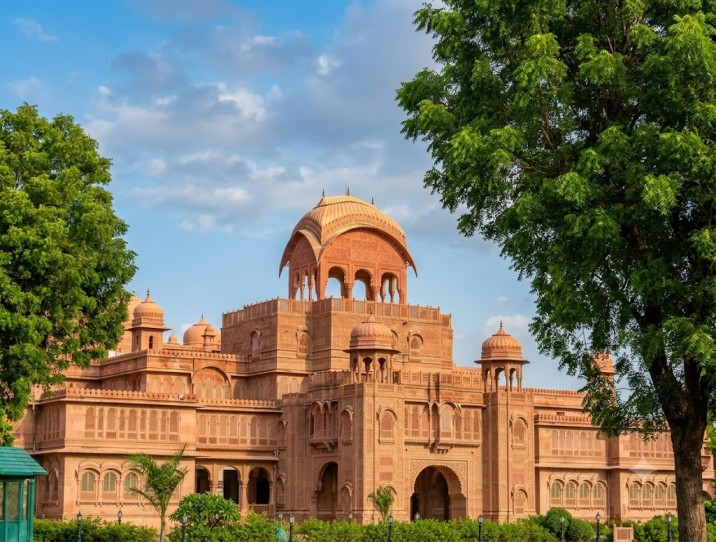
Lalgarh-Palace : The Grand Red Sandstone Jewel Of Bikaner
Lalgarh Palace stands as one of the most architecturally splendid and historically evocative destinations in Rajasthan, representing a magnificent royal residence of the Bikaner royal family whose ornate red sandstone facades, intricately carved latticework screens, and graceful Indo-Saracenic architectural character combine to create a building of exceptional beauty and historical significance set within the desert city of Bikaner. Situated in the heart of Bikaner in the Bikaner district of Rajasthan, Lalgarh Palace was commissioned by Maharaja Ganga Singh of Bikaner at the turn of the twentieth century and designed by the British architect Sir Samuel Swinton Jacob, whose mastery of the Indo-Saracenic style produced a structure that synthesizes European spatial planning with the decorative vocabulary of Rajput and Mughal architectural traditions in a manner of exceptional elegance and refinement. The destination draws history enthusiasts, architecture lovers, heritage hotel guests, and culturally curious travelers from across the country and the world, offering an encounter with a royal residence whose carved stone galleries, museum collections of remarkable richness, and the continuing presence of the Bikaner royal family within a portion of the palace create a heritage experience of unusual intimacy and living historical character.
🏰 Lalgarh Palace (Rajasthan)
Overview
Lalgarh Palace stands as one of the most architecturally splendid and historically evocative destinations in Rajasthan, representing a magnificent royal residence of the Bikaner royal family whose ornate red sandstone facades, intricately carved latticework screens, and graceful Indo-Saracenic architectural character combine to create a building of exceptional beauty and historical significance set within the desert city of Bikaner. Situated in the heart of Bikaner in the Bikaner district of Rajasthan, Lalgarh Palace was commissioned by Maharaja Ganga Singh of Bikaner at the turn of the twentieth century and designed by the British architect Sir Samuel Swinton Jacob, whose mastery of the Indo-Saracenic style produced a structure that synthesizes European spatial planning with the decorative vocabulary of Rajput and Mughal architectural traditions in a manner of exceptional elegance and refinement. The destination draws history enthusiasts, architecture lovers, heritage hotel guests, and culturally curious travelers from across the country and the world, offering an encounter with a royal residence whose carved stone galleries, museum collections of remarkable richness, and the continuing presence of the Bikaner royal family within a portion of the palace create a heritage experience of unusual intimacy and living historical character.
Why Visit Lalgarh Palace
The recognition of Lalgarh Palace as one of the finest examples of Indo-Saracenic royal architecture in Rajasthan reflects its unparalleled importance within the princely heritage landscape of the state, standing as a monument to the architectural ambition and cultural sophistication of one of the most progressive and internationally connected rulers of the princely era in Indian history. One of the most compelling reasons to visit is the architectural quality of the palace itself, whose three-storeyed red sandstone facade of considerable horizontal grandeur is decorated with carved stone screens of exceptional intricacy, projecting balconies of graceful proportion, and ornamental details that draw equally from Rajput, Mughal, and European decorative traditions to create a visual experience of architectural richness and historical depth that rewards extended and unhurried observation. The palace complex also houses the Shri Sadul Museum, dedicated to the life and legacy of Maharaja Sadul Singh, whose collection of royal portraits, hunting photographs, personal artifacts, and ceremonial objects of the Bikaner royal family offers a deeply intimate and historically revealing window into the life of a princely court at the height of its power and cultural confidence.
Key Highlights Within the Area
The carved red sandstone facade of Lalgarh Palace stands out as the most iconic and visually distinctive feature of the complex, its three storeys of ornate latticework screens, carved brackets, and projecting jharokha balconies creating a surface of extraordinary decorative richness that catches the desert light at every hour of the day in shifting patterns of shadow and illumination of considerable natural beauty. The Shri Sadul Museum within the palace is a highlight of exceptional historical and cultural significance, its galleries presenting royal portraits of considerable artistic quality, hunting trophies from expeditions conducted by the Bikaner rulers across the subcontinent and beyond, personal photographs, ceremonial regalia, and the rich material culture of a princely court that maintained connections with the British imperial establishment and the broader international world of the early twentieth century with unusual sophistication and engagement. The palace gardens and the broader complex of heritage buildings surrounding the principal structure add a dimension of landscape and architectural variety to the visit that rewards exploration beyond the principal facade and museum galleries.
Activities
Exploring the Shri Sadul Museum and the accessible portions of the palace complex is the primary and most rewarding activity, with the museum collection offering an intimate and historically detailed encounter with the Bikaner royal family across the pivotal decades of the late nineteenth and early twentieth centuries. Staying in the heritage hotel section of the palace, now operated as a luxury heritage property, offers the most immersive engagement with the architectural character of the building, allowing guests to experience the carved stone galleries and the royal atmosphere of the palace as a lived environment rather than a visited monument.
📅 Best Time to Visit
The most favorable period to visit Lalgarh Palace is from October to March, when the pleasant desert winter temperatures make extended exploration of the palace grounds and museum comfortable and the clear winter light falls most beautifully across the carved red sandstone facade.
🚗 Connectivity
Lalgarh Palace is accessible from Bikaner city center, situated within easy reach by local transport. Bikaner Junction offers regular rail services from Delhi, Jaipur, and Jodhpur, making the palace a practical inclusion in Rajasthan heritage itineraries for travelers combining the destination with visits to the Junagarh Fort and the broader cultural landscape of the Marwar region.