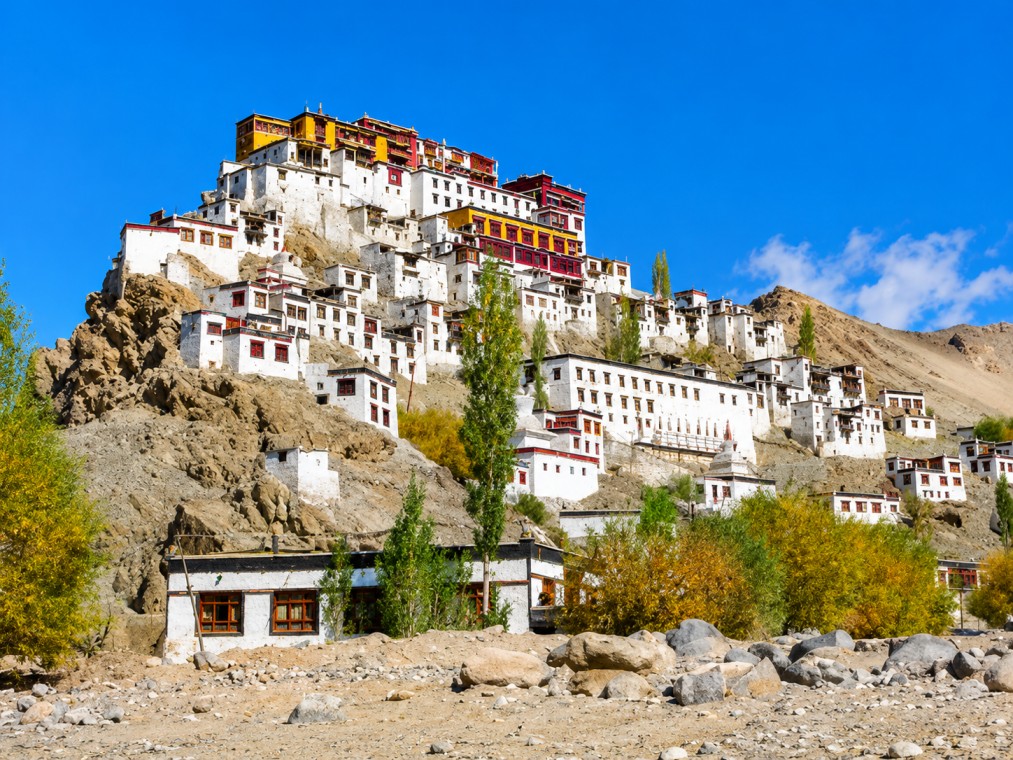
Leh Palace : The Royal Jewel Of Ladakh
High above the ancient town of Leh, rising from the rocky spine of Tsemo Hill at an altitude of roughly 3,500 metres, Leh Palace surveys the world like a king who has seen everything and forgotten nothing. Known in Ladakhi as Lhachen Palkhar — meaning "the great king palace" — this nine-storey monument is one of the most remarkable structures in the entire Himalayan region. Part fortress, part royal residence, part cultural archive, it stands as the most visible symbol of Ladakh's proud and layered history. For travellers who make the journey to this remote corner of India, Leh Palace is not merely a stop on an itinerary — it is an encounter with a civilisation that flourished in some of the harshest terrain on earth.
🏔️ Leh Palace: The Himalayan Crown of Ladakh's Royal Legacy
High above the ancient town of Leh, rising from the rocky spine of Tsemo Hill at an altitude of roughly 3,500 metres, Leh Palace surveys the world like a king who has seen everything and forgotten nothing. Known in Ladakhi as Lhachen Palkhar — meaning "the great king's palace" — this nine-storey monument is one of the most remarkable structures in the entire Himalayan region. Part fortress, part royal residence, part cultural archive, it stands as the most visible symbol of Ladakh's proud and layered history. For travellers who make the journey to this remote corner of India, Leh Palace is not merely a stop on an itinerary — it is an encounter with a civilisation that flourished in some of the harshest terrain on earth.
📍 A Palace in the Clouds: Location and Setting
Leh Palace occupies a commanding position on the hillside above old Leh town, with the barren Ladakh ranges stretching behind it and the silver thread of the Indus River visible in the distance. The palace's silhouette — a tiered, tapering stack of ochre-coloured walls, wooden balconies, and blind windows — is visible from almost anywhere in Leh, making it an ever-present landmark in the lives of locals and a magnetic first sight for visitors.
To reach it, you walk through the narrow lanes of the old city, past whitewashed homes, fluttering prayer flags, and the occasional chorten (Buddhist stupa). The climb itself is part of the experience — each step upward shifts the view, until the valley below opens into a full panorama that seems almost too vast to be real.
👑 Origins and the Namgyal Dynasty
The story of Leh Palace begins with the Namgyal dynasty, the royal house that unified and ruled Ladakh for several centuries. Construction of the palace was initiated around 1553 by Tsewang Namgyal, the founder of the dynasty, who chose the Tsemo Hill as the site for his grand new capital. The project was completed in the early 17th century by his successor, Sengge Namgyal — known as the Lion King — who expanded and refined the structure into the formidable palace that stands today.
Sengge Namgyal was one of Ladakh's most celebrated rulers: a military commander, a patron of Buddhist culture, and a builder of lasting monuments. Under his reign, Ladakh reached the height of its territorial extent and cultural vitality. The Leh Palace was the physical expression of that power — the tallest and most impressive building in the region, built to awe visitors, intimidate rivals, and house an entire royal court.
An oral tradition adds a charming layer to the palace's origin story: the celebrated Tibetan saint Stagsang Raspa is said to have designed the palace in the shape of a Tibetan monk's robes — wide and thick at the base, tapering upward. It is further said that at the completion of each floor, he blessed the ground with his footprint and offered prayers for the structure's longevity. Whether legend or fact, these stories speak to the deep connection between the palace's architecture and the Buddhist spiritual world that shaped Ladakhi life.
🏛️ Architecture: A Himalayan Mirror of the Potala Palace
Leh Palace is widely compared to the Potala Palace in Lhasa, Tibet — and the resemblance is unmistakable. Both share the same broad-based, tapering form; both rise in tiers from a natural rock foundation; both served as royal residences inseparable from Buddhist religious practice. Leh Palace is smaller in scale, but in its mountain setting it carries no less visual authority.
The palace is built entirely from local materials — stone, mud, wood, and sand — chosen both for availability and for their remarkable insulating properties. The thick mud walls keep the interior cool during Ladakh's brief, intense summers and trap warmth during the brutal winters. It is a building designed for survival, not just ceremony.
🏔️ Nine Storeys, Nine Purposes
Each of the palace's nine floors served a distinct function. The uppermost floors were the private quarters of the royal family — airy, light-catching spaces with views across the valley. The middle floors housed the Durbar Hall, prayer rooms, and spaces for courtly functions. The lower levels, closer to the rock foundation, were devoted to stables, storage, and practical domestic use. This vertical hierarchy — sacred and royal at the top, functional at the base — reflects a worldview in which elevation was equated with spiritual rank.
🪵 Wooden Balconies and the Zara
Among the most distinctive features of Leh Palace are its projecting wooden balconies, which jut out from the upper floors and catch the thin Himalayan sunlight. These balconies, elaborately carved and now worn by centuries of weather, were once the vantage points from which the royal family observed ceremonies, processions, and the life of the city below.
Inside, a particularly ingenious feature called the zara — or sky well — was built into the structure to channel natural light and fresh air deep into the palace's interior. In a building of nine storeys with thick mud walls, this was a sophisticated engineering solution, ensuring that even the inner rooms were not perpetually dark and airless.
🔐 The Hidden Passage
Perhaps the most intriguing architectural secret of Leh Palace is a hidden passage that connects it directly to the Namgyal Tsemo Gompa, the monastery perched above the palace on the hilltop. This concealed route was designed as an escape path for the royal family during times of attack, allowing them to reach the monastery's sanctuary without exposure. It is a reminder that even the most powerful dynasties lived with the constant awareness of danger.
🎨 Inside the Palace: Art, Artefacts, and Sacred Spaces
Leh Palace today functions as an archaeological museum managed by the Archaeological Survey of India (ASI), and its exhibition halls hold a collection that rewards careful attention.
The jewel of the collection is the palace's treasury of Tibetan thangka paintings, some over 450 years old. These devotional scroll paintings — depicting Buddhist deities, cosmic mandalas, and scenes from Ladakhi royal history — were created using pigments derived from crushed and powdered gems and precious stones. Astonishingly, their colours remain vivid, defying the centuries with a brightness that feels almost supernatural.
The museum also displays an extraordinary array of royal regalia: ceremonial crowns, ornamental jewellery, richly embroidered robes, and the everyday utensils of a royal household. Together, they offer an unusually intimate portrait of life at the Namgyal court.
Within the palace complex, a monastery contains a statue of Lord Buddha, reminding visitors that spiritual and temporal authority were never separate in Ladakhi royal tradition. Ancient murals line the walls of the prayer rooms, their colours faded but their devotional power still palpable.
⚔️ Decline, Abandonment, and the Dogra Conquest
Leh Palace's golden era came to an abrupt end in the mid-19th century, when Dogra forces under General Zorawar Singh swept through Ladakh as part of the expanding Sikh Empire's campaigns in the region. The Namgyal royal family, unable to defend the palace against the military assault, was forced to abandon it and relocate to the more modest Stok Palace, about 15 kilometres south of Leh — where descendants of the dynasty still reside today.
The palace bore the physical marks of these wars: cannonball damage scarred its walls, and without royal occupation to fund its maintenance, the structure began its long decline. By the time the British officer Alexander Cunningham visited and documented the palace in 1854, he found a building already emptied of its former life, though still standing in impressive dimensions.
What the Dogra conquest began, time continued. Yet the palace's essential structure survived — battered, weathered, and stripped of most of its interior furnishings, but structurally intact enough to become the heritage site it is today.
✨ The Palace in Festive Light
One of the most magical experiences Leh has to offer occurs during the Galdan Namchot festival — the Ladakhi new year celebration — when Leh Palace is dramatically illuminated against the night sky. The warm light playing across its ancient walls, with the stars of Ladakh's high-altitude sky blazing above, creates a scene of rare beauty. Locals gather in the lanes of the old town, music and butter lamps fill the air, and the palace seems momentarily returned to the living centre of Ladakhi life that it once was.
🧭 Visiting Leh Palace: What to Know
⏰ Timings
7:00 AM to 4:00 PM, open all days of the week.
🎟️ Entry Fee
₹15 for Indian nationals; ₹100 for foreign visitors.
✈️ Access
The palace is located in old Leh town, about 5 km from the Leh Airport.
🌤️ Best Time
May to September.
Getting there: The palace is located in old Leh town, about 5 km from the Leh Airport. It is accessible on foot through the lanes of the old city — a walk that is itself a rewarding exploration of traditional Ladakhi urban life.
The best time to visit is from May to September, when Leh's roads are open and the weather is mild enough to make the uphill climb comfortable. October offers stunning post-monsoon clarity, with the Zanskar and Stok Kangri ranges sharp against deep blue skies. Winter (November to March) closes most access roads, though Leh itself can be reached by air year-round.
A few practical notes: the climb to the palace involves steep, uneven stone paths, making sturdy footwear essential. The altitude — over 3,500 metres — means visitors should allow a day or two of acclimatisation before attempting the walk. Photography inside the museum is restricted, but the views from the rooftop and the approach path offer unlimited photographic possibilities.
🌏 Why Leh Palace Matters for Heritage Tourism
In an era when Ladakh draws thousands of visitors for its landscapes, passes, and monasteries, Leh Palace offers something more specific and more rare: a direct encounter with the political and cultural history of a civilisation that developed entirely on its own terms, shaped by altitude, Buddhism, trade routes, and centuries of sovereign rule.
For international travellers, the palace's kinship with the Potala Palace in Lhasa provides a fascinating architectural thread connecting the Himalayan Buddhist world across political boundaries. For domestic tourists, it represents a chapter of Indian history that rarely makes it into mainstream historical narratives — the story of Ladakh as a kingdom, not merely a landscape.
As Ladakh's profile as a travel destination continues to grow — especially since it became a Union Territory in 2019 — Leh Palace stands as the anchor of the region's heritage tourism ecosystem. It gives the visitor something to carry home beyond photographs: an understanding of this high-altitude kingdom that endured for centuries before the modern world finally arrived at its gates.
📌 Essential Information
📍 Location
Tsemo Hill, Old Leh Town, Ladakh
🏛️ Managed By
Archaeological Survey of India
✈️ Nearest Airport
Kushok Bakula Rimpochee Airport, Leh (5 km)
🌄 Best Season
May – September