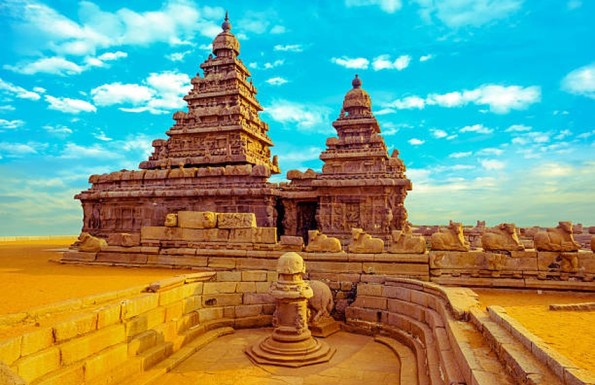
Mahabalipuram - Wonder Carved By The Sea
There are few places in India where the ancient and the elemental coexist quite so dramatically as at Mahabalipuram. Situated on the Coromandel Coast of Tamil Nadu, approximately 60 kilometres south of Chennai, this small coastal town contains one of the most remarkable concentrations of rock-cut architecture and open-air sculpture in the entire world. Known officially as Mamallapuram, and carrying the UNESCO World Heritage Site designation since 1984, Mahabalipuram is a place where 7th and 8th century Pallava craftsmen turned granite outcrops and boulders directly into temples, sculptures, and narrative panels of extraordinary ambition — and where the Bay of Bengal provides a backdrop so vast and timeless that it puts even the greatest human achievements into humbling perspective
🌊 Mahabalipuram: Where Ancient Stone Meets the Eternal Sea
There are few places in India where the ancient and the elemental coexist quite so dramatically as at Mahabalipuram. Situated on the Coromandel Coast of Tamil Nadu, approximately 60 kilometres south of Chennai, this small coastal town contains one of the most remarkable concentrations of rock-cut architecture and open-air sculpture in the entire world. Known officially as Mamallapuram, and carrying the UNESCO World Heritage Site designation since 1984, Mahabalipuram is a place where 7th and 8th century Pallava craftsmen turned granite outcrops and boulders directly into temples, sculptures, and narrative panels of extraordinary ambition — and where the Bay of Bengal provides a backdrop so vast and timeless that it puts even the greatest human achievements into humbling perspective.
This is not a site you visit quickly or casually. Mahabalipuram rewards those who slow down, who look carefully, who are willing to stand in the sun beside a carved granite boulder and try to understand what extraordinary imagination and technical mastery went into transforming raw rock into one of the world's great artistic legacies.
📍 Location
Coromandel Coast, Tamil Nadu
🏛 UNESCO
World Heritage Site Since 1984
🌊 Setting
Bay of Bengal Coastline
📜 History and Origins: The Pallava Dynasty and the Birth of a Port City
The story of Mahabalipuram is inseparable from the story of the Pallava dynasty, which ruled much of southern India from approximately the 3rd to the 9th century CE and established their capital at Kanchipuram, about 70 kilometres inland. Under the Pallavas, the Coromandel Coast became a thriving maritime corridor connecting southern India with Southeast Asia, China, and the islands of the Indian Ocean. Mahabalipuram — then known as Mamallapuram, named after the great Pallava king Narasimhavarman I, whose title was Mamalla meaning "great wrestler" — served as the principal seaport of this maritime network.
It was under Narasimhavarman I (630–668 CE) and his successor Narasimhavarman II (also known as Rajasimha, 700–728 CE) that the monuments of Mahabalipuram reached their fullest flowering. The artistic programme undertaken during these reigns was staggering in its ambition — dozens of rock-cut caves, monolithic temples carved from single boulders, enormous open-air relief panels, and the construction of the Shore Temple directly on the seafront, all executed within roughly a century and representing the beginning of what would become the Dravidian style of temple architecture that defines South Indian sacred building to this day.
The Pallava sculptors essentially invented the grammar of South Indian temple design — the tiered pyramidal tower (vimana), the pillared mandapa (hall), the elaborate sculptural programmes on exterior walls — and Mahabalipuram is where you can watch that grammar being developed, refined, and perfected in real time, in stone.
🏛 The Monuments: An Open-Air Museum of Unparalleled Richness
🌅 The Shore Temple: Standing Against the Sea
The Shore Temple is Mahabalipuram's most immediately iconic structure — a granite temple complex that has stood on the seafront for over thirteen centuries, its tiered towers silhouetted against the Bay of Bengal in one of the most photographed images in South Indian heritage. Dedicated to both Shiva and Vishnu, the Shore Temple represents one of the earliest examples of freestanding structural temple architecture in South India — a transition from the earlier rock-cut style to the construction of built temples that would define subsequent centuries of Indian sacred architecture.
The temple has been battered by thirteen centuries of sea wind and salt spray, and its sculptural detail is considerably eroded from its original state. Yet its form remains powerfully present, and the experience of standing beside it at dawn — when the rising sun catches the granite towers and the waves break twenty metres away — is one that stays with visitors long after they have left.
🪨 Arjuna's Penance: The World's Largest Rock Relief
If the Shore Temple is Mahabalipuram's most famous structure, Arjuna's Penance — also known as the Descent of the Ganges — is its most astonishing artistic achievement. Carved across the face of two enormous adjacent granite boulders, this relief panel measures approximately 27 metres wide and 9 metres tall, making it one of the largest open-air rock reliefs anywhere in the world.
The central composition depicts a natural cleft in the rock — once channelled with actual flowing water during festivals — that represents the sacred river Ganga descending from heaven to earth. Around this central axis, hundreds of figures are carved in extraordinary detail: gods, celestial beings, humans, animals, and mythological creatures, all depicted in motion, all moving toward the central cleft as if drawn to the sacred river's arrival. Elephants rendered with remarkable anatomical accuracy dominate the lower portion of the panel. Celestial figures fly overhead. Ascetics meditate in postures of great discipline.
The identity of the central human figure — whether it depicts Arjuna performing penance to obtain the divine weapon Pashupatastra, or the sage Bhagiratha performing austerities to bring the Ganga to earth — has been debated by scholars for decades. Most now favour the Bhagiratha interpretation, but the ambiguity has not reduced the relief's impact or significance one degree.
🛕 The Five Rathas: A Textbook of Temple Styles
Among Mahabalipuram's most intellectually fascinating monuments are the Pancha Rathas (Five Chariots) — five monolithic temples carved from a single long granite outcrop, each different in form and dedicated to a different deity, and each named after a character from the Mahabharata despite having no actual connection to that epic.
What makes the Pancha Rathas remarkable is that they appear to be a workshop or pattern book — a series of experimental temple forms carved in stone to explore different architectural possibilities before committing to construction. Each ratha demonstrates a different roofline style, a different relationship between the tower and the mandapa, a different proportion and treatment of the exterior wall. Together they read as an architectural laboratory, a space where Pallava builders were working out — quite literally in stone — what the future of Indian temple architecture might look like.
The largest of the five, the Dharmaraja Ratha, rises in three diminishing tiers to a octagonal crown, its exterior walls populated with finely carved deities and attendant figures. The Draupadi Ratha, the smallest, is shaped like a thatched hut — a form thought to reference the earliest wooden or bamboo shrines that preceded stone temple construction in India.
🎨 The Mandapas: Mythology Carved in Cave Walls
Scattered across the rocky hillside above the town are a series of rock-cut cave temples or mandapas, each carved directly into the living granite and decorated with sculptural panels of exceptional quality. The most celebrated of these is the Mahishasuramardini Mandapa, which contains two panels of such force and dynamism that they are frequently cited among the finest examples of narrative sculpture in the entire Indian tradition.
The panel depicting Durga slaying the buffalo demon Mahishasura captures the goddess mid-battle — her multiple arms wielding weapons, her lion mount surging forward — with a sense of kinetic energy and controlled violence that is genuinely extraordinary. Directly opposite, a panel of Vishnu reclining on the cosmic serpent Ananta conveys absolute stillness and cosmic repose — two entirely different moods achieved through the same medium, in the same cave, demonstrating the range and control of Pallava sculptural art.
⚖ Krishna's Butter Ball: Nature's Riddle
No visit to Mahabalipuram is complete without encountering Krishna's Butter Ball — a massive granite boulder approximately five metres in diameter, resting on a smooth sloping rock face at an angle so precarious that it appears to defy every law of physics. Despite its appearance of imminent catastrophe, the boulder has rested in exactly this position for centuries, unmoved by either time or the several attempts by later rulers — including reportedly Narasimhavarman himself — to move it using elephants.
Local tradition holds that the boulder is a ball of butter left behind by the god Krishna, who was famous in his childhood for his irresistible fondness for butter. Scientists attribute its stability to a small but perfectly positioned contact point at the base that distributes the boulder's weight in equilibrium. Both explanations are offered freely at Mahabalipuram, and visitors are welcome to decide which they find more satisfying.
🌊 The Submerged City: Secrets Beneath the Waves
One of the most fascinating chapters in Mahabalipuram's history was opened by the 2004 Indian Ocean tsunami, which temporarily pulled the sea back from the shore and revealed submerged structures — walls, foundations, and carved elements — lying on the seabed just offshore. These findings lent credence to a long-standing local tradition that Mahabalipuram was once home to seven temples, of which only the Shore Temple remains above water, the others having been swallowed by the sea over the course of centuries.
Subsequent underwater archaeological surveys have confirmed the presence of man-made structures offshore, though their exact nature, age, and relationship to the monuments on land continue to be studied. The possibility that a significant portion of ancient Mahabalipuram lies beneath the Bay of Bengal adds an additional layer of mystery and historical depth to a site already extraordinarily rich in both.
🌞 Visitor Experience: Light, Stone, Wind, and Water
Visiting Mahabalipuram is a sensory experience as much as a historical one. The combination of warm sea air, the sound of waves, the warmth of sun-heated granite under your hands, and the visual richness of the sculptures creates an atmosphere unlike any other heritage site in India. The monuments are spread across a relatively compact area, and it is entirely possible to walk between the major sites — though the heat of the Tamil Nadu coast makes early morning or late afternoon visits significantly more comfortable than midday explorations.
The best time to visit is between November and February, when the coastal climate is at its most pleasant. The annual Mahabalipuram Dance Festival, held from December to January, brings classical dance performances — Bharatanatyam, Kuchipudi, Odissi, and other forms — staged against the backdrop of the monuments themselves, creating an experience that connects the living tradition of Indian classical arts directly to their ancient architectural context.
Accommodation in Mahabalipuram ranges from budget guesthouses to well-appointed beach resorts, and the town's relaxed coastal atmosphere makes it an easy place to linger for two or three days rather than rushing through in a single visit.
🌍 Heritage Tourism and Global Significance
Mahabalipuram draws visitors from across India and from dozens of countries, occupying a unique position in the heritage tourism landscape — equally important to art historians, architectural scholars, religious pilgrims, beach travellers, and cultural tourists seeking an experience genuinely different from the Mughal monuments that dominate most international India itineraries.
For travellers exploring South India, Mahabalipuram is an essential first chapter — a place where the distinctive visual language of Dravidian architecture was born, where the principles that would eventually produce the great temple complexes of Thanjavur, Madurai, and Hampi were first worked out in granite by artists whose names history has not preserved but whose achievements it has preserved in stone, in wind, and in the eternal sound of the sea.