Mandu -The City Of Joy
There are places in India where history has been so completely absorbed into the landscape that the stones themselves seem to carry memory. Mandu is one of them. Perched on a rocky plateau in the Vindhya Range of western Madhya Pradesh, at an elevation of 633 metres above sea level, this ancient hilltop city — also known as Mandavgad or Shadiabad (City of Joy) — is one of Central India& most extraordinary and least-crowded heritage destinations.
🏰 Mandu: The City of Joy Where Ruins Still Echo with Romance
Mandu: The City of Joy Where Ruins Still Echo with Romance
There are places in India where history has been so completely absorbed into the landscape that the stones themselves seem to carry memory. Mandu is one of them. Perched on a rocky plateau in the Vindhya Range of western Madhya Pradesh, at an elevation of 633 metres above sea level, this ancient hilltop city — also known as Mandavgad or Shadiabad (City of Joy) — is one of Central India's most extraordinary and least-crowded heritage destinations.
Mandu is not a single monument. It is a ruined city spread across 20 square kilometres of plateau, ringed by nearly 37 kilometres of fortified walls punctuated by 12 monumental gateways. Within those walls lie palaces that float between lakes, marble tombs that anticipated the Taj Mahal, mosques that echo the great mosque of Damascus, and pavilions from which a queen once watched her beloved river. And woven through all of it — in the carvings, the courtyards, the very air of the place — is a love story that the balladeers of Malwa still sing.
📍 Location and Setting: A Plateau Above the World
Mandu lies approximately 100 kilometres west of Indore and 35 kilometres from Dhar, accessible by road through a landscape of winding hills and villages that feels deliberately unhurried. The plateau on which it sits is separated from the surrounding terrain by deep ravines on all sides, with the southern edge offering a sheer drop to the Nimar plains below, where the Narmada River threads through the valley like a silver ribbon visible on clear days from the highest points of the fort.
This dramatic geography was not accidental. Mandu's location made it one of the most naturally defended positions in Central India — a hilltop stronghold that any army would struggle to approach, and that any ruler would fight to hold. The popular local saying captures it precisely: "The one who holds Mandu, controls the region."
Mughal Emperor Jahangir, who spent nearly seven months at Mandu, wrote of it with unmistakable affection: "I have never known of any other existing place on earth like Mandu, which can be so exciting in terms of its climate — and that too in the rainy season." Even Lord Curzon, not easily given to admiration, declared that no monument in all of India had inspired him quite as deeply as Mandu's architectural richness and mature natural setting.
📜 History: From Paramara Rajputs to the City of Joy
Mandu's recorded history stretches back to the 6th century CE, when an inscription from nearby Talanpur documents a flourishing settlement here. In the 10th and 11th centuries, it rose to prominence under the Paramara Rajput kings — most famously Raja Bhoj, the scholar-king after whom Bhopal is named, who fortified the site. But it was the arrival of the Muslim rulers that gave Mandu its most celebrated architectural identity.
In 1305, Alauddin Khalji of Delhi captured the Malwa region, and the Paramaras were swept from power. Nearly a century later, Dilawar Khan, the Afghan governor of Malwa, declared independence from the weakening Delhi Sultanate in 1401 and established the Ghuri dynasty with Mandu as his capital — renaming it Shadiabad, the City of Joy. His son Hoshang Shah (ruled 1405–1434) proved to be one of Mandu's greatest builder-kings, commissioning the Jami Masjid, his own magnificent tomb, and numerous other structures that defined the city's skyline.
The Malwa Sultanate that followed under the Khilji rulers saw Mandu reach its territorial zenith and cultural peak. The city then passed through a succession of hands — Gujarat Sultanate, Humayun, Sher Shah Suri — before arriving at its most celebrated chapter: the reign of Baz Bahadur, the last independent sultan of Malwa (1555–1562), poet, musician, and the other half of one of India's most enduring love stories.
When Akbar's Mughal forces captured Mandu in 1561, Baz Bahadur fled. The Mughals used it as a retreat and administrative centre, and Jahangir's extended stay speaks to its continuing prestige. In 1732, the Marathas of Dhar took the city, and thereafter Mandu faded quietly into the beautiful, haunted ruins we find today.
❤️ The Love Story of Baz Bahadur and Rani Roopmati
Ask anyone in Mandu what the city means and they will answer not with a building but with two names: Baz Bahadur and Roopmati.
The story goes that while on a hunting trip in the forests near Mandu, Sultan Baz Bahadur — a man known as much for his love of music and poetry as for his rule — encountered a shepherdess of extraordinary beauty and a singing voice that stopped him where he stood.
Her name was Roopmati, and she was a woman of Rajput origin, deeply devoted to the River Narmada as her sacred mother. He fell in love at first sight and begged her to come to Mandu and marry him.
Roopmati agreed, but on one condition: he must build her a palace from which she could see and offer prayers to her beloved Narmada every day. Baz Bahadur fulfilled this promise — converting a military watchtower into the graceful Roopmati Pavilion, perched at the highest point of the fort on the southern edge, from which the Narmada is visible on clear days, winding through the plains some 23 kilometres below.
The lovers' idyll was shattered in 1562 when Akbar sent his general Adham Khan to capture Mandu. Baz Bahadur's small army was no match for the Mughal force. He fled — and Roopmati, learning that Adham Khan sought her as a trophy, chose to poison herself rather than fall into enemy hands. She wrote a final poem before she died, its last lines translating roughly as: "My heart is sad seeing the sunrise in Mandu since Baz Bahadur has run away. The days of meeting my lover are over."
History or legend, or both — this story has given Mandu the identity of one of India's most romantic destinations. The balladeers of Malwa still sing of it, Bollywood has filmed here repeatedly, and couples come to Mandu for pre-wedding shoots among the arched corridors and lake-ringed palaces.
🏛️ Notable Monuments: An Open-Air Museum of Afghan Architecture
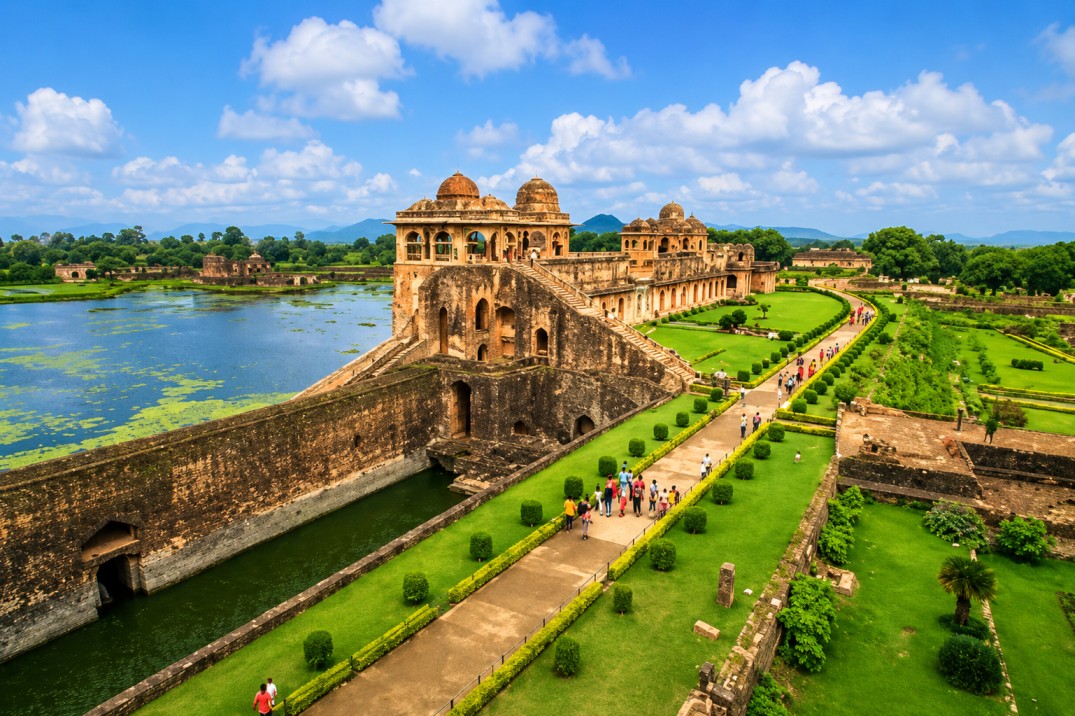
The most photographed and instantly recognisable structure in Mandu, the Jahaz Mahal (Ship Palace) is a 120-metre-long, two-storeyed palace built between two artificial lakes — Munj Talao and Kapur Talao — so that it appears to float on water like a great stone vessel.
Built in white marble and completed in 1439, the Tomb of Hoshang Shah is considered India's first marble mausoleum — predating the Taj Mahal by nearly two centuries.
Immediately adjacent to Hoshang Shah's Tomb stands the Jami Masjid (Great Mosque), begun by Hoshang Shah and completed in 1454.
The Hindola Mahal (Swinging Palace) earns its name from its dramatically sloping outer walls, which create the optical illusion that the entire building is swaying.
Standing at the southernmost and highest point of the Mandu plateau, Roopmati's Pavilion was originally a military watchtower before Baz Bahadur had it converted into a retreat for his queen, with two graceful canopied pavilions added so she could scan the horizon for the Narmada.
Below it, Baz Bahadur's Palace sits in a spacious courtyard surrounded by halls and high terraces, with the Rewa Kund reservoir nearby — built by Baz Bahadur specifically to supply Roopmati's pavilion with water, lifted by animal-powered Persian wheels from this tank far below.
Built by Hoshang Shah's successor Mahmud Shah Khilji as an academic institution (madrassa) and later expanded into a mausoleum, the Ashrafi Mahal (Palace of Gold Coins) takes its evocative name from a legend: the king would place a gold coin (ashrafi) on each step for the queen to collect as she ascended — a gesture of devotion that yielded 160 gold coins, later distributed as charity.
🌳 Unique Features: Baobab Trees and an African Connection
Among Mandu's many surprises are its giant Baobab trees — native to Africa, found almost nowhere else in India, and believed to have been gifted by the Caliphs of Egypt to Mandu's rulers during the height of their reign. Their enormous, otherworldly silhouettes rising above the ruins of palaces and mosques are one of Mandu's most visually striking and least-expected features.
🎒 Visitor Experience: Monsoon Magic and Heritage Walks
Mandu rewards slow travel. The monuments are grouped into several distinct clusters — the Royal Enclave, the Village Group, and the Rewa Kund Group — spread across the plateau, meaning that a thorough visit is best done over two days rather than one.
August to February, with the monsoon season (July–September) considered peak season by experienced visitors who come specifically for Mandu's transformation into a landscape of extraordinary green.
Mandu is about 100 km from Indore (approximately 2 hours by road) and 35 km from Dhar.
Hire a local guide — Mandu's monuments are rich with stories that signage alone cannot convey.
Regular buses run from Indore. The nearest railway station is at Dhar; the nearest airport is Devi Ahilyabai Holkar Airport, Indore.
Carry water and wear comfortable shoes; the distances between monuments are significant. Try the local Dal Paniya — a traditional Malwa dish of maize-flour bread dipped in spiced lentils, best eaten at a roadside stall near Jami Masjid.
✨ Why Mandu Is a Heritage Destination Like No Other
Mandu is, as Madhya Pradesh Tourism describes it, a celebration in stone — of life, joy, and love. It is a place where the ambition of medieval rulers, the genius of Afghan architects, the devotion of a queen to her river, and the loyalty of a poet-king to his love all converge in a single ruined plateau above the Narmada Valley.
For heritage travellers, Mandu offers something increasingly rare: a major historical site that has not been over-restored, over-crowded, or over-merchandised. The ruins here still feel like ruins — alive with possibility, draped in creeper, loud with birds, and quiet enough that you can stand in the Jami Masjid or on Roopmati's terrace and feel, very genuinely, that you are alone with history.