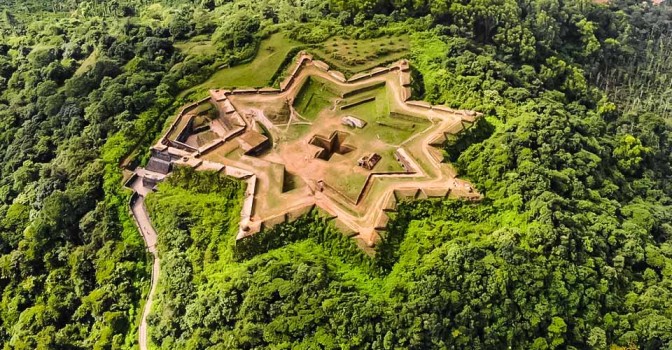
Manjarabad Fort: Karnataka's Unique Star-Shaped Hill Fortress
Manjarabad Fort stands as one of the most architecturally distinctive and historically intriguing heritage destinations in Karnataka, representing a unique star-shaped hilltop fortification of considerable strategic ingenuity whose unusual eight-pointed geometric design, commanding hilltop position, and sweeping panoramic views across the Western Ghats together create a destination of genuine architectural curiosity and scenic grandeur that distinguishes it from virtually every other fort in southern India. Situated near the town of Sakleshpur in the Hassan district of Karnataka, perched atop a hill at an elevation of approximately 3240 feet within the forested terrain of the Western Ghats, Manjarabad Fort was constructed in 1792 by Tipu Sultan, the ruler of Mysore, to serve as a strategic outpost guarding the trade and military route connecting the Mysore plateau to the Malabar coast. The destination draws history enthusiasts, architecture lovers, trekkers, and nature travelers from across Karnataka and beyond, offering an encounter with a fortification whose distinctive star-shaped plan, an unusual and relatively rare design choice in the broader landscape of Indian military architecture, reflects the military engineering sensibilities that Tipu Sultan absorbed from European fortification traditions during his extensive engagement with the colonial powers of his era.
Manjarabad Fort The Star Fortress
A rare eight-pointed star-shaped fortification built in 1792 by Tipu Sultan, standing watch over the Mysore-to-Malabar trade route amid the misty Western Ghats.
Overview
Manjarabad Fort stands as one of the most architecturally distinctive and historically intriguing heritage destinations in Karnataka, representing a unique star-shaped hilltop fortification of considerable strategic ingenuity whose unusual eight-pointed geometric design, commanding hilltop position, and sweeping panoramic views across the Western Ghats together create a destination of genuine architectural curiosity and scenic grandeur that distinguishes it from virtually every other fort in southern India. Situated near the town of Sakleshpur in the Hassan district of Karnataka, perched atop a hill at an elevation of approximately 3240 feet within the forested terrain of the Western Ghats, Manjarabad Fort was constructed in 1792 by Tipu Sultan, the ruler of Mysore, to serve as a strategic outpost guarding the trade and military route connecting the Mysore plateau to the Malabar coast. The destination draws history enthusiasts, architecture lovers, trekkers, and nature travelers from across Karnataka and beyond, offering an encounter with a fortification whose distinctive star-shaped plan, an unusual and relatively rare design choice in the broader landscape of Indian military architecture, reflects the military engineering sensibilities that Tipu Sultan absorbed from European fortification traditions during his extensive engagement with the colonial powers of his era.
Why Visit Manjarabad Fort
The recognition of Manjarabad Fort as one of the most architecturally unusual hill forts in Karnataka reflects its unparalleled distinction within the broader landscape of South Indian military architecture, where the conventional irregular or rectangular fort plans more typically encountered give way here to a deliberate and precisely executed eight-pointed star design that immediately marks the structure as a departure from local building tradition. One of the most compelling reasons to visit is the opportunity to appreciate this geometric design directly, with the star shape best understood and appreciated from an elevated vantage point or through the fort's internal layout, where the converging walls and angular bastions reveal the careful military logic behind the unusual configuration, designed to eliminate blind spots and maximize defensive sightlines along every approach to the fort. The hilltop position of Manjarabad offers sweeping panoramic views across the surrounding Western Ghats landscape, with layered ridgelines, dense forest, and on clear days the distant profile of further hills extending toward the Malabar coast, creating a visual reward of considerable beauty that complements the architectural interest of the fort itself. The combination of an unusual and historically significant architectural design, the connection to the formidable historical figure of Tipu Sultan, and the genuinely rewarding scenic setting further strengthens the appeal of Manjarabad as a destination that offers both intellectual and visual reward in equal measure.
🎯 Eight-Pointed Defense
The converging walls and angular bastions reveal the careful military logic behind the unusual configuration, designed to eliminate blind spots and maximize defensive sightlines along every approach to the fort.
Key Highlights Within the Area
The star-shaped fortification plan itself stands out as the single most distinctive and historically significant feature of Manjarabad, its eight converging points creating a geometric architectural form that is immediately apparent both from aerial perspective and from careful observation of the fort's internal walls and bastions at ground level. The underground tunnels and chambers within the fort, reportedly constructed for storage and strategic movement during periods of siege, add a further dimension of historical intrigue to the site, their dark and partially explored passages contributing to the fort's atmosphere of military mystery and engineering ambition. The panoramic views from the fort's elevated ramparts across the surrounding Western Ghats landscape represent a highlight of considerable natural beauty, with the misty hills and forested valleys of the Sakleshpur region stretching in every direction, particularly atmospheric during and immediately after the monsoon season when low cloud and mist frequently drift across the surrounding ridgelines.
🕳️ Underground Tunnels
The underground tunnels and chambers within the fort, reportedly constructed for storage and strategic movement during periods of siege, add a further dimension of historical intrigue, their dark and partially explored passages contributing to the fort's atmosphere of military mystery.
Activities
Exploring the fort's star-shaped walls and bastions on foot is the primary activity at Manjarabad, allowing visitors to trace the unusual geometric plan of the fortification and appreciate the military engineering logic behind its design at close quarters. Photography of the fort's distinctive shape and the surrounding Western Ghats panorama is a popular pursuit, particularly during the monsoon and immediate post-monsoon months when the landscape is at its most vividly green and atmospheric. Trekking through the surrounding forested hillsides of the Sakleshpur region offers a rewarding complement to the fort visit for those interested in extending their exploration of the broader Western Ghats landscape.
Fort at a Glance
Best Time to Visit
The most favorable period to visit Manjarabad Fort is during and immediately after the monsoon season from July to September, when the surrounding Western Ghats landscape is at its most lushly green and the misty atmospheric conditions create a particularly dramatic setting for the fort and its panoramic views, though the post-monsoon months of October and November also offer excellent clarity and comfortable temperatures for visiting.
Connectivity
Manjarabad Fort is accessible from Sakleshpur, situated approximately 5 kilometres away, and from Hassan, located approximately 50 kilometres from the fort. Bengaluru, situated approximately 220 kilometres away, provides the nearest major airport and rail connectivity, with Sakleshpur also connected by rail through the scenic Hassan-Mangalore railway line, making Manjarabad Fort a practical and rewarding inclusion in Western Ghats heritage and nature itineraries for travelers exploring the Hassan district and the broader Karnataka coffee country landscape.