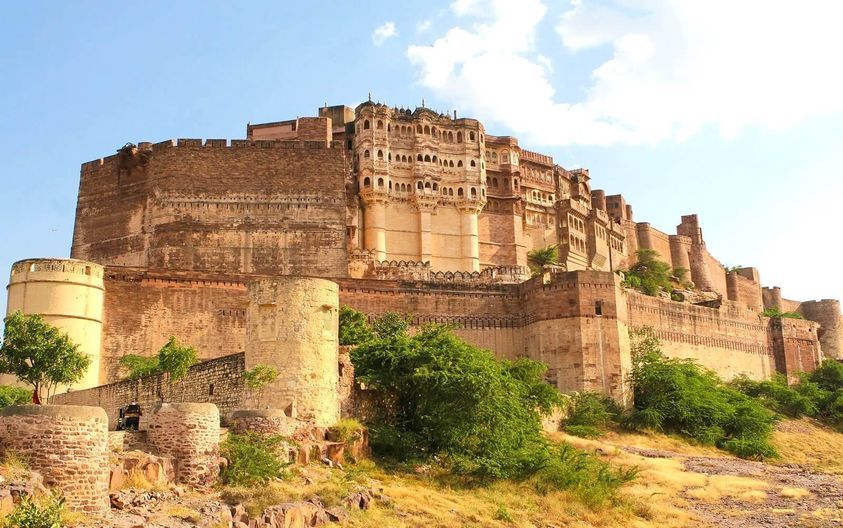
Mehrangarh : The Pride Of The Blue City
Rising sheer and imposing from a rocky outcrop 122 metres above the city of Jodhpur, Mehrangarh Fort is one of those rare places that genuinely takes your breath away before you have even stepped inside. Its massive sandstone walls — up to 36 metres high and 21 metres wide in places — have watched over the Blue City of Rajasthan for more than five and a half centuries, surviving wars, sieges, and the slow erosion of time with equal indifference. For anyone trying to understand the grandeur, the complexity, and the sheer audacity of Rajput civilization, Mehrangarh is an essential destination.
🏰 Mehrangarh Fort: The Mighty Citadel That Defines Jodhpur
📍 Location
Jodhpur, Rajasthan
📅 Founded
1459 CE
👑 Founder
Rao Jodha
☀️ Meaning
Fort of the Sun
Rising sheer and imposing from a rocky outcrop 122 metres above the city of Jodhpur, Mehrangarh Fort is one of those rare places that genuinely takes your breath away before you have even stepped inside. Its massive sandstone walls — up to 36 metres high and 21 metres wide in places — have watched over the Blue City of Rajasthan for more than five and a half centuries, surviving wars, sieges, and the slow erosion of time with equal indifference. For anyone trying to understand the grandeur, the complexity, and the sheer audacity of Rajput civilization, Mehrangarh is an essential destination.
📍 Location and Setting: A Fort Born from the Landscape
Jodhpur sits at the edge of the Thar Desert in western Rajasthan, and Mehrangarh crowns it like a crown that the city has quietly grown beneath. The fort is visible from almost everywhere in Jodhpur — an ever-present silhouette that shifts in colour through the day, from pale gold in the morning to deep amber at dusk. The city's famous blue-washed houses cluster at the fort's base like devotees around a temple, creating one of the most photographed urban landscapes in all of India.
The name Mehrangarh comes from Mihir (the sun) and Garh (fort) — the Fort of the Sun — a title that reflects both its commanding position and its association with the Rathore clan, who claimed descent from the sun god Surya.
👑 History and Origins: Rao Jodha and the Rathore Dynasty
The story of Mehrangarh begins in 1459 CE, when Rao Jodha, the fifteenth chief of the Rathore clan, decided to shift his capital from the older fort of Mandore and establish a new, more defensible stronghold. He chose Bhakurcheeria — "the mountain of birds" — a rocky hill that offered natural protection on every side and a commanding view of the surrounding plains.
The founding of the fort, however, did not come without conflict. According to historical accounts, a hermit named Cheeria Nathji lived on the hill and was deeply displeased at being displaced. He reportedly cursed the new city with perpetual water scarcity — a curse that Jodhpur's residents felt acutely through recurring droughts over the centuries. To appease him, Rao Jodha built a temple dedicated to the hermit within the fort complex, where it stands to this day.
Over the following centuries, successive Rathore rulers expanded and embellished Mehrangarh. Each ruler left his mark — adding palaces, gates, temples, and bastions — transforming what began as a military stronghold into an extraordinary layered canvas of Rajput architecture and royal ambition. Key among these rulers were Rao Maldeo, who significantly expanded the fort in the 16th century, and Maharaja Jaswant Singh, under whose reign much of the ornate palace interior took shape.
The Rathores of Jodhpur maintained complex and often turbulent relationships with the Mughal Empire. Maharaja Gaj Singh I and later rulers negotiated, allied with, and sometimes resisted Mughal authority — a political dance reflected in Mehrangarh's architecture, which blends distinctly Rajput sensibilities with subtle Mughal influences in its later additions.
🏛️ Architecture: Where Strength Meets Splendour
Mehrangarh's architecture is a study in contrasts. From the outside, the fort is all brute strength — sheer walls of red sandstone rising from the cliff face so seamlessly that it is sometimes difficult to tell where the natural rock ends and the construction begins. The approach to the fort winds through seven successive gates, each with its own name and history. The most famous is the Jayapol (Victory Gate), built by Maharaja Man Singh in 1806 to celebrate victories over the armies of Jaipur and Bikaner, and the Fatehpol (Gate of Victory), erected to mark Maharaja Ajit Singh's triumph over the Mughals.
Two of these gates still bear the haunting imprints of hands — the sati handprints of royal widows who immolated themselves on their husbands' funeral pyres. There are 31 such impressions near the Loha Pol gate, dating from 1843. They are sobering reminders of a practice now rightly abolished, but they remain part of the fort's historical record, visited with a complex mixture of reverence and reflection.
Step inside, and the mood shifts entirely. The palace complex within Mehrangarh is extraordinarily refined — a world of delicate latticed screens (jharokhas), ornately carved sandstone panels, mirrored ceilings, and expansive courtyards bathed in warm light. The Moti Mahal (Pearl Palace), Sheesh Mahal (Mirror Palace), Phool Mahal (Flower Palace), and Daulat Khana are among the most celebrated interiors, each reflecting the taste and resources of the ruler who commissioned them.
The Phool Mahal, in particular, is breathtaking — its ceiling gilded with gold brought from Ahmedabad, its walls painted with scenes from Rajput court life, and its atmosphere suggesting a space designed purely for pleasure and cultural refinement. It served as the private audience hall and music room of the maharajas.
🏺 The Museum: One of India's Finest
Mehrangarh houses what is widely regarded as one of the best fort museums in India. Spread across multiple galleries, it preserves an astonishing collection of royal artefacts — palanquins (including the famous elephant howdahs used in royal processions), miniature paintings in the Marwar school style, royal cradles, antique furniture, armour, cannons, and an extraordinary collection of musical instruments. The museum does not simply display objects; it contextualises them within the living history of Jodhpur's royal family, making it genuinely educational as well as visually stunning.
📖 Legends, Curses, and Extraordinary Facts
Beyond the hermit's curse, Mehrangarh carries several other remarkable stories. During the 1965 war with Pakistan, the Indian Air Force reportedly used the fort as an observation post, a fact that underlines how its strategic value never quite faded even in the modern era.
The fort also gained international recognition when it featured prominently in Christopher Nolan's 2012 film The Dark Knight Rises, where its dramatic geography served as the setting for the fictional Pit prison. This brought a new wave of global attention to Mehrangarh and introduced it to audiences who might never otherwise have encountered it.
One of the fort's most unique features is its Chamunda Mata Temple, perched at the edge of the fort and dedicated to the presiding deity of Jodhpur's rulers. The goddess Chamunda was brought from Mandore by Rao Jodha himself and has been worshipped continuously at Mehrangarh since the fort's founding. In 2008, a tragic stampede during a festival here claimed over 200 lives — a dark chapter in the fort's modern history that led to sweeping improvements in crowd management and safety infrastructure.
🚶 Visitor Experience: What Awaits You
Walking through Mehrangarh today is a richly layered experience. The fort is beautifully maintained by the Mehrangarh Museum Trust — a private body established by the royal family — and the quality of interpretation, signage, and preservation is noticeably high compared to many of India's government-managed heritage sites. Audio guides are available in multiple languages, and the route through the fort is thoughtfully designed to reveal its spaces in a logical, gradually unfolding sequence.
From the fort's ramparts, the view over Jodhpur is unforgettable. The dense blue expanse of the old city stretches below, punctuated by domes and minarets, and on clear days the white marble of the Umaid Bhawan Palace is visible in the distance. At sunset, the fort walls glow deep ochre and the city below turns golden — it is one of Rajasthan's most iconic visual moments.
The best time to visit Mehrangarh is between October and March, when the weather is cool and the skies are clear. The fort opens at 9 AM and closes at 5 PM, and early morning visits are particularly rewarding before the crowds arrive. The annual World Sacred Spirit Festival, held within the fort, brings together Sufi musicians, folk artists, and performers from across the world in an event that feels perfectly suited to the setting.
🌍 Heritage Tourism and Global Recognition
Mehrangarh consistently ranks among the top heritage sites in India and has received numerous awards for conservation and museum excellence. It draws a remarkably diverse audience — history enthusiasts, architecture students, photographers, Bollywood filmmakers, and international tourists who place it firmly on the Rajasthan circuit alongside Jaipur and Udaipur.
For travellers seeking an authentic encounter with Rajput history and culture, Mehrangarh delivers on every level. It is not a ruin, not a reconstruction, but a living monument — still owned by the Jodhpur royal family, still home to active places of worship, and still capable, after more than 550 years, of making every visitor feel the weight and wonder of what human ambition can achieve in stone.