Mubarak Mandi Palace: Where Jammu’s Royal History Lives On
- Home
- Historical trek Experiences
- Details
Mubarak Mandi Palace: Where Jammu’s Royal History Lives On
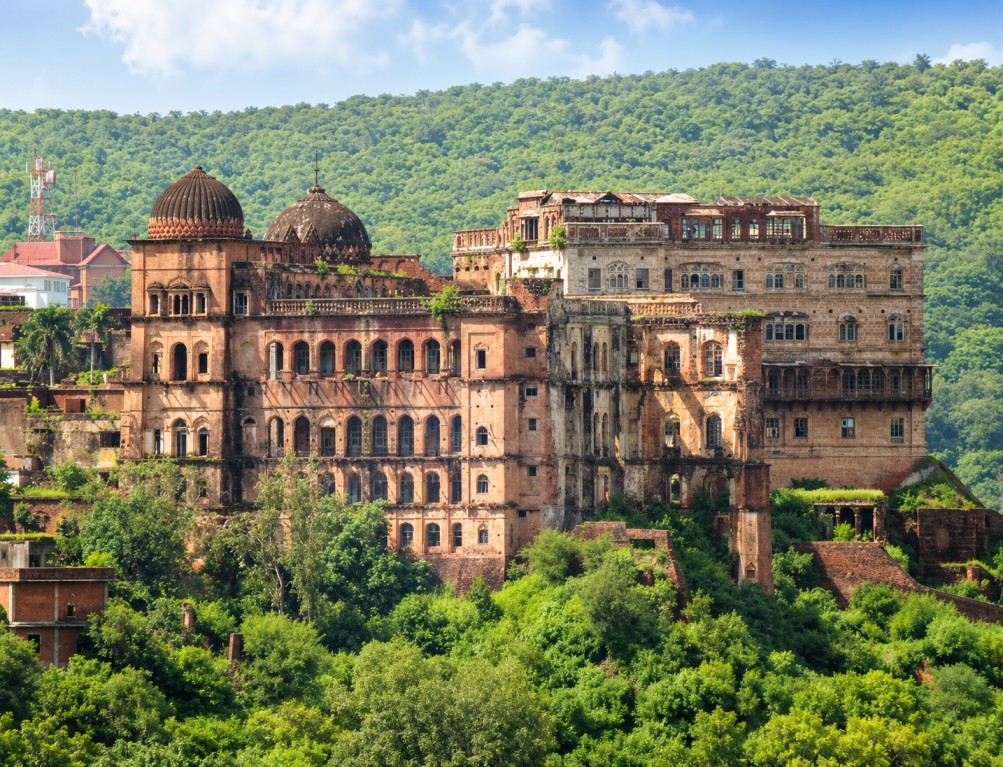
Perched on a rocky cliff in the heart of Jammu's historic walled city, the Mubarak Mandi Palace Complex looms over the winding Tawi River like a citadel frozen mid-breath. This sprawling ensemble of palaces, halls, courtyards, and gardens was the seat of Dogra royal power for over two centuries — a place where kingdoms were consolidated, alliances forged, and the rich cultural identity of Jammu took its enduring shape. Today, the complex stands at a fascinating crossroads: part ruin, part living museum, and very much a work in progress, it rewards curious travelers with an experience that no polished heritage property can quite replicate.
🏰 Mubarak Mandi Palace: Jammu's Forgotten Royal Citadel
Perched on a rocky cliff in the heart of Jammu's historic walled city, the Mubarak Mandi Palace Complex looms over the winding Tawi River like a citadel frozen mid-breath. This sprawling ensemble of palaces, halls, courtyards, and gardens was the seat of Dogra royal power for over two centuries — a place where kingdoms were consolidated, alliances forged, and the rich cultural identity of Jammu took its enduring shape. Today, the complex stands at a fascinating crossroads: part ruin, part living museum, and very much a work in progress, it rewards curious travelers with an experience that no polished heritage property can quite replicate.
👑 Origins: A Dynasty Moves Its Throne
The story of Mubarak Mandi begins in 1710, when Raja Dhruv Dev (1707–1733), consulting his royal astrologers, decided to relocate his court from the older Purani Mandi palace to a commanding new site overlooking the Tawi River. The choice of location was deliberate: the hilltop position offered sweeping views across the river while providing natural defensive advantage against potential threats from the city below.
What Dhruv Dev began, successive rulers of the Dogra dynasty greatly expanded. Over the next 150 years, the complex grew outward and upward as each maharaja added his own contribution — new palaces for queens, administrative halls for governance, ceremonial spaces for public court. Maharaja Gulab Singh (1792–1856), the formidable ruler who founded the princely state of Jammu and Kashmir and later signed the Treaty of Amritsar with the British in 1846, added three mansions on the northeastern side. Maharaja Ranbir Singh (1856–1885) gave the complex much of its current form — constructing his own palace, palaces for his queens, completing the Gol Ghar, and building the celebrated Sheesh Mahal, as well as separate palaces for his three sons. Maharaja Partap Singh later ordered extensive renovations of the Pink Hall, Green Hall, and the Central Pavilion, and added the Rani Charak Palace on the eastern side.
By the early 20th century, Mubarak Mandi comprised 25 individual buildings — a city within the city. The royal era at Mubarak Mandi effectively drew to a close in 1925, when Maharaja Hari Singh — the last ruler of Jammu and Kashmir — shifted his primary residence to the newer Hari Niwas Palace. The complex gradually passed into government hands, and while parts of it were repurposed for offices and courts, much fell into the slow disrepair that still marks it today.
🏛️ Architecture: Three Civilizations in One Complex
What makes Mubarak Mandi architecturally extraordinary is precisely its inconsistency. This is not a palace designed in a single vision, built in a single season. It is a living record of changing tastes across two centuries, and its eclectic character is its greatest distinction.
Walk through its gates and you'll encounter Rajasthani jharokhas — intricately carved overhanging balconies that would look at home in a Jodhpur haveli. Turn a corner and Mughal-influenced arched courtyards and garden terraces come into view, their geometry recalling the pleasure gardens of Agra and Lahore. Step into a later wing and the influence shifts again: European Baroque columns and arched windows appear, reflecting the 19th-century Dogra rulers' engagement with British colonial aesthetics. The result is an architecture that could only have come from a dynasty at the crossroads of India's great cultural traditions.
The complex is organized around multiple courtyards known locally as Ahattas — categorized into public, semi-public, and private zones, each reflecting its function in the royal household. External entrances (Deorhis) like Chowk Chabutra and Pakki Dhakki connect the complex to the old city, while internal gateways lead toward the more private palace quarters.
Notable structures within the complex include the Darbar Hall, where public court was held and royal ceremonies conducted; the Pink Palace (Pink Hall), which now houses the Dogra Art Museum; the Gol Ghar, a distinctive circular structure; the Sheesh Mahal (Palace of Mirrors), entirely clad in glass and mirrorwork; the Hawa Mahal; and the Toshakhana Palace, once the royal treasury. To the east, seven terraced gardens separated by walls cascaded toward the river, offering the royal family a private green retreat above the city.
🖼️ The Dogra Art Museum: Treasures of a Princely Kingdom
The most accessible and best-preserved section of Mubarak Mandi is the Government Dogra Art Museum, housed within the Pink Hall. Regarded as one of the richest museum collections in northern India, it offers a concentrated glimpse into the cultural wealth of the Dogra kingdom.
The collection includes Pahari and Dogra miniature paintings — delicate works of extraordinary refinement depicting mythological scenes, courtly life, and landscapes. There are Persian manuscripts, including folios believed to be from the Sikandernama and the Shahnama. The armory section displays royal weapons, and the collection also encompasses coins, jewellery, sculptures, costumes, and ceremonial objects spanning multiple eras. A remarkable highlight is the gold-plated bow and arrow believed to have belonged to Mughal Emperor Shah Jahan — a rare artifact that underlines the complex political relationships between the Dogra chiefs and the Mughal court. A dedicated tribal gallery brings everyday Dogra folk culture to life through material objects and contextual displays.
🔥 Fires, Earthquakes, and the Battle for Survival
Mubarak Mandi's history is not just one of royal grandeur — it is also a story of remarkable endurance against repeated catastrophe. The complex has been consumed by fire more than 36 times over the centuries, each blaze leaving its mark on walls, rooftops, and interior woodwork. Earthquakes in the 1980s and again in 2005 caused further structural damage, collapsing sections and accelerating the decay that decades of administrative neglect had begun.
Three of the original 25 buildings have been lost entirely. Many remaining sections are in a state of partial ruin, their stone walls still standing but interiors gutted or sealed. In May 2025, the long-sealed Toshakhana within the complex was officially reopened, with metallurgy experts and law enforcement jointly documenting the artifacts inside — a sign that the government's commitment to the palace's revival is, at last, gaining momentum. Proposals also exist to link Mubarak Mandi with the nearby Bahu Fort via a ropeway, which would create a connected heritage circuit across Jammu's most significant historical sites.
📍 Visiting Mubarak Mandi Palace: What to Expect
🕒 Museum Timings
The Dogra Art Museum is the primary destination within the complex and is open to visitors from 10:30 AM to 4:30 PM, closed on Mondays.
🎟️ Entry Fee
Entry to the museum is affordable at just ₹20 per person.
🌤️ Best Time to Visit
The best time to visit Mubarak Mandi Palace is between October and March, when Jammu's climate is mild and walking the extensive grounds is comfortable.
🚕 Accessibility
Getting there is straightforward: the palace is about 7 km from Jammu Railway Station and 5 km from Jammu Airport, reachable by auto-rickshaw or taxi.
Approaching the palace from the narrow lanes of Jammu's old city, the sheer scale of the complex comes as a surprise. The clifftop setting delivers panoramic views of the Tawi River and the sprawling New City across its banks — a vista that alone makes the visit worthwhile.
The rest of the complex — with its ruined halls, sealed wings, and half-restored courtyards — can be explored on foot, and its atmospheric decay has a particular appeal for photographers and architecture enthusiasts who appreciate authenticity over restoration gloss.
Guided tours are available and strongly recommended, since the complex's layout and the historical significance of individual buildings are not always self-evident. A guide transforms the warren of courtyards and crumbling palaces into a coherent narrative.
Early mornings on weekdays offer the most peaceful experience — with fewer crowds and better light for photography.
At 1.5 km from the city bus stand, it sits in the heart of the old city and pairs naturally with a visit to the nearby Raghunath Temple complex and the ancient Bahu Fort.
⭐ Why Mubarak Mandi Deserves a Place on the Heritage Map
In a region often associated primarily with religious pilgrimage sites like Vaishno Devi and Amarnath, Mubarak Mandi Palace represents a different kind of heritage travel — one centered on history, architecture, and the layered story of a dynasty that once ruled from the Pir Panjal range to Ladakh. Its blend of Rajasthani, Mughal, and European styles is found nowhere else in quite the same configuration, making it a genuine architectural curiosity as well as a historical document in stone.
For domestic travelers tracing Jammu's pre-independence history, and for international visitors seeking royal India beyond the well-worn Rajasthan circuit, Mubarak Mandi Palace offers something genuinely rare: unmediated contact with a past that hasn't yet been tidied up for tourism. Its scars, its silences, and its slow revival are all part of what makes it so compelling.
Gallery & Highlights
Get In Touch
We are a specialist B2B Destination Management Company (DMC) with over 17 years of operational experience across India. We work exclusively with travel agencies, tour operators, and wholesalers in the USA, UK, and Europe handling every aspect of ground operations so your programs run smoothly, your clients are safe, and your brand reputation stays protected.