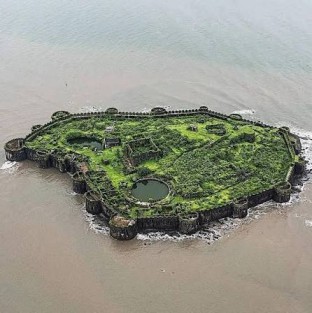
Murud Janjira Fort : The Unconquered Sea Fortress of India
There is a particular kind of power that belongs to things the world has tried and failed to destroy. Murud Janjira — a sea fort rising from the waters of the Arabian Sea off the Konkan coast of Maharashtra — carries that power in every one of its basalt walls. Situated on an oval-shaped rock off the Arabian Sea coast, near the port town of Murud, 165 km south of Mumbai, this island fortress is one of the most extraordinary and genuinely unconquered military structures in all of India. The Marathas attacked it repeatedly. The Portuguese tried. The British attempted and failed. None of them succeeded. That singular record of invincibility, held across centuries of maritime warfare, is what makes Murud Janjira more than just a fort — it is a monument to the strategic genius and sheer determination of the people who built and defended it.
🏰 Murud Janjira: The Unconquered Island Fort of the Arabian Sea
🌊 One of India's most extraordinary and genuinely unconquered military structures rising from the Arabian Sea.
📍 Location
Situated on an oval-shaped rock off the Arabian Sea coast, near the port town of Murud, 165 km south of Mumbai.
🛡️ Legacy
One of the most extraordinary and genuinely unconquered military structures in all of India.
🌊 Setting
A sea fort rising from the waters of the Arabian Sea off the Konkan coast of Maharashtra.
There is a particular kind of power that belongs to things the world has tried and failed to destroy. Murud Janjira — a sea fort rising from the waters of the Arabian Sea off the Konkan coast of Maharashtra — carries that power in every one of its basalt walls. Situated on an oval-shaped rock off the Arabian Sea coast, near the port town of Murud, 165 km south of Mumbai, this island fortress is one of the most extraordinary and genuinely unconquered military structures in all of India. The Marathas attacked it repeatedly. The Portuguese tried. The British attempted and failed. None of them succeeded. That singular record of invincibility, held across centuries of maritime warfare, is what makes Murud Janjira more than just a fort — it is a monument to the strategic genius and sheer determination of the people who built and defended it.
The word Janjira is a corruption of the Arabic word "jazira," which means "island." The full name is effectively a doubling of that same meaning — Murud Island, Janjira Island — as if the place needed to announce its maritime nature twice to be believed.
⚓ From Fishermen's Refuge to Imperial Stronghold: The Origins
The origins of this magnificent fortress date back to the 15th century when a group of local fishermen from Rajapuri built a wooden fort atop a massive rock to protect their families from pirates. The sea that provided their livelihood also brought danger, and the isolated rock offshore offered a defensive position that no pirate vessel could easily approach.
That modest wooden garrison did not stay modest for long. The Nizam Shahi Sultan of Ahmadnagar saw its potential as a stronghold for maritime defence and captured the small wooden fort. What followed was one of history's more remarkable stories of social mobility — and of a diaspora community rising to unprecedented power. His military strategist Malik Ambar, of the African Siddi tribe, started the construction of the formidable stone fort along the Arabian Sea in the 16th century.
The story of Malik Ambar is extraordinary in its own right. Originally from the Adal Sultanate in present-day Ethiopia, Malik Ambar was sold as a slave when he was a child. His journey eventually brought him to India, where his extraordinary talents in military strategy and governance came to the fore. From enslaved child to the architect of one of India's most formidable sea fortresses — his life alone is a story that deserves far wider telling.
After its construction in 1567 CE, the fort was key to the Siddis withstanding various invasion attempts by the Marathas, Mughals, and Portuguese to capture Janjira. In 1621, Siddi Ambar the Little successfully defied his overlord's attempt to replace him and is accordingly considered the first Nawab of Janjira state. From that point, the Siddis — an Abyssinian Muslim community of African descent — ruled Janjira as an independent sultanate, a fact that makes the fort's history one of the most culturally distinctive in South Asia.
⚔️ The Unconquered: A Record That Humbled Empires
The military history of Murud Janjira reads like a catalogue of failures by some of the most powerful forces in Indian history.
During the Maratha assault, the Marathas led by Chhatrapati Shivaji Maharaj attempted to scale the 12-metre-high granite walls but failed in their attempts. Shivaji — the same military commander who built an empire across the Deccan and outmanoeuvred the Mughals repeatedly — could not take this island.
Maratha ruler Sambhaji tried different strategies including assigning allies to fake defection to the Janjira side, and filling a channel eight hundred yards wide and thirty feet deep with stones and rock fragments to create a causeway for assaulting parties. That too failed. So frustrated was Sambhaji by his inability to take Janjira that he built another island fort known as Kansa or Padmadurg, just 9 km north of Janjira — effectively creating a rival fort simply to counter the one he could not conquer.
When the British sought to claim the fort, they were compelled to sign a treaty with the Siddis, which ensured that Murud Janjira remained under local rule. This made it the only independent frontier in the Indian subcontinent during the British colonial period. That distinction — the only fortress on India's west coast to remain undefeated throughout the colonial era — sits at the heart of Janjira's identity and its hold on the popular imagination.
Nearly 20 Siddi rulers reigned from the fort. Siddi Muhammad Khan was the last Siddi king before the merger of the fort into the Indian Union on 3 April 1948.
🏗️ Architecture: Built to Outlast Everything
The engineering of Murud Janjira is inseparable from its military success. Every structural choice was made with defence in mind.
Constructed using locally quarried basalt rock, the fort boasts robust walls, bastions, a citadel, a palace, and a network of freshwater tanks. What sets it apart is its unique 19 rounded bastions, designed to deflect cannonball attacks.
The fort's imposing walls rise up to 40 feet in height. Three of the fort's famous cannons survive today — named Kalal Bangdi, Landakasam, and Chavari — out of an original arsenal that once reportedly included 572 guns.
The main entrance, the Darya Darwaza or Sea Gate, is a masterpiece of controlled access. It opens directly onto the waters, positioned such that approaching boats could only see it when already close enough to be within range of the fort's guns.
The fusion of Indian, Persian, and Arabian architectural influences is a testament to the diverse cultural interactions of the time, reflecting the unique heritage of the region.
🏰 Inside the Fort: What the Walls Still Hold
Despite centuries of exposure to the Arabian Sea's salt winds and monsoon rains, the interior of Murud Janjira holds remarkable survivals.
Inside the fort's complex are the Palace of the Nawabs with its ornate structure and vast courtyards, an ancient Koli Temple dedicated to the goddess Bhavani, and 26 well-preserved artillery towers.
One of the fort's most practically impressive features is its freshwater supply. Despite being surrounded by salt water, a deep well of fresh water is still functioning inside the fort.
There are also secret passages and hidden doors built into the fort's structure — escape routes that allowed the fort's defenders to move unseen and, if necessary, evacuate.
The fort complex also houses intricately carved tombs of Siddi rulers and their families.
🏛️ The Nawab's Palace at Murud: A Companion Landmark
Visitors to Janjira should not overlook the Nawab's Palace at Murud on the mainland. Spread over a vast land of more than 45 acres, the Siddi Palace features a distinct architectural style representing a mix of Gothic and Mughal approaches.
🚤 The Visitor Experience
Reaching Murud Janjira is part of its appeal. The fort sits about two kilometres offshore, and the only way to reach it is by boat. Boats leave from the Rajapuri pier, the traditional approach to the fort.
Inside, the visit mixes archaeological exploration with natural atmosphere. Sea birds nest in the bastions, the sound of the ocean is constant, and salt-weathered stone gives every surface a textured, ancient quality that purpose-built heritage sites rarely replicate.
The best time to visit Murud Janjira is October to February, when the Konkan coast's post-monsoon weather is at its most pleasant and sea conditions allow regular boat service.
🗺️ Getting There and Practical Information
Murud Janjira Fort is approximately a three-hour drive from Mumbai and a four-hour drive from Pune. The nearest railway station is Roha Junction on the Konkan Railway, approximately 50 km from Murud, from where taxis and buses connect to the coast.
The fort is typically open from 7 AM to 6 PM, and entry fees are minimal. Boat fares for the crossing are separate and vary by season and operator.
✨ Why Murud Janjira Belongs on Every Heritage Traveller's Map
Murud Janjira is remarkable for several reasons simultaneously. As a piece of military engineering, it is among the finest sea fortresses ever built in Asia.
Murud Janjira Fort is more than just a fort; it is a living chronicle of resilience and the enduring charm of India's maritime heritage.
For international travellers, it presents something genuinely unique: an island fort, built and ruled by an African diaspora community, that defied every major power of the 17th and 18th centuries and was never taken by force.
The Arabian Sea still surrounds it. The walls still stand. And the story of the Siddis, the sea, and the fortress they made unconquerable still holds.