Orchha: The Hidden Kingdom of Bundelkhand
Picture yourself stepping onto ancient stone pathways where time seems to have deliberately slowed its pace, where massive palaces rise unexpectedly from the banks of a gentle river, and where the air carries whispers of forgotten kingdoms and untold stories. Sunlight filters through ornate arches, casting dancing shadows across courtyards where peacocks once strutted and royalty once ruled. The Betwa River flows quietly beside this medieval town, as if consciously protecting the secrets embedded in Orchha's ancient stones. This is Orchha—a place where history hasn't been preserved in museums or tourist packages but lives authentically in the streets, temples, and palaces that still stand after nearly 500 years. Located in Madhya Pradesh, this extraordinarily preserved medieval town was founded in the 16th century by the Bundela kings and remains one of India's most enchanting yet underrated heritage destinations. What makes Orchha truly extraordinary is that it's not a dead monument or reconstructed theme park—it's a living town where local families still inhabit centuries-old structures, where festivals continue to be celebrated in ancient temples, where the rhythm of life flows to the same cadence it has for generations. Once you walk these lanes and stand before these magnificent structures, you understand why Orchha has captivated historians, architects, and dreamers for centuries.
🏰 Orchha – Where Medieval Dreams Rest by the River's Edge
Picture yourself stepping onto ancient stone pathways where time seems to have deliberately slowed its pace, where massive palaces rise unexpectedly from the banks of a gentle river, and where the air carries whispers of forgotten kingdoms and untold stories. Sunlight filters through ornate arches, casting dancing shadows across courtyards where peacocks once strutted and royalty once ruled. The Betwa River flows quietly beside this medieval town, as if consciously protecting the secrets embedded in Orchha's ancient stones. This is Orchha—a place where history hasn't been preserved in museums or tourist packages but lives authentically in the streets, temples, and palaces that still stand after nearly 500 years. Located in Madhya Pradesh, this extraordinarily preserved medieval town was founded in the 16th century by the Bundela kings and remains one of India's most enchanting yet underrated heritage destinations. What makes Orchha truly extraordinary is that it's not a dead monument or reconstructed theme park—it's a living town where local families still inhabit centuries-old structures, where festivals continue to be celebrated in ancient temples, where the rhythm of life flows to the same cadence it has for generations. Once you walk these lanes and stand before these magnificent structures, you understand why Orchha has captivated historians, architects, and dreamers for centuries.
📜 The Kingdom of Bundela Dreams – 1531 and Beyond
Orchha's story begins in 1531 when Bundela king Rudra Pratap Singh founded this magnificent town on the banks of the Betwa River. The name "Orchha" is derived from "Orcha," meaning "hidden place," reflecting the town's position nestled in a bend of the river, almost deliberately concealed from the outside world. What's remarkable about Orchha's founding is that it was built with artistic vision and strategic brilliance—not as a fortress in the military sense but as a cultural capital showcasing the Bundela dynasty's refinement and power.
Over two centuries, successive Bundela rulers transformed Orchha into a thriving capital, attracting artists, architects, and craftsmen who created structures of extraordinary beauty. The kingdom flourished during the reigns of Madhukar Shah and his successors, reaching its zenith of prosperity and cultural achievement in the 16th and 17th centuries. Unlike many medieval kingdoms that experienced violent decline, Orchha's transition was gentler—as political power shifted and the capital moved to Tikamgarh, Orchha gradually became quieter, smaller, less significant politically. This gradual fade, paradoxically, saved Orchha. Because it wasn't violently destroyed, conquered, and rebuilt repeatedly, the original structures remained intact. Because it wasn't modernized extensively, medieval character persisted. Orchha slipped into peaceful obscurity, becoming a place where time moved differently, where the past remained tangibly present.
🏛️ The Architecture That Defies Categorization
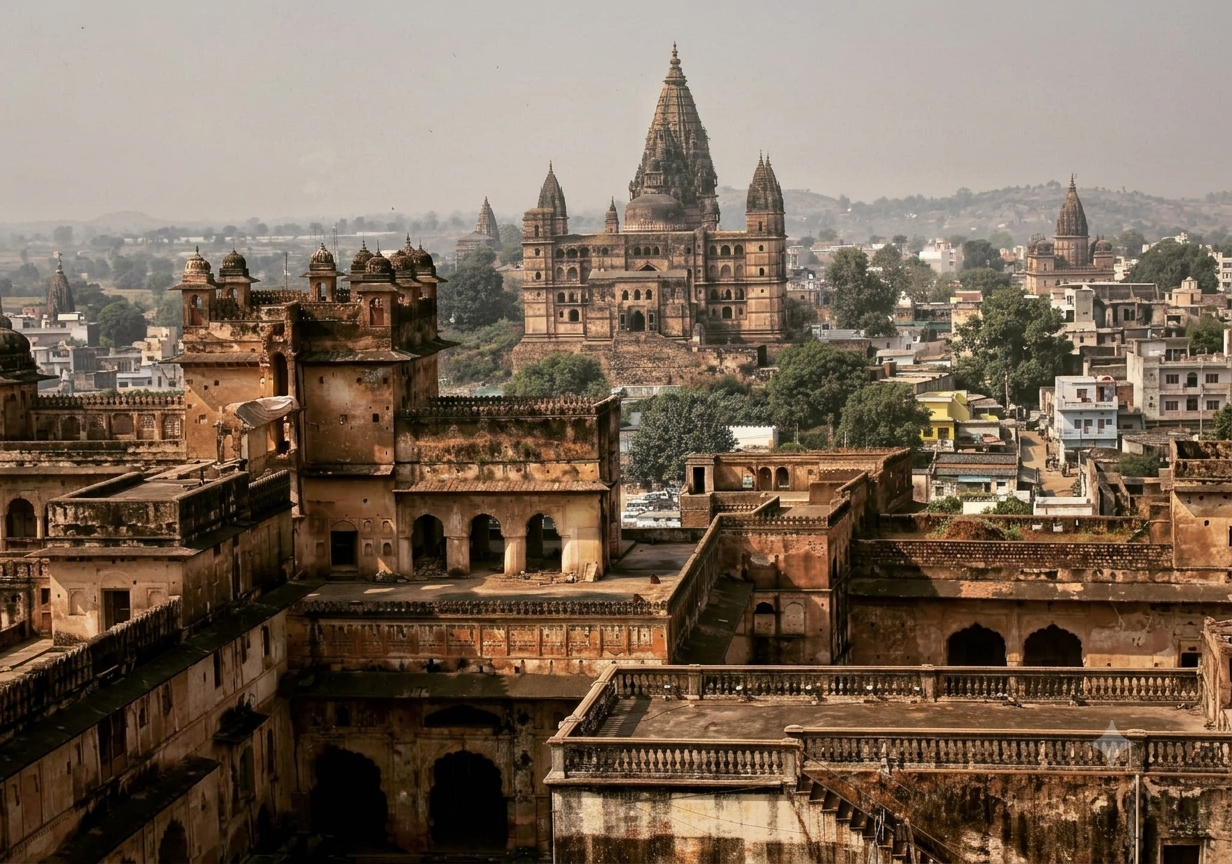
Approaching Orchha, the first striking impression is of magnificent structures rising unexpectedly from a small, quiet town. The architecture is genuinely unique—a remarkable fusion of Hindu temple design with Islamic palatial traditions, creating something that belongs entirely to the Bundela kingdom's distinctive aesthetic vision. This architectural eclecticism reflects the Bundela court's cosmopolitan character and artistic openness.
The Orchha Fort Complex showcases this architectural brilliance. Unlike military fortresses designed purely for defense, Orchha's fort incorporates palatial elegance alongside functional strength. Massive walls constructed from stone rise dramatically, yet they're adorned with delicate carvings and ornamental details. The gates are imposing yet welcoming. The overall impression is of power expressed through beauty rather than aggression.
The Palace Structures—Raj Mahal, Jehangiri Mahal, Rai Mahal—showcase extraordinary architectural innovation. Multi-storied structures feature arched windows, latticed screens, and carved balconies arranged in harmonious proportions. The interiors reveal sophisticated understanding of ventilation, light management, and spatial organization. Every element—from the placement of windows to the curve of arches—reflects deliberate architectural thinking rather than arbitrary decoration.
The Temple Designs display unique characteristics. Rather than following strict orthodox temple architecture, Orchha temples incorporate palatial elements—ornate towers with decorative details, intricate stone carvings, elaborate entrance gateways. The Ram Raja Temple, perhaps Orchha's most significant religious structure, showcases this fascinating architectural hybridity.
✨ The Treasures Within These Stone Walls
The Jahangiri Mahal (Emperor Jehangir's Palace) stands as one of Orchha's most impressive structures. Built around 1605 to commemorate Mughal emperor Jehangir's visit, this palatial complex features intricate stone carvings, latticed screens, and multi-tiered balconies. The palace reveals how Bundela rulers engaged with Mughal culture while maintaining their distinct architectural identity. Walking through its chambers, you encounter spaces designed for royal comfort—rooms with clever ventilation systems, courtyards designed for specific seasons, passages that guide cool air through the structure during scorching summers.
The Raj Mahal (Royal Palace) showcases Bundela architectural magnificence at its grandest. This massive palace complex spreads across several levels, revealing layers of rooms, courtyards, and passages. The architectural arrangement tells stories—royal chambers occupied the highest levels, administrative spaces occupied designated areas, living quarters for attendants occupied specific wings. The entire structure was designed as a functioning city within walls.
The Cenotaphs (Chattris) deserve particular attention. These ornate stone structures commemorating deceased rulers display extraordinary carving and architectural finesse. The chattris dot the landscape, each one a monument to a different ruler, each one showcasing unique architectural characteristics and artistic vision. Together, they create a landscape of memory and commemoration.
The Ram Raja Temple remains an active place of worship, which distinguishes it from many heritage temples that function primarily as tourist attractions. The daily rituals, the chanting of priests, the fragrance of flowers—these living spiritual practices give the temple authentic resonance beyond architectural appreciation.
🌿 A Living Medieval Town
What profoundly distinguishes Orchha is its authentic living character. Unlike heritage sites where local populations have been displaced to accommodate tourism, Orchha's residents have remained. Local families inhabit the palaces, temples serve worshipping communities, the town's rhythms continue unaltered by tourism infrastructure. This living presence means Orchha isn't a museum but a functioning settlement where the past and present coexist without self-consciousness.
Walking Orchha's lanes, you encounter schoolchildren playing near 500-year-old walls, vendors selling flowers for temple offerings, women drawing water from ancient wells, families preparing meals in medieval kitchens. These everyday activities, happening amidst extraordinary architecture, create something rare—heritage appreciated in context, history lived rather than studied.
📅 Best Time to Visit
October to March offers ideal weather—cool mornings and pleasant afternoons make exploration comfortable and rewarding. April to May brings intense heat, though early morning visits are manageable. Monsoon (June-September) transforms the landscape with lush greenery and occasionally causes water accumulation in low areas. November-January is particularly magical—cool weather and clear skies create ideal conditions for photography and exploration.
🚗 How to Get There
Orchha is located in Madhya Pradesh, approximately 120 kilometers from Gwalior and 245 kilometers from Bhopal. The nearest railway station is at Jhansi (8 kilometers away), connected to major cities like Delhi, Agra, and Bhopal. Orchha is easily accessible by taxi or auto-rickshaw from Jhansi (15-20 minute drive). The town can also be reached by road from Agra and Gwalior.
Plan 2-3 hours minimum to explore Orchha's central monuments. A full day allows comprehensive exploration of all palaces, temples, and cenotaphs.
📍 Nearby Places Worth Exploring
Jhansi Fort (8 kilometers away) showcases impressive military architecture and houses the Museum of Jhansi. Khajuraho Temples (110 kilometers) display extraordinary erotic architecture and intricate stone carvings. Chanderi (90 kilometers) is famous for traditional silk weaving and historical monuments. Datia Palace (40 kilometers) showcases Bundela architectural traditions.
🎒 A Few Travel Tips
Wear comfortable shoes—Orchha's lanes involve considerable walking over uneven stone paths. Carry water and sun protection. Respect the living temples; remove shoes when entering and dress modestly (cover shoulders and knees). Photography is generally permitted but check before photographing inside active temples. Guides are available and invaluable—they share stories and architectural insights that transform simple sightseeing into genuine understanding. Stay overnight if possible; Orchha's evenings offer magical quietness as tourists depart and local life continues.
❤️ Why You Simply Must Visit Orchha
Orchha represents something increasingly rare—a medieval town that remains authentically itself. It's where architectural brilliance isn't displayed in isolated monuments but integrated into the fabric of a living community. Where history isn't performed for tourists but genuinely lived by inhabitants who maintain traditions across centuries.
Standing in Orchha's courtyards, surrounded by 500-year-old stones while peacocks cry overhead and the Betwa River flows gently beside, you understand that some places transcend the category of "tourist destination" to become something more profound—a window into how humans have built communities, created beauty, and maintained culture across centuries without waiting for outside appreciation or validation.
Walk Orchha's authentic lanes. Sit in its quiet courtyards. Watch locals go about their daily lives amidst extraordinary architecture. Understand why this small medieval town, bypassed by modern India's rapid development, remains one of the subcontinent's most enchanting destinations—not because of tourism infrastructure but precisely because it lacks it.