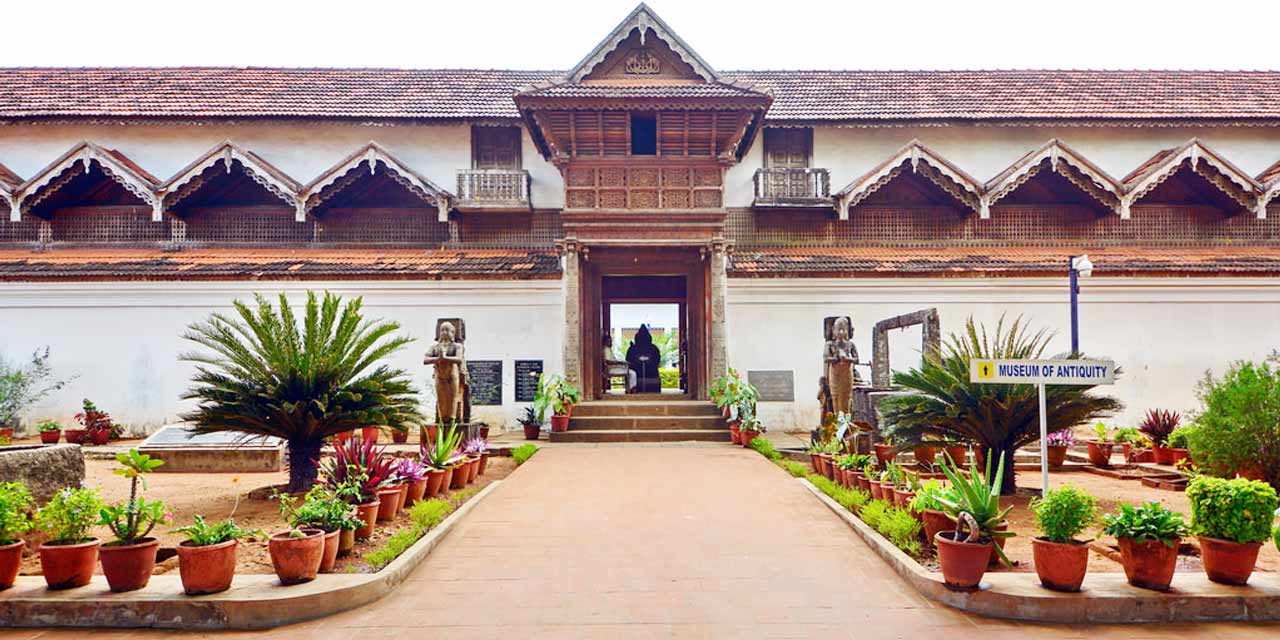
Padmanabhapuram Palace: South India's Hidden Architectural Gem
There are palaces that announce themselves through marble, gold, and sheer imposing scale. And then there is Padmanabhapuram — a palace that whispers its grandeur through carved teak, painted ceilings, and rooms that seem to hold the warmth of centuries within their timber walls. Padmanabhapuram Palace is the oldest, largest, and best-preserved surviving example representative of traditional wooden architecture in India. Sitting at the foot of the Western Ghats in the Kanyakumari district of Tamil Nadu, yet administered by the Government of Kerala, it is a place that defies easy categorisation — and that, in many ways, is exactly what makes it so compelling.
🏛️ Padmanabhapuram Palace: The Wooden Wonder at the Edge of Two States
There are palaces that announce themselves through marble, gold, and sheer imposing scale. And then there is Padmanabhapuram — a palace that whispers its grandeur through carved teak, painted ceilings, and rooms that seem to hold the warmth of centuries within their timber walls. Padmanabhapuram Palace is the oldest, largest, and best-preserved surviving example representative of traditional wooden architecture in India. Sitting at the foot of the Western Ghats in the Kanyakumari district of Tamil Nadu, yet administered by the Government of Kerala, it is a place that defies easy categorisation — and that, in many ways, is exactly what makes it so compelling.
Spanning over 6.5 acres of land, Padmanabhapuram Palace proudly holds the title of one of Asia's largest wooden palaces. It was once the beating heart of the Travancore kingdom, a seat of royal power that shaped the southern tip of the Indian peninsula for nearly two centuries. Today, it draws visitors from across India and the world who come for the architecture and leave with the feeling that they have touched something genuinely rare.
🙏 The Name and Its Sacred Meaning
The name Padmanabhapuram carries a story of royal devotion within it. King Marthaanda Varma dedicated the kingdom to his family deity Sree Padmanabha, a form of Lord Vishnu, and ruled the kingdom as Padmanabha Dasa — servant of Lord Padmanabha. Hence the name Padmanabhapuram, meaning "City of Lord Padmanabha." Before Marthanda Varma renamed it in 1744, the palace and its surrounding town were known simply as Kalkulam — a name that still survives in certain administrative contexts today.
📜 History: Four Centuries of Travancore Power
The story of Padmanabhapuram Palace begins in the final years of the 16th century, when the Venad kingdom — the precursor to the state of Travancore — chose this location as its capital.
The palace was constructed around 1601 CE by Iravi Varma Kulasekhara Perumal, who ruled Venad between 1592 and 1609. The site was chosen with strategic care: the location was strategically chosen for its protective terrain, with the Western Ghats providing a natural barrier to the east and the surrounding granite fortress adding a man-made layer of defence.
The palace might have remained a modest royal residence had it not been for the arrival of one of South India's most consequential rulers. The founder of modern Travancore, King Anizham Thirunal Marthanda Varma (1706–1758), who ruled Travancore from 1729 to 1758, rebuilt the palace in around 1750. Under his vision, what had been a functional royal residence was transformed into a complex worthy of an empire — expanded, renovated, and renamed to reflect his spiritual devotion to Lord Padmanabha.
Padmanabhapuram was the ancient capital of the erstwhile Travancore State from about 1555 CE to the latter half of the 18th century. The region of ancient Travancore extended from Marthandom in present-day Tamil Nadu in the south to Cochin in Kerala in the north, covering an area of 2,600 sq. km.
The palace's reign as capital came to an end in 1795, when Maharaja Karthika Thirunal Rama Varma decided to move the capital to Thiruvananthapuram, driven by strategic, administrative, and economic reasons — Thiruvananthapuram offered better access to trade routes and coastal regions. Without its role as capital, Padmanabhapuram gradually declined. British forces occupied its fortifications in 1809, and by the mid-19th century, its halls had grown quiet.
The palace's modern chapter began in the 1930s, when Sree Chithira Thirunal Balarama Varma, the last king of Travancore, collaborated with the archaeology department to restore and preserve the palace as a museum complex. Today it is maintained by the Department of Archaeology, Government of Kerala — an unusual arrangement that places a palace in Tamil Nadu under Kerala's custodianship, a legacy of the state's historical boundaries that remain unchanged even after India's post-independence reorganisation.
🏗️ Architecture: The Genius of Wood and Stone
To walk through Padmanabhapuram Palace is to receive an education in a building tradition that has no close equivalent anywhere else in India.
The palace structure is constructed out of wood with laterite (locally available building stone) used very minimally for plinths and for a few select walls. The roof structure is constructed out of timber, covered with clay tiles. This is not austerity or limitation — it is the highest expression of a regional craft tradition that developed over centuries in Kerala's timber-rich landscape.
The exterior of the palace reflects the architectural idiom of ancient Kerala: roofs with triangular gables, carved wooden pillars and screens, latticed wooden windows, cool and ventilated rooms and corridors, and intricately carved wooden beams. Every element was designed for the climate — the deep overhanging eaves shade interiors from the fierce South Indian sun, while the latticed windows allow cross-breezes that cool without the need for any mechanical intervention. This is passive climate control refined to an art form.
The palace is a product of the fusion of traditional building technology, exquisite craftsmanship, and superior knowledge of material science, bearing living testimony to traditional timber architecture with strict adherence to the traditional building code, the Taccusastra, which has clear prescriptions for every aspect of a structure's function.
One particularly striking contrast within the complex is the Navarathri Mandapam (Dance Hall), built in 1744. The marvellously sculpted granite structures of the Navarathri Mandapam and the Saraswathy Temple, with decorated pillars and graceful figurines, are in stark contrast to the simplicity of the rest of the wooden structures in the palace complex. These are reminiscent of Vijayanagara style architecture. The unexpected appearance of Vijayanagara-style granite carving within a predominantly wooden complex reveals the cosmopolitan cultural influences that shaped Travancore's royal court.
The later additions showcase the changing styles in architecture with the influence of the Portuguese and the Dutch, while the uniformity of style is maintained throughout, with variety achieved in differences in the details of decorative motifs.
🏰 Notable Structures Within the Complex
Padmanabhapuram Palace complex consists of fourteen palaces spread over an area of 6.5 acres. Each structure tells a different story about royal life.
The Uppirikka Malika — the multi-storeyed tower — is perhaps the most architecturally dramatic building in the complex. Built in 1745 by King Marthanda Varma, the ground floor of this building housed the coveted Travancore royal treasury. Above the treasury was the king's bedchamber, wherein lies the famous Sapramancha Kattil — a grand poster bed supposedly made from 64 types of medicinal timber. A stair from the king's room leads to his fasting chambers, where the king resided during periods of devotional fasting. The building carries a vertical narrative of power, prayer, and private life, stacked one atop the other.
The murals at the Padmanabhapuram Palace are the best preserved in the state, executed in the traditional style invoking rich and vivid realism and infusing grace and beauty into the figures. The topmost floor of the Uppirikka Malika displays murals whose quality and preservation level is extraordinary — large-scale compositions depicting scenes from Hindu mythology, painted in the same visual idiom as the murals at Padmanabhaswamy Temple in Thiruvananthapuram.
The Thai Kottaram (Queen Mother's Palace) is the oldest surviving structure in the complex and features beautifully painted ceilings. The Poomukha Malika greets visitors with a triangular entrance arch and a wooden ceiling featuring 90 different floral carvings, showcasing intricate craftsmanship. The Mantrasala (King's Council Chamber) and the Nataksala (Performance Hall) give a sense of how public and ceremonial life was organised within the palace.
✨ Legends, Unique Facts, and Curiosities
Few places in South India accumulate as many fascinating details as Padmanabhapuram. The medicinal bed in the king's chamber — crafted from 64 different types of therapeutic wood — represents a convergence of royal luxury and Ayurvedic wisdom that is almost entirely unique. The museum within the complex holds remarkable objects: single wood pillars, stone sculptures, beautiful wooden sculptures like a Veena-bearing Saraswati, ancient stone inscriptions, copper plates, weapons, Chinese jars, Belgian mirrors, and the Sapramancha Kattil.
The Chinese jars are particularly intriguing — gifts from Chinese merchants to the Travancore kings, they hint at a trade network that stretched across the Bay of Bengal and the Indian Ocean, connecting this remote corner of South India to the wider world of medieval commerce. The Belgian mirrors, meanwhile, are a reminder that European trade influence reached the Travancore court long before the British political dominance that followed.
🕒 Day and Time
Opening Hours
The palace is open Tuesday to Sunday, 9:00 AM to 4:30 PM (closed on Mondays and national holidays).
Entry Information
Entry fees are modest, with separate rates for Indian adults, children, and foreign visitors. Photography charges apply for cameras and video equipment.
Best Time to Visit
The best time to visit Padmanabhapuram Palace is October to March, when the Kanyakumari district's weather is at its most pleasant and conducive to extended exploration.
The monsoon months (June to September) bring heavy rainfall to the Western Ghats, which can make the grounds muddy, though the lush greenery surrounding the palace becomes spectacular. Avoid the peak summer months of April and May when the heat can be intense.
🌏 Why Padmanabhapuram Belongs on Every South India Itinerary
Padmanabhapuram Palace is conveniently located en route to Kanyakumari, the southernmost tip of India, making it easy to combine with a visit to the Vivekananda Rock Memorial and the Thiruvalluvar Statue. This location advantage means the palace rarely exists in isolation on a travel itinerary — and yet, for those who give it proper time, it consistently overshadows many of its more famous neighbours.
For domestic travellers, particularly those from Kerala, Padmanabhapuram carries an almost emotional resonance — a physical connection to the Travancore kingdom whose legacy shapes everything from the state's religious culture to its administrative ethos. For international visitors, particularly those interested in vernacular architecture, wood craftsmanship, or the political history of South India's princely states, it offers something that no other site in the country quite replicates.