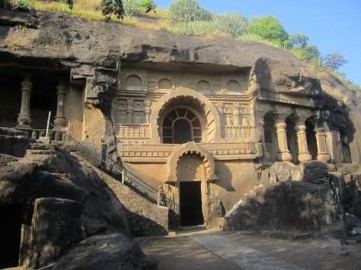
Pandavleni Caves: A Window into 2,000 Years of Buddhist History
Tucked into the rocky slopes of Trirashmi Hill on the southern edge of Nashik, the Pandavleni Caves are one of India's most compelling yet understated heritage sites. Also known as the Trirashmi Caves or Nasik Caves, this cluster of 24 rock-cut sanctuaries offers a window into more than two thousand years of Buddhist history, royal patronage, and extraordinary craftsmanship — all carved directly from basaltic rock by human hands. For anyone drawn to ancient architecture, spiritual history, or simply the beauty of something enduring, the Pandavleni Caves are a destination that leaves a lasting impression.
🏛️ Pandavleni Caves, Nashik: A Complete Guide to Maharashtra's Ancient Buddhist Marvel
⛰️ One of India's most compelling yet understated heritage sites.
📍 Location
Tucked into the rocky slopes of Trirashmi Hill on the southern edge of Nashik.
🏺 Heritage
A cluster of 24 rock-cut sanctuaries offering a window into more than two thousand years of Buddhist history.
⏳ Timeline
The construction of the Pandavleni Caves spanned several centuries, beginning around 250 BCE and continuing through to roughly 600 CE.
Pandavleni Caves, Nashik: A Complete Guide to Maharashtra's Ancient Buddhist Marvel
Tucked into the rocky slopes of Trirashmi Hill on the southern edge of Nashik, the Pandavleni Caves are one of India's most compelling yet understated heritage sites. Also known as the Trirashmi Caves or Nasik Caves, this cluster of 24 rock-cut sanctuaries offers a window into more than two thousand years of Buddhist history, royal patronage, and extraordinary craftsmanship — all carved directly from basaltic rock by human hands. For anyone drawn to ancient architecture, spiritual history, or simply the beauty of something enduring, the Pandavleni Caves are a destination that leaves a lasting impression.
📖 A Name Rooted in Legend
The word "Pandavleni" translates loosely from Marathi as "caves of the Pandavas," a nod to the heroes of the Mahabharata.
Local tradition holds that the five Pandava brothers once sought refuge within these rocky chambers during their years of exile. The story has persisted through generations, and while archaeologists have long established that these caves were actually built by Buddhist monks and their royal patrons, the mythological connection adds a certain romance to the site that visitors still find compelling.
The more ancient name, Trirashmi, meaning "triple royal," reflects the political reality of the era — these caves were shaped under the influence of not one but several powerful dynasties.
🏛️ History: Three Dynasties, One Sacred Hill
The construction of the Pandavleni Caves spanned several centuries, beginning around 250 BCE and continuing through to roughly 600 CE. This extended timeline means the caves are not the product of a single vision, but a layered accumulation of faith, ambition, and artistry across generations.
The earliest caves are associated with the Satavahana dynasty, rulers who were among the most significant patrons of Buddhism in the Deccan region. Cave 3 — the grandest of the complex — was dedicated by Queen Gotami Balasiri, mother of the celebrated Satavahana king Gautamiputra Satakarni, in the 2nd century BCE. Other inscriptions within the complex mention rulers including Vashishthiputra Pulumavi and Sri Yajna Satakarni, the last powerful Satavahana king.
The Kshaharatas (or Western Kshatrapas), a dynasty of Indo-Scythian origin, also played a significant role. Cave 10, known as Nahapana Vihara, was built by the Kshatrapa ruler Nahapana around 120 CE. It contains six inscriptions from his family and is considered one of the oldest and finest caves in the entire complex — often compared in quality to the celebrated Karla Caves near Lonavala.
Later, the Abhiras added to this already rich tapestry. Taken together, these three dynasties gave the Pandavleni Caves their remarkable historical depth and variety.
The site was first formally documented by Captain James Delamaine of the British East India Company in 1823, and today it is protected by the Archaeological Survey of India (ASI). In recent years, ASI archaeologists made an exciting discovery: three previously unknown caves were found within the Trirashmi complex, underlining that this hill still holds secrets.
🏗️ Architecture and Artistic Excellence
The Pandavleni Caves are considered among the finest surviving examples of Hinayana (Theravada) Buddhist rock-cut architecture in India.
Of the 24 caves, 23 are viharas — monastic dwellings where Buddhist monks lived, meditated, and studied.
They typically feature narrow verandas, stone-cut sleeping platforms, small cells for monks, and communal halls.
The one exception is Cave 18, the complex's only chaitya (prayer hall), which boasts an elaborately carved facade and remains one of the most visually striking spaces in the entire site.
Cave 3 is the crown jewel: the largest and most elaborate vihara, with a grand doorway, a central prayer hall, multiple cells, a large carved stupa, and a remarkable collection of sculpted idols.
Cave 20 is also noteworthy — its hall measures over 60 feet in depth, flanked by colossal dvarapalas (guardian figures) standing nearly 9.5 feet tall.
The carvings throughout the complex reflect a mastery of working with hard basaltic rock.
Worth noting is the site's sophisticated water management system. Cisterns and drainage channels were carved directly into the rock to harvest rainwater, demonstrating that the monks who lived here understood engineering as well as spirituality.
Adding another dimension to the site, later additions include sculptures of Jain Tirthankaras such as Rishabhdeo and Ambikadevi, as well as some Hindu imagery, reflecting the religious plurality that gradually emerged at the site over centuries.
🪨 Inscriptions: History Written in Stone
One of the Pandavleni Caves' most significant contributions to scholarship is its collection of ancient inscriptions.
Found in Caves 3, 10, 11, 12, 13, 14, 15, 19, and 20, these texts — many written in Brahmi script — record the names of kings, queens, merchants, and even ordinary fishermen who donated to the monastic community.
Cave 8's inscription records a donation from a fisherman named Mugudasa, while Cave 7 credits a female ascetic named Tapasini.
The cave's north-facing orientation has been key to their survival. Protected from south-westerly monsoon rains and direct sunlight, the carvings and inscriptions remain remarkably well-preserved after nearly 2,000 years.
🚶 The Visitor Experience
Arriving at the base of Trirashmi Hill, visitors are greeted by lush greenery and a peaceful atmosphere — a pleasant contrast to the bustle of nearby Nashik city.
The climb to the caves involves approximately 200 stone steps, a moderate ascent that takes around 15 to 20 minutes and rewards the effort with sweeping panoramic views of the Nashik valley.
Inside the caves, the atmosphere shifts entirely.
A typical visit, including the climb and exploration of all 24 caves, takes around 2 to 3 hours.
Entry fees are minimal (₹5 per person), making this one of the most accessible heritage sites in Maharashtra.
The caves are open daily from 8 AM to 6 PM.
At the base of the hill, visitors can also explore the Dadasaheb Phalke Smarak, a memorial museum dedicated to the pioneer of Indian cinema, adding a surprisingly cinematic footnote to what is primarily an ancient Buddhist pilgrimage.
🌤️ Best Time to Visit
The ideal window for visiting the Pandavleni Caves is October to March, when Nashik's weather is cool and comfortable.
The monsoon months (June to September) bring heavy rainfall and can make the stone steps slippery, though the surrounding greenery is at its most vivid during this period.
Summer (April to June) can be quite hot.
🌍 Why Pandavleni Caves Matter for Heritage Tourism
The Pandavleni Caves occupy a unique position in India's heritage landscape.
They are neither as famous as Ajanta nor as visited as Ellora, yet they represent an earlier phase of the same artistic and spiritual tradition — one that helped shape the entire trajectory of Buddhist art in India.
For domestic travelers, the site offers a rare and affordable encounter with living history.
For international visitors — particularly those with an interest in Buddhism, ancient architecture, or South Asian history — Pandavleni provides an experience that feels genuinely off the beaten path.
The caves also fit naturally into a broader Nashik itinerary.
The sacred Ramkund on the Godavari River, the Kalaram Temple, Panchvati (associated with the Ramayana), and the vineyards of Sula are all within easy reach — making Nashik a destination that layers spiritual, historical, and contemporary culture with unusual ease.
🚗 Getting There
The Pandavleni Caves are located approximately 8 kilometers south of Nashik city, along the Trimbak Road.
Taxis, autos, and local buses connect the city to the site with ease, and the base of the hill has parking facilities for those traveling by private vehicle.
Whether you are a history enthusiast tracing the roots of Indian Buddhism, an architecture lover marveling at ancient rock-cut precision, or a curious traveler looking for something beyond the ordinary, the Pandavleni Caves of Nashik deliver on every level. These silent stone chambers have endured wars, dynastic changes, monsoons, and centuries — and they still have much to say.