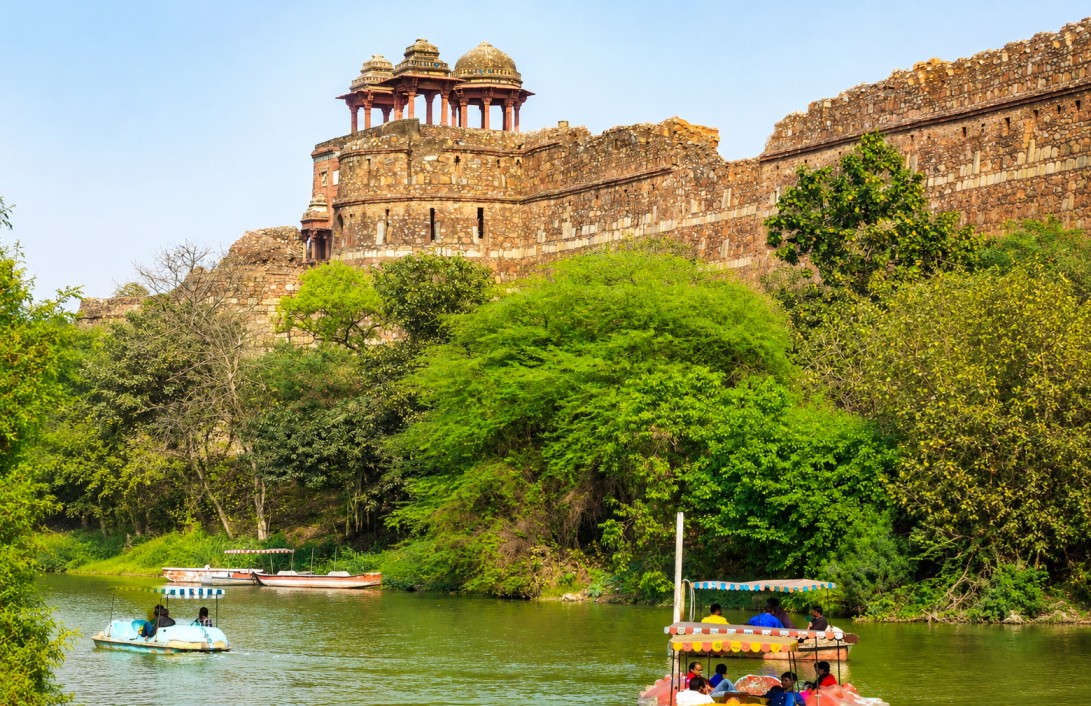
Purana Qila : Where History Comes Alive
Standing on the banks of the Yamuna River, Purana Qila — meaning "Old Fort" — is one of Delhi's most ancient and evocative monuments. Long before the British laid the first stone of New Delhi, before the Mughals built their grand walled cities, this site was already steeped in history stretching back thousands of years. For anyone drawn to India's layered past, Purana Qila offers a rare, almost humbling encounter with civilizations that rose and fell across the same patch of earth
🏰 Purana Qila: Delhi's Oldest Fortress and Its Timeless Legacy
Standing on the banks of the Yamuna River, Purana Qila — meaning "Old Fort" — is one of Delhi's most ancient and evocative monuments. Long before the British laid the first stone of New Delhi, before the Mughals built their grand walled cities, this site was already steeped in history stretching back thousands of years. For anyone drawn to India's layered past, Purana Qila offers a rare, almost humbling encounter with civilizations that rose and fell across the same patch of earth.
📍 A Location Steeped in Myth and Memory
Situated near Mathura Road in central Delhi, Purana Qila overlooks a wide moat that now serves as a boating lake. The fort's massive red sandstone walls rise dramatically against the city skyline, creating a striking contrast between ancient stone and the modern metropolis surrounding it. The Archaeological Survey of India (ASI) manages the site today, and a small but well-curated museum within the complex helps visitors piece together its long and layered story.
What makes this location particularly fascinating is its possible connection to Indraprastha — the legendary capital of the Pandavas from the epic Mahabharata. Excavations at the site have unearthed painted grey ware pottery dating back to around 1000 BCE, lending tantalizing archaeological weight to what many once dismissed as myth. Whether or not Indraprastha truly stood here, the site's continuous human occupation for over three millennia is itself extraordinary.
📜 History and Origins: From Humayun to Sher Shah Suri
The fort as it stands today owes its construction to two rival emperors: Mughal Emperor Humayun and Sher Shah Suri, the Afghan ruler who briefly wrested the throne from him. Humayun began building his new capital, Dinpanah, at this site around 1533 CE. His grand vision for a walled city was interrupted when Sher Shah Suri defeated him in 1540, sending Humayun into exile in Persia.
Sher Shah, who proved to be not only a formidable military commander but also a gifted administrator, took over the construction project and significantly expanded and fortified the complex. He renamed it Shergarh and added several structures that blended Afghan and early Mughal architectural sensibilities. After Humayun's return and Sher Shah's death, the Mughals reclaimed the fort, though Humayun himself died in 1556 — shortly after regaining power — when he fell down the steps of the fort's library building.
🏛️ Architectural Highlights: Grandeur in Red Sandstone
Purana Qila's architecture reflects a transitional moment in Indian history — a meeting point between the robust Afghan style and the refined elegance that would later define Mughal craftsmanship under Akbar, Jahangir, and Shah Jahan.
🕌 Qila-i-Kuhna Mosque
The finest structure within the complex is the Qila-i-Kuhna Mosque, built by Sher Shah Suri in 1541. It is considered one of the most important early examples of Mughal-era mosque architecture in India. The mosque features five graceful arched bays, intricate marble inlay work, red sandstone panels with white marble detailing, and elegant calligraphy carved into stone — elements that foreshadow the architectural vocabulary Mughal builders would refine over the next century. The prayer hall is harmonious and serene, with a quiet dignity that stops most visitors in their tracks.
🏯 Sher Mandal
Rising on a low platform nearby is the Sher Mandal, an octagonal red sandstone tower that Sher Shah used as a pleasure pavilion. Later, Humayun converted it into his personal library. It was on the narrow stairs of this very tower that Humayun slipped and fell to his death in January 1556 — one of history's more poignant ironies, ending a reign that had barely restarted. The Sher Mandal is modest in scale but enormous in historical significance.
🚪 The Fortification Walls and Gateways
The fort's massive defensive walls stretch for nearly two kilometres, punctuated by three monumental gateways — the Bara Darwaza (Great Gate) to the west, the Humayun Darwaza to the south, and the Talaqi Darwaza (Forbidden Gate) to the north. The gateways are adorned with geometric tile work, projecting balconies, and chattris (kiosk-like domed pavilions) — all hallmarks of the Indo-Afghan architectural style.
🏺 Cultural Importance and Historical Echoes
Purana Qila is more than a collection of old stones. It represents the tug-of-war between empires, the resilience of ideas across centuries, and the physical overlap of legend and history. The fort witnessed the power struggles of the Sur dynasty, the fall and return of the Mughals, and in the 20th century served as a refugee camp during the traumatic partition of India in 1947, when hundreds of thousands of displaced people sheltered within its ancient walls.
The Archaeological Museum inside the fort displays finds from excavations — pottery shards, terracotta figurines, coins, and other artefacts — tracing habitation at this site across many centuries and cultures.
🎒 Visiting Purana Qila: What to Expect
A visit to Purana Qila rewards both casual tourists and serious history enthusiasts. The sprawling grounds feel surprisingly unhurried compared to the city's chaos just outside the walls. Families picnic on the lawns, couples walk the shaded pathways, and photographers find endless compositions in the play of light on weathered sandstone.
The moat boating facility is especially popular with families and children. The calm water reflects the fort walls beautifully during the golden hours of morning and late afternoon.
Every evening, a Sound and Light Show narrates the fort's history through dramatic lighting and recorded narration — an atmospheric way to absorb centuries of Delhi's past in under an hour.
📅 Best Time to Visit
Best time to visit: October through March, when Delhi's weather is cool and pleasant. Early mornings offer soft light and fewer crowds, ideal for photography.
🌏 Why Purana Qila Matters for Heritage Tourism
For international travellers exploring Delhi's many historical layers, Purana Qila offers something the more famous Red Fort or Qutub Minar cannot quite replicate: a sense of unbroken time. Here, the Mughal, Afghan, and possibly Vedic-era pasts coexist on the same ground. Domestic tourists, especially school groups and history students, find it an accessible introduction to Delhi's pre-colonial identity.
As India continues to grow as a heritage tourism destination, sites like Purana Qila — complex, layered, and deeply human in their stories — are increasingly valued by travellers seeking depth over spectacle. Whether you come for the archaeology, the architecture, the legends, or simply the quiet beauty of a green park framed by ancient walls, Purana Qila delivers something genuine and lasting.