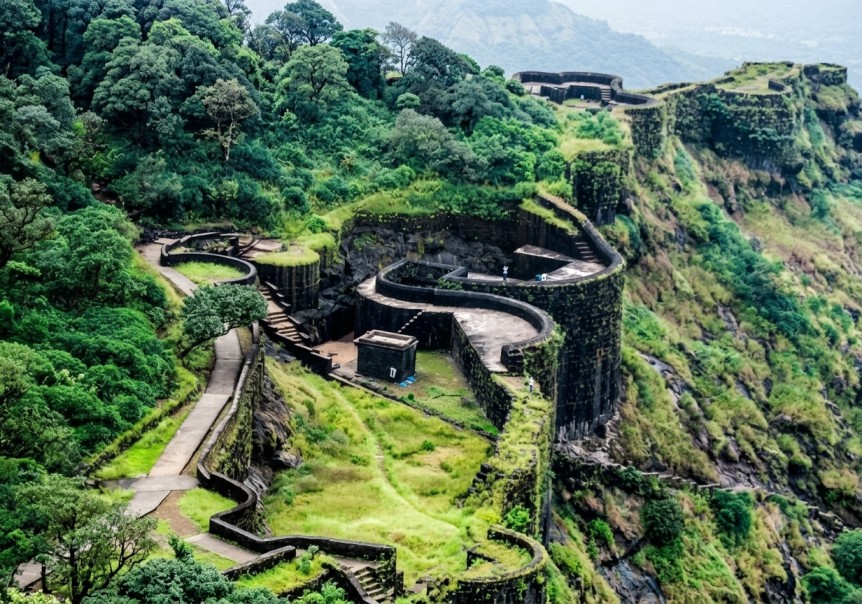
Raigad Fort: Gateway to Maratha Heritage
Imagine standing at the edge of a cloud, the valley below swallowed by mist, a cool wind carrying the faint echo of war drums that no longer beat. Beneath your feet, ancient stone — worn smooth by centuries of devotion, ambition, and sacrifice. That's Raigarh Fort for you — not just a historical monument, but a living legend. Perched at an altitude of about 820 metres above sea level in the Sahyadri range of Maharashtra, this magnificent hill fortress was once the capital of the Maratha Empire. Warriors called it "the Gibraltar of the East," and the moment you set eyes on its sheer ramparts rising from the jungle, you'll understand why.
Imagine standing at the edge of a cloud, the valley below swallowed by mist, a cool wind carrying the faint echo of war drums that no longer beat. Beneath your feet, ancient stone — worn smooth by centuries of devotion, ambition, and sacrifice. That's Raigarh Fort for you — not just a historical monument, but a living legend. Perched at an altitude of about 820 metres above sea level in the Sahyadri range of Maharashtra, this magnificent hill fortress was once the capital of the Maratha Empire. Warriors called it "the Gibraltar of the East," and the moment you set eyes on its sheer ramparts rising from the jungle, you'll understand why.
📜 A Little Bit of History First
Raigarh's story is as grand and turbulent as the empire it once commanded. Originally known as Rairi, the fort existed long before Chhatrapati Shivaji Maharaj transformed it into his crowning glory. In 1656, Shivaji captured it from the Chandrarao More family and immediately recognised its near-impossible natural position — surrounded on all sides by steep cliffs, accessible only through a handful of treacherous mountain paths.
He renamed it Raigarh — meaning "Fort of the King" — and undertook a massive reconstruction, adding palaces, granaries, water cisterns, market streets, and temples, all at an elevation that seemed to defy the heavens.
In 1674, in one of the most momentous events in Indian history, Shivaji was crowned Chhatrapati (Emperor) of the Maratha Kingdom right here on this fort. It was a declaration to the Mughal Empire and the world: a new power had risen.
Raigarh remained the Maratha capital until 1689, when Mughal forces under Aurangzeb besieged and captured it following Shivaji's death. Though the fort changed hands several times afterward, its soul has always belonged to the Marathas.
✨ The Attractions That Will Leave You Breathless
The Maha Darwaja (Grand Gate) is your first encounter with Raigarh's power. This enormous fortified entrance, flanked by two watchtowers, once stood as the first line of defence and still commands awe with its sheer scale. Walking through it feels like stepping across centuries.
At the heart of the fort lies the Coronation Throne — the very spot where Shivaji Maharaj was crowned in 1674. A simple stone platform, yet standing on it sends a chill down your spine. A modern statue of the great king stands nearby, sword raised, facing the horizon he once claimed.
The Jagdishwar Temple, built by Shivaji himself, remains an active place of worship even today. Its carved stonework and peaceful courtyard provide a meditative contrast to the martial grandeur surrounding it. Close by is the Samadhi of Shivaji Maharaj, the king's tomb, where thousands of devotees come to pay their respects every year.
Don't miss the Queen's Palace ruins (Rani Mahal), the market street (Bazar Peth) where traders once hawked goods at the very top of a mountain, and the remarkable series of rock-cut cisterns that stored fresh water for the fort's entire population.
The Takmak Tok, a cliff edge from which traitors were historically thrown, offers both a sobering history lesson and one of the most dramatic views in all of Maharashtra.
🎭 Culture, People, and the Spirit of Raigarh
The villages nestling around the base of Raigarh — particularly Pachad and Mahad — are steeped in Maratha pride. Locals celebrate Shivaji Jayanti here with remarkable enthusiasm: processions, folk music, and a collective reverence that feels deeply personal, not merely ceremonial.
The region speaks Marathi with warmth, and visitors are almost always greeted with generous hospitality.
For food, the area around Mahad offers simple, nourishing Maharashtra fare — Misal Pav, Bhakri with thecha (spicy garlic chutney), and freshly made Sol Kadhi to cool you after the climb. Small dhabas along the route serve hot tea that tastes inexplicably perfect at altitude.
🌤️ Best Time to Visit
October to February is the ideal window — the skies clear after the monsoon, offering crisp visibility and stunning panoramic views. Monsoon season (June–September) is dramatic and wildly beautiful, with clouds wrapping around the ramparts and waterfalls streaming down the cliffs, though the climb can be slippery. March to May gets warm but remains manageable with an early morning start.
🚗 How to Get There
✈️ By Air
The nearest airport is Pune International Airport, approximately 130 km away, with good connections to Mumbai and other major cities. From Pune, taxis or buses run to Mahad.
🚆 By Rail
The closest railway station is Mahad, about 25 km from the fort's base. Mahad is connected to Mumbai via the Konkan Railway — a scenic route in itself.
🛣️ By Road
Maharashtra State Transport buses connect Mumbai and Pune to Mahad regularly. From Mahad, autos and private vehicles reach the fort's base village. A ropeway (cable car) is also available from Pachad village, making the ascent accessible for those who prefer not to trek.
📍 Nearby Places Worth Exploring
The surrounding Konkan and Sahyadri region is extraordinarily rich. Pratapgarh Fort, about 60 km away, is where Shivaji famously defeated Afzal Khan — an essential companion visit. Mahabaleshwar, the popular hill station, lies about 80 km away. The coastal town of Dapoli and the beaches of Harihareshwar are within a few hours and offer a beautiful contrast to the mountain experience.
🧭 A Few Travel Tips Before You Go
Wear sturdy footwear — the trek up is steep and the stone steps uneven. Carry water and snacks, as facilities on the fort itself are limited. Start your climb early to beat both the heat and the crowds, especially on weekends. If you're visiting during monsoon, a raincoat and waterproof bag are non-negotiables. And please — treat this ground with the reverence it deserves. You are walking where history was made.
❤️ Why You Simply Must Visit Raigarh
Some forts are preserved in stone. Raigarh is preserved in the hearts of an entire people. It's the kind of place where history stops being a chapter in a textbook and becomes something you can feel — in the wind that whips across the ramparts, in the silence of a king's tomb, in the view of a horizon that a great man once believed was worth fighting for.
Whether you're a history enthusiast, a trekker chasing Sahyadri peaks, a student of Indian culture, or simply someone searching for a place that makes the modern world feel very small and very far away — Raigarh will give you something you didn't know you were looking for.
So lace up your boots, fill your water bottle, and climb. The king's fort is waiting.