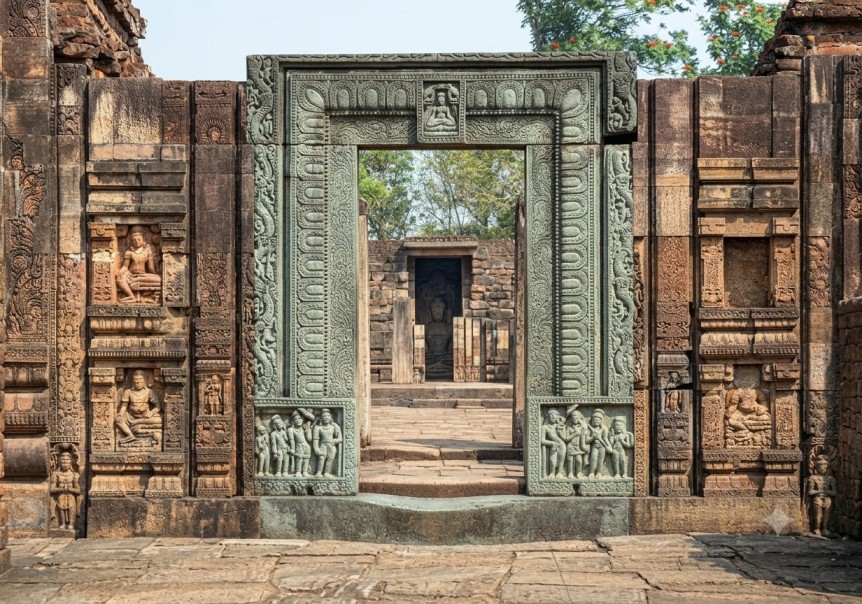
Imagine climbing a quiet hilltop in rural Odisha, where the air smells of red earth and the only sound is the wind whispering through old neem trees — and then suddenly, before you, rises a gateway so intricately carved it stops you in your tracks. Lotus vines curl across its stone face, Bodhisattvas gaze down serenely, and the weight of fifteen centuries presses gently against your chest. That is Ratnagiri — not merely an archaeological site, but a portal into one of India most dazzling and forgotten chapters. Tucked into the Jajpur district of Odisha, on a hilltop between the Brahmani and Birupa rivers, Ratnagiri is one of India& most important Buddhist heritage sites — and yet it remains beautifully, almost mysteriously, off the radar of most travellers.
📜 A Little Bit of History First
The name Ratnagiri comes from Sanskrit — Ratna meaning "jewels" and Giri meaning "hill" — making it, quite literally, the Hill of Jewels. And once you see what lies here, you understand the name completely.
The site flourished as a thriving centre of Mahayana and Vajrayana Buddhism from the 5th to 13th centuries CE, gaining prominence under the Gupta Empire and later under the Bhaumakara dynasty. Some scholars even regard Ratnagiri as a rival to Nalanda as a centre of Buddhist learning, and certain Tibetan texts trace the origins of the Mahayana and Tantrayana sects of Buddhism to this very hilltop. At its peak between the 7th and 10th centuries, this hilltop hummed with the energy of monks, scholars, and pilgrims. After perhaps the 16th century, the site ceased to be used and fell into ruins, little known until major excavations by the Archaeological Survey of India in the 1960s revealed its true magnitude. Tourism Orissa + 2
✨ The Attractions That Will Leave You Breathless
The main attraction is the great monastery — Monastery 1 — whose principal entrance has come to be called "the most beautiful monastery entrance in India." Three layers of carving frame the doorway: an innermost ring of floral vines, a middle band of lotus petals, and an outer frame of plants and flowers. Ratnagiri is also the only monastery in India to have a curvilinear roof. Beyond the doorway unfolds a large central courtyard — once the prayer hall — surrounded by monk cells and a main shrine. Stories by SoumyaOdisha Tourism
The Main Stupa is equally arresting. It is surrounded by more than 700 smaller votive stupas — an exceptionally large number by any global standard — most carved from single pieces of stone and decorated with seated deity figures, lotus petals, and beaded tassels, representing 22 identified deities. Walking among them is an almost meditative experience. Wikipedia
The site has also yielded over two dozen colossal Buddha heads, serene and massive, carved in two striking stone types: a blue-green chlorite and a plum-toned local khondalite, creating a beautiful natural contrast. Alongside these are sculptures of Tara, Avalokiteshvara, and various Vajrayana deities that speak to Ratnagiri& evolution as a centre of Tantric Buddhism. Wikipedia
Don 't miss the on-site Archaeological Museum. It is an absolute treasure trove, spread across four galleries, housing stone sculptures, bronze and brass figurines, terracotta pieces, clay seals that helped identify the site, and inscribed copper plates. This is where the stories hidden in stone finally get to speak. Stories by Soumya
🍲 Culture, People, and Food
Ratnagiri sits in Jajpur district — rural, spiritual, and unhurried. The site features remarkable Hindu-Buddhist syncretic imagery, such as Hariti, a goddess revered by both traditions, carved alongside purely Buddhist iconography — a reminder that religions here did not compete but coexisted. For food, the nearest areas offer simple, honest Odia meals: dal, rice, pakhala (fermented rice water), and khichdi. If you are based in Bhubaneswar for the day trip, the Ekamra Haat is a great spot to pick up pattachitra paintings and tribal crafts as souvenirs. Localdrive
🌤️ Best Time to Visit
The best time to visit Ratnagiri is during the winter months — October to February — when the weather is pleasant and ideal for exploring the open-air ruins. The summer months are best avoided due to heat and humidity. If you visit between 11 AM and 4 PM in any season, carry water, sunscreen, and a hat. The monsoon brings lush green surroundings but can make pathways slippery. Tourism Orissa
🚗 How to Get There
✈️ By Air
The nearest airport is Biju Patnaik International Airport in Bhubaneswar, approximately 100 km from Ratnagiri. It is connected to Delhi, Mumbai, Kolkata, and Bengaluru. A hired cab from Bhubaneswar for a Diamond Triangle day trip is the most convenient option. Tripadvisor
🚆 By Rail
The nearest station is Jajpur-Keonjhar Road, well connected on major lines. From there, local cabs reach Ratnagiri in about 30–40 minutes.
🛣️ By Road
The drive from Bhubaneswar takes roughly 2.5 hours through paddy fields and mango groves. OTDC organises conducted tours to the Buddhist Diamond Triangle, or your hotel can arrange a private cab. Odisha Tourism
📍 Nearby Places Worth Exploring
Combine Ratnagiri with Lalitgiri — believed to hold relic caskets containing the remains of the Buddha himself — and Udayagiri, the largest of the three Diamond Triangle sites, for a complete day of Buddhist heritage. Cuttack, about 70 km away, is known for its silver filigree work, Barabati Fort, and the Netaji Birthplace Museum. The Konark Sun Temple, a UNESCO World Heritage Site, is about 130 km away and absolutely worth a dedicated visit. Tourism Orissa
💎 Why You Simply Must Visit Ratnagiri
Some places exist in guidebooks. Ratnagiri exists in the imagination — quietly, insistently, waiting to be found. It is the kind of place where you stand before a carved stone doorway and feel, with a sudden certainty, that you are somewhere that once mattered enormously to the world.
Whether you are a history lover, a Buddhist pilgrim, a photographer, or simply a curious traveller looking for India beyond the obvious, Ratnagiri will give you something rare: the feeling of genuine discovery. Of walking where great thinkers once walked. Of seeing beauty that has endured a thousand years, not behind glass, but open to the sky.
So plan the trip. Make the drive. Climb the hill. And let Ratnagiri do what it has always done — remind you, quietly and powerfully, that India's most extraordinary stories are often the ones least told.