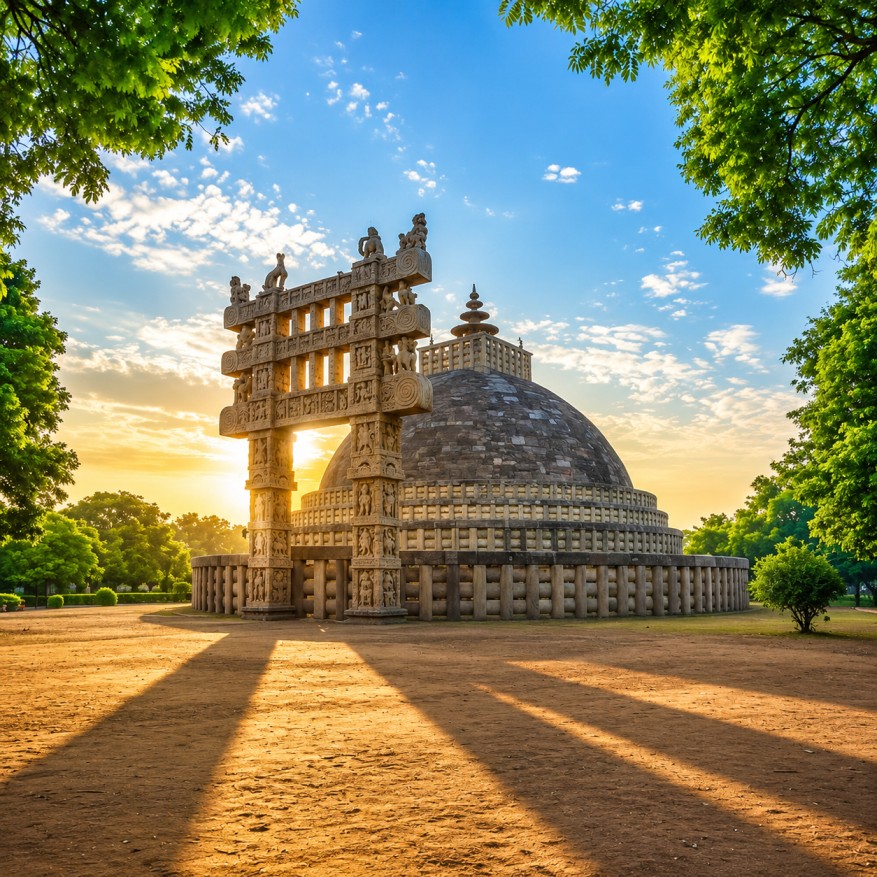
Sanchi Stupa -A Sacred Heart of Buddhist Heritage
On a gentle hill rising from the plains of central India, surrounded by the quiet of the Madhya Pradesh countryside, stands one of the oldest and most significant Buddhist monuments in the world. The Sanchi Stupa — more precisely, the Great Stupa at Sanchi — is not the largest religious structure in India, nor the most elaborately ornamented. What it is, unmistakably, is one of the most important. A UNESCO World Heritage Site since 1989, Sanchi represents the earliest surviving stone architecture in the Indian subcontinent, the birthplace of Buddhist sculptural art, and a monument whose gateways contain some of the most sophisticated narrative carving produced anywhere in the ancient world.
On a gentle hill rising from the plains of central India, surrounded by the quiet of the Madhya Pradesh countryside, stands one of the oldest and most significant Buddhist monuments in the world. The Sanchi Stupa — more precisely, the Great Stupa at Sanchi — is not the largest religious structure in India, nor the most elaborately ornamented. What it is, unmistakably, is one of the most important. A UNESCO World Heritage Site since 1989, Sanchi represents the earliest surviving stone architecture in the Indian subcontinent, the birthplace of Buddhist sculptural art, and a monument whose gateways contain some of the most sophisticated narrative carving produced anywhere in the ancient world.
Located approximately 46 kilometres northeast of Bhopal in Madhya Pradesh, Sanchi sits on a hilltop that was chosen with a quiet genius — elevated enough to be seen from the surrounding plains, accessible enough to receive pilgrims, and removed enough from urban distraction to maintain the contemplative atmosphere that Buddhist sacred sites require. Today, as in the time of Ashoka, arriving at Sanchi involves a gradual ascent through terraced grounds, past smaller shrines and monasteries, until the Great Stupa itself comes into view — a moment of quiet but genuine impact.
📍 Location
Madhya Pradesh
🌏 UNESCO
World Heritage Site Since 1989
🏛️ Significance
Earliest Surviving Stone Architecture
📜 History and Origins: From Ashoka to the Shunga Dynasty and Beyond
The history of Sanchi spans nearly a thousand years of active construction and patronage, beginning with one of the most transformative figures in Indian history. Emperor Ashoka of the Maurya dynasty, who ruled from approximately 268 to 232 BCE, is credited with establishing Sanchi as a sacred site. Following his conversion to Buddhism after the devastating Kalinga War, Ashoka embarked on an extraordinary programme of Buddhist monument construction across the subcontinent, erecting stupas, pillars, and monasteries from Afghanistan to Sri Lanka.
Sanchi was chosen for particular attention, partly because Ashoka's wife Devi — whom he had met in the nearby city of Vidisha — was from the region, and their son Mahinda and daughter Sanghamitra were among the most important early Buddhist missionaries, carrying the dharma to Sri Lanka. The personal connection made Sanchi a site of special devotion for Ashoka, and the original stupa he built here was a modest brick structure housing relics of the Buddha.
The Great Stupa as it stands today is substantially larger than Ashoka's original structure, having been expanded during the Shunga dynasty (2nd–1st century BCE) when the brick core was encased in stone and the structure was enlarged to roughly its current dimensions. The famous torana gateways — the four elaborately carved stone gateways that stand at the cardinal points around the stupa — were added even later, during the Satavahana period (1st century BCE to 1st century CE), and it is these gateways that elevate Sanchi from an important monument to an incomparable one.
After the decline of Buddhist patronage in India following the rise of Hinduism, Sanchi was gradually abandoned and fell into disrepair. The site was rediscovered by British officer General Taylor in 1818, and subsequent archaeological work — including by Sir John Marshall, who directed extensive restoration from 1912 to 1919 — has restored it to the condition in which visitors see it today.
🏛️ Architecture: The Grammar of Buddhist Sacred Space
The Great Stupa at Sanchi — Stupa No. 1 — is the centrepiece of a complex that contains three major stupas, several temples, and the remains of numerous monasteries, all spread across the hilltop in a landscape that feels both sacred and serene.
The stupa form itself carries profound symbolic meaning. The hemispherical dome (anda) represents the cosmic mountain or the dome of the sky, enclosing the sacred relic chamber at its heart. Above it rises the harmika — a square railing enclosure representing the abode of the gods — from which springs the chattra, a tiered umbrella structure symbolising the three jewels of Buddhism: the Buddha, the Dharma, and the Sangha. Around the base of the dome runs an elevated pradakshina patha (circumambulatory path) enclosed by a stone railing, and a second path at ground level serves the same function — the ritual of circumambulating the stupa clockwise being one of the most fundamental acts of Buddhist devotion.
The Great Stupa measures approximately 36.5 metres in diameter and stands 16.4 metres high, its proportions balanced with a deliberateness that feels calm rather than imposing. The stone railing (vedika) that surrounds it at ground level is one of the earliest examples of Buddhist architectural stone carving, its posts and crossbars decorated with simple but elegant lotus and medallion motifs.
🎨 The Torana Gateways: Narrative Art at Its Ancient Finest
If the stupa itself is Sanchi's architectural achievement, the four torana gateways are its artistic triumph. Each gateway consists of two square pillars supporting three curved horizontal crossbars (architraves), and every surface of every element is covered with carved relief panels depicting scenes from the life of the Buddha, the Jataka tales (stories of the Buddha's previous lives), and events from the history of early Buddhism.
What makes these carvings remarkable — beyond their narrative density and their technical accomplishment — is the convention they employ. At this early period of Buddhist art, the Buddha himself was not depicted in human form. Instead, his presence is indicated through symbols: a wheel representing the first sermon, a footprint marking where he walked, an empty throne indicating his enlightened presence, a Bodhi tree under which he attained enlightenment, and a parasol denoting his royal and divine status.
This aniconic tradition — representing the divine through symbol rather than image — gives the Sanchi carvings a quality of visual poetry, a language of suggestion rather than depiction that rewards careful attention. You do not simply look at these carvings; you learn to read them, and in doing so you enter into a visual tradition that shaped Buddhist art across Asia for centuries.
The South Gateway is the oldest and is considered particularly sacred, as it faces the direction from which pilgrims traditionally approached. It depicts the Great Departure of the prince Siddhartha from his palace — rendered as a riderless horse with a parasol floating above the empty saddle — and the Temptation of Mara, the demon of desire who attempted to prevent Siddhartha from achieving enlightenment.
The North Gateway is celebrated for its depictions of the Miracle of Sravasti, where the Buddha multiplied himself into thousands of images, and for its remarkably vivid rendering of the Great Monkey Jataka, in which the Buddha in a previous life sacrificed himself to save his monkey subjects.
The East Gateway contains what many art historians consider the single most beautiful carving at Sanchi — the Shalabhanjika, a figure of a woman or celestial being grasping the branch of a mango tree, rendered with a graceful sensuality and technical mastery that stands among the finest examples of ancient Indian sculpture. This figure — sometimes identified as a yakshi (nature spirit) and sometimes as a fertility goddess incorporated into Buddhist iconography — has become one of the most reproduced images in all of Indian art.
🏺 Other Monuments at Sanchi: A Hill of History
Beyond the Great Stupa, the Sanchi complex contains two other major stupas worth careful attention. Stupa No. 2 stands lower on the hillside and is notable for the decoration of its railing, which covers the earliest known depictions of the Jataka tales in systematic form. Stupa No. 3 contained the relics of Sariputra and Mahamoggallana — two of the Buddha's most important disciples — which were removed by British archaeologists in 1853 and taken to the Victoria and Albert Museum in London. Following Indian independence, the relics were returned in 1952 and reinstalled in Stupa No. 3 in a ceremony presided over by the Prime Minister Jawaharlal Nehru — a moment of considerable emotional and political significance for independent India's relationship with its Buddhist heritage.
The Ashoka Pillar at Sanchi, though now broken and partially fallen, bears one of the emperor's famous edicts and is topped by a capital featuring four lions — the same design that became the national emblem of the Republic of India. The original lion capital is preserved in the site museum.
🕯️ Cultural Significance: A Living Heritage of Buddhism
Sanchi is not merely a monument to a historical religion — it remains an active site of Buddhist devotion and an important centre of Buddhist cultural life. The nearby Chetiyagiri Vihara monastery, established in the 20th century, houses monks and continues the tradition of Buddhist practice on the hill. Pilgrims from Sri Lanka, Japan, Thailand, Myanmar, and other Buddhist-majority countries visit Sanchi regularly, and the site carries an international significance within the Buddhist world that goes beyond its importance as an Indian heritage monument.
The connection to Sri Lanka is particularly strong. Ashoka's son Mahinda, who carried Buddhism to Sri Lanka from this very region, is remembered at Sanchi with a deep reverence that Sri Lankan visitors express tangibly — many arrive with flowers, prayer flags, and a sense of pilgrimage rather than tourism.
🌅 Visitor Experience: Quiet, Contemplative, and Deeply Rewarding
Visiting Sanchi is a genuinely different experience from visiting India's more celebrated heritage sites. There are no vast crowds, no aggressive souvenir hawkers at the gates, no sense of the monument being overwhelmed by its own popularity. The hilltop has a quietude that seems appropriate to its history and to the tradition it represents.
The Archaeological Museum at Sanchi — one of the oldest site museums in India, established in 1919 — houses the original Ashoka lion capital, the carved railings removed for conservation, and a significant collection of Buddhist sculptures from the site and surrounding area. It is compact but excellent, and a visit here before ascending the hill significantly enriches the experience of the monuments themselves.
The best time to visit is between November and February, when Madhya Pradesh's climate is cool and clear. The site opens at sunrise and closes at sunset, and early morning visits — when the light is low and golden and the hilltop is at its most peaceful — are particularly atmospheric. The Buddha Purnima festival, celebrated on the full moon of May, draws large numbers of Buddhist pilgrims and monks to Sanchi in an annual event of genuine spiritual intensity.
🌍 Heritage Tourism and Why Sanchi Matters
Sanchi occupies a unique position in India's heritage tourism landscape — significant enough to be UNESCO-listed and internationally known, yet far less visited than the Taj Mahal, the Ajanta Caves, or the monuments of Rajasthan. For the traveller willing to make the journey to central Madhya Pradesh, this relative quietude is itself a gift. You can stand before the East Gateway in the early morning and have it almost to yourself — a privilege that the quality of the carving absolutely does not warrant being taken for granted.
For international visitors, particularly those from Buddhist-majority countries, Sanchi is not optional — it is essential. For Indian visitors, it offers something rare: an encounter with the very earliest layer of the country's artistic and architectural heritage, a place where you can see the beginning of traditions that would unfold across the entire subsequent history of Indian art.
In a country of extraordinary monuments, Sanchi's greatness is quiet and patient rather than overwhelming. It asks you to look carefully, to slow down, to learn its visual language — and it rewards that attention with insights into the ancient world that no other site in India can quite replicate. The hill has been sacred for over two thousand years, and something of that accumulated devotion seems to have settled permanently into the stone.