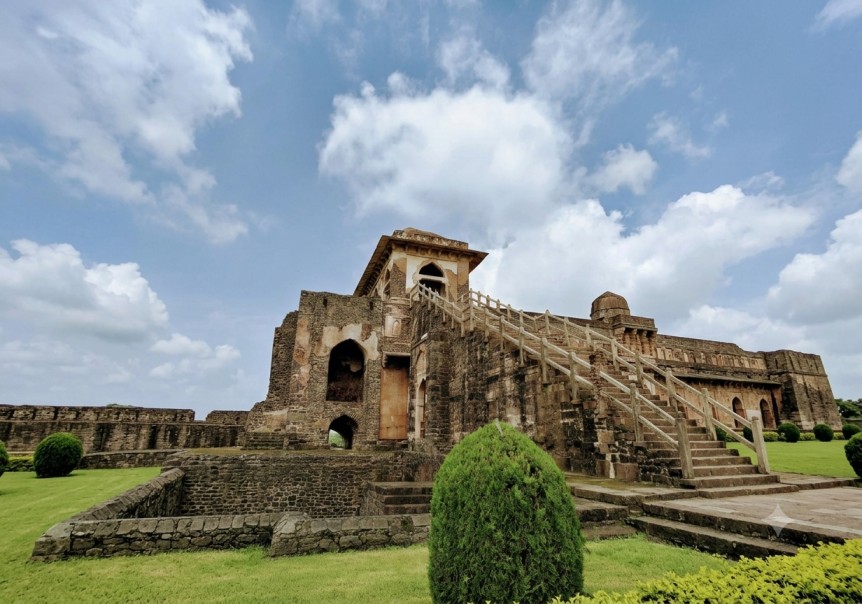
Shahi Qila - The crown of mughal splendor
Picture a crumbling but majestic structure standing quietly on the banks of the Tapti River, its honeycombed ceilings still whispering stories of royal romance and Mughal grandeur. That's Shahi Qila for you — not just a ruined fort, but a witness to one of history's most enduring love stories. Located in Burhanpur, Madhya Pradesh, locals affectionately call it "Bhulbhulaiya," meaning labyrinth, because its sprawling, seven-storied architecture is puzzling enough to disorient even the most attentive visitor.
🏰 Shahi Qila, Burhanpur – The Palace Where an Empire Mourned
Picture a crumbling but majestic structure standing quietly on the banks of the Tapti River, its honeycombed ceilings still whispering stories of royal romance and Mughal grandeur. That's Shahi Qila for you — not just a ruined fort, but a witness to one of history's most enduring love stories. Located in Burhanpur, Madhya Pradesh, locals affectionately call it "Bhulbhulaiya," meaning labyrinth, because its sprawling, seven-storied architecture is puzzling enough to disorient even the most attentive visitor.
📜 A Little Bit of History First
Burhanpur's story stretches back to the 14th century, when it was founded by Nasir Khan, a ruler of the Faruqi dynasty, and the city soon became an important center of trade and commerce. The Shahi Qila itself was originally constructed by rulers of the Farooqi Dynasty around 1500 CE, long before the Mughals arrived on the scene.
Everything changed when Mughal Emperor Shah Jahan stayed in the city for two years while quelling a revolt among southern kingdoms. He grew so attached to the fort that it became the seat of his court for the first three years after he ascended the throne, and he personally expanded the palace, adding the Diwan-i-Aam and Diwan-i-Khas on its terrace. Aurangzeb, Mohammad Shuja, and other Mughal nobles were regular participants in these courtly assemblies, making Burhanpur, for a brief but glittering period, a true center of Mughal power in the Deccan.
✨ The Attractions That Will Leave You Breathless
🛁 Shahi Hammam
The undisputed highlight of the Qila is the Shahi Hammam, a royal bath built specifically for Shah Jahan's beloved wife, Mumtaz Mahal, where she could bathe in water scented with khus, saffron, and rose petals. Designed in Mughal-Iranian style with elegant domed roofs, the chamber is genuinely magical — a marble hall with an octagonal bathing pool at its center, once filled with perfumed, saffron-tinted water. Even today, the ceilings carry intricate paintings done in honeycomb work, and one fresco depicting a domed monument is widely believed to have inspired the design of the Taj Mahal itself.
❤️ Taj Mahal Connection
That connection isn't a coincidence. The site originally chosen for the Taj Mahal still lies vacant near the Tapti River, since Mumtaz died in Burhanpur while giving birth to her fourteenth child, and her body rested here before being carried to Agra. Walking through the Qila, knowing this, adds an unmistakable weight to the silence between its walls.
👑 Royal Court Complex
Beyond the Hammam, the palace complex includes the remains of the Diwan-i-Aam and Diwan-i-Khas, the public and private audience halls where Mughal nobility once gathered, along with the Jenana Hammam, identifiable today mostly by its surviving water channels. The fort is now under the care of the Archaeological Survey of India, and though much of it lies in ruins, the surviving sections still reveal genuinely exquisite carvings and sculptural detail.
🕌 Nearby Mughal Landmarks
Just beyond the Qila, the Jama Masjid, an elegant 16th-century mosque built by the Farooqui dynasty and later completed under Akbar, is known for its intricate arches and tranquil courtyard. A short distance away, the Ahukhana ("deer park"), once a Mughal hunting ground, and the imposing Asirgarh Fort, historically considered nearly impregnable, round out a rich circuit of Burhanpur's Mughal-era landmarks.
🎭 Culture, People, and Food
Burhanpur carries the layered imprint of Faruqi, Mughal, Maratha, and British rule, and that history shows up in its architecture, festivals, and everyday life. The city has long been known for its textile craftsmanship, particularly its fine silk and cotton fabrics, a tradition that continues among local artisans today.
The food carries unmistakable Mughal influence. Burhanpur's cuisine blends Mughlai richness with local Madhya Pradesh flavors, and travelers can expect hearty biryanis, kebabs, and traditional Malwa-region dishes at local eateries around the old city.
🌤️ Best Time to Visit
The ideal window to explore Burhanpur runs from October to March, when the weather stays pleasant enough for comfortable heritage walks and outdoor sightseeing. Summers turn quite hot, while the monsoon brings welcome greenery but occasional heavy showers that can disrupt travel plans. The Qila itself stays open daily from 6 AM to 6 PM, with a modest entry fee.
🚗 How to Get There
✈️ By Air
By Air: The nearest airport is in Indore, around 180 km away, with good connectivity to major Indian cities.
🚆 By Rail
By Rail: Burhanpur Railway Station sits directly on the Mumbai–Delhi line, making it one of the most convenient ways to reach the city.
🛣️ By Road
By Road: Burhanpur is well connected by highway to Indore, Khandwa, Jalgaon, and other nearby towns, making a road trip a comfortable and scenic option.
📍 Nearby Places Worth Exploring
Burhanpur rewards travelers willing to explore beyond the Qila. The Tomb of Shah Nawaz Khan, a beautiful Mughal monument on the banks of the Utaoli river just outside town, and Asirgarh Fort, with its sweeping countryside views, both make for memorable additions to any itinerary. The Dargah-e-Hakimi, set amid sprawling gardens, offers a peaceful, spiritually significant stop as well.
🧳 A Few Travel Tips Before You Go
Wear sturdy footwear, since the Qila's uneven, ruined sections require careful navigation.
Hiring a local guide is genuinely worthwhile — much of the fort lacks informative signage, and its stories are far richer than what's visible at first glance.
Carry water and sun protection, especially outside the cooler months, and keep your camera ready for the Hammam's faded but striking frescoes.
⭐ Why You Simply Must Visit Shahi Qila
Some monuments showcase power. Shahi Qila showcases something more intimate — grief, devotion, and the fragile threshold between an empire's grandeur and its grief. It's the place where a love story that produced the Taj Mahal quietly began its final chapter. For history lovers, romantics, and curious travelers alike, Shahi Qila offers a rare, unembellished encounter with Mughal Burhanpur — weathered, half-forgotten, and all the more moving because of it.