Sheesh-Mahal : The Palace Of Mirrors & Royal Elegance
There are rooms in the world that are merely beautiful, and then there are rooms that feel like stepping inside a dream. The Sheesh Mahal — literally the Palace of Mirrors — belongs firmly in the second category. Whether encountered within the Amber Fort in Jaipur, the Lahore Fort in Pakistan, the Agra Fort, or the various royal complexes across northern India where versions of it appear, the Sheesh Mahal represents one of the most distinctive and enchanting achievements in the entire tradition of Mughal and Rajput decorative architecture. This piece focuses primarily on the most celebrated version — the Sheesh Mahal within Amber Fort, Jaipur — while acknowledging the broader tradition this extraordinary interior belongs to. A space where thousands of tiny mirrors cover every surface of the walls and ceiling, where a single candle flame multiplies into what appears to be an entire cosmos of light, the Sheesh Mahal is not simply a room. It is an experience — one that has survived centuries, inspired poets, and left virtually every visitor struggling to find adequate words for what they have just witnessed.
✨ Sheesh Mahal: The Palace of Mirrors Where Light Becomes Magic
There are rooms in the world that are merely beautiful, and then there are rooms that feel like stepping inside a dream. The Sheesh Mahal — literally the Palace of Mirrors — belongs firmly in the second category. Whether encountered within the Amber Fort in Jaipur, the Lahore Fort in Pakistan, the Agra Fort, or the various royal complexes across northern India where versions of it appear, the Sheesh Mahal represents one of the most distinctive and enchanting achievements in the entire tradition of Mughal and Rajput decorative architecture. This piece focuses primarily on the most celebrated version — the Sheesh Mahal within Amber Fort, Jaipur — while acknowledging the broader tradition this extraordinary interior belongs to.
A space where thousands of tiny mirrors cover every surface of the walls and ceiling, where a single candle flame multiplies into what appears to be an entire cosmos of light, the Sheesh Mahal is not simply a room. It is an experience — one that has survived centuries, inspired poets, and left virtually every visitor struggling to find adequate words for what they have just witnessed.
📍 Location and Setting: A Jewel Within a Jewel
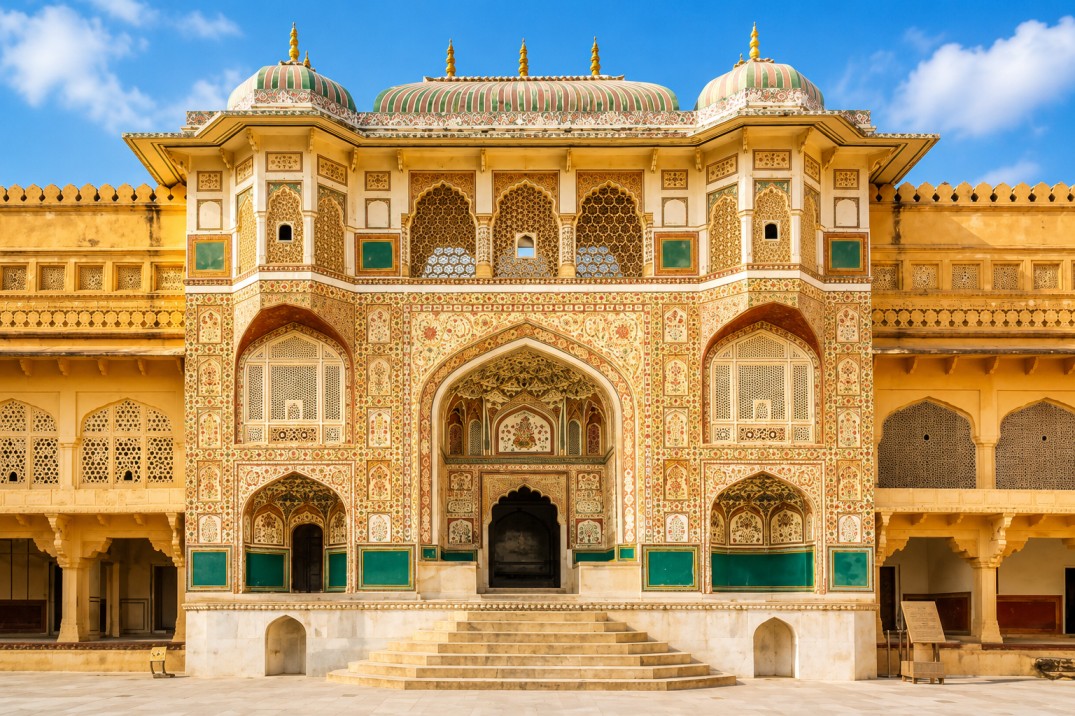
The Sheesh Mahal at Amber Fort sits within the fort's innermost private precinct, reached through the gloriously ornate Ganesh Pol gateway — itself one of the most elaborately decorated gateways in Rajasthan. This positioning was deliberate. The Sheesh Mahal was not a public space. It was the private apartments of the Maharaja and his queens, hidden behind layers of ceremonial gateways and courtyard transitions that ensured only the most trusted members of the royal household ever crossed its threshold.
Amber Fort itself perches on a ridge of the Aravalli Hills, 11 kilometres north of Jaipur, overlooking the still waters of Maota Lake. The journey to the Sheesh Mahal — through the fort's successive gates, up its broad staircases, across its sunlit courtyards — builds anticipation in a way that feels carefully choreographed, because it was.
🏰 History and Origins: The Kachchwaha Rajputs and Mughal Influence
The Amber Fort complex was developed over several generations of Kachchwaha Rajput rulers, beginning in earnest with Raja Man Singh I around 1592 CE. However, the Sheesh Mahal as it exists today is attributed primarily to Mirza Raja Jai Singh I, who ruled from 1621 to 1667 CE, and whose reign saw the most intensive and sophisticated phase of interior decoration within the fort.
The Kachchwaha rulers maintained a close and mutually beneficial alliance with the Mughal Empire. Raja Man Singh I served as a trusted general under Emperor Akbar, and subsequent rulers maintained similar relationships with Jahangir and Shah Jahan. This connection was not merely political — it was cultural and artistic. Mughal aesthetics, refined to their peak under Shah Jahan's patronage (the same emperor who built the Taj Mahal), flowed directly into Rajput court culture, and the Sheesh Mahal is perhaps the most spectacular example of this artistic exchange.
The technique of mirror inlay work — known as aaina kari or shish kari — had roots in Persian architectural tradition and entered the Mughal repertoire during the 16th and 17th centuries. Shah Jahan himself commissioned a Sheesh Mahal within the Lahore Fort and another within the Red Fort at Delhi, and it is widely believed that artisans trained in these imperial workshops were brought to Amber to execute the work there. The result synthesised Mughal technical mastery with the Rajput love of colour, narrative, and decorative exuberance into something entirely its own.
🪞 The Architecture and Design: Every Surface a Mirror
✨ Mirror Work
The walls and ceiling are covered with thousands of small convex mirrors, each no larger than a coin, set into ornate plasterwork frames and arranged in geometric and floral patterns of extraordinary intricacy.
💡 Light Effect
When a single candle — or today, a small electric torch — is introduced into the darkened room, the effect is immediate and astonishing: the entire ceiling appears to bloom with stars.
🏛 Jai Mandir
The Jai Mandir's upper portion features particularly fine pietra dura work — the technique of inlaying coloured stones into marble in floral and geometric patterns.
🎨 Decorative Art
The lower panels of the walls feature painted floral motifs in the characteristic Mughal style — climbing vines, blooming flowers, birds perched among leaves.
🎭 Artistic Features: The Craft Behind the Magic
The creation of a Sheesh Mahal interior required extraordinary skill across multiple disciplines simultaneously. Plasterers had to create perfectly smooth, curved surfaces capable of holding the mirror pieces. Glassworkers had to cut and shape the mirrors to precise sizes. Pattern designers had to calculate the geometric arrangements that would cover entire ceiling vaults and wall surfaces without repetition or error. And painters had to integrate their work seamlessly with the surrounding mirror and stonework.
The geometric patterns in the Amber Sheesh Mahal range from simple star forms to complex multi-pointed rosettes, and from interlocking hexagons to flowing arabesque curves — a vocabulary drawn equally from Islamic geometric tradition and Hindu decorative arts. The fusion feels not like compromise but like synthesis, as though both traditions were always moving toward this point.
Natural light entering through perforated marble screens (jalis) on the exterior walls creates an additional layer of visual complexity during the day, casting intricate shadow patterns across the mirrored surfaces that shift as the sun moves. The room behaves differently at every hour, a quality that was surely as delightful to its royal inhabitants as it is to modern visitors.
👑 Cultural Significance and Royal Life
The Sheesh Mahal was the private domain of the Maharaja and his principal queens. It served simultaneously as a bedchamber, a reception room for intimate gatherings, and a space for musical and poetic entertainment. The acoustics of the mirrored room are remarkable — sound reflects and amplifies in ways that made musical performances within it particularly magical, and it is said that court musicians prized the opportunity to perform in the Sheesh Mahal above almost any other venue.
The concept of the mirror palace carried deep symbolic weight in Mughal and Rajput culture. Mirrors were associated with self-knowledge, divine reflection, and the idea that the visible world is itself a reflection of a higher reality — themes that resonate across both Hindu and Sufi philosophical traditions. A room that multiplied light infinitely was not merely a luxury; it was a philosophical statement about the nature of illumination and perception.
📖 Legends and Remarkable Stories
One of the most enduring stories about the Amber Sheesh Mahal concerns its use as a private planetarium. The royal family, it is said, would extinguish all lamps and then introduce a single candle, watching as the mirrored ceiling transformed into a perfect representation of the night sky.
Another legend holds that the Sheesh Mahal was designed so that no two people could see exactly the same reflection in the thousands of mirrors surrounding them.
It is also recorded that the Sheesh Mahal was used for the royal women's private celebrations — festivals of colour, music, and dance conducted entirely within the mirrored chamber.
🚶 Visitor Experience: Entering a World of Infinite Light
Today, the Sheesh Mahal is one of the most visited rooms within Amber Fort, and for good reason — few spaces in Indian heritage architecture produce such an immediate and universal reaction. Visitors are typically shown the mirror effect through the use of a small flashlight or torch, which a guide will use to illuminate the ceiling while encouraging everyone to look upward. The gasp that follows is reliable and completely genuine.
Photography inside the Sheesh Mahal is challenging and rewarding in equal measure. The mirrors create lens flare and exposure difficulties that frustrate automatic camera settings, but the images that result — when they work — are among the most distinctive that any heritage site in India can produce.
The best approach is to visit early in the morning, before the crowds arrive, when there is a better chance of experiencing the room in something close to the quiet that its royal inhabitants knew. The light at that hour, entering through the marble screens and catching the mirror surfaces, is soft and golden rather than the harsh midday brightness that can flatten the room's subtlety.
The best overall time to visit Amber Fort, and therefore the Sheesh Mahal, is between October and March, when Jaipur's climate is at its most comfortable and the skies are clear enough to appreciate the fort's dramatic setting fully.
🌍 Heritage Tourism and Global Appeal
The Sheesh Mahal at Amber Fort draws visitors from every corner of the world, and it consistently ranks among the most memorable experiences that travellers report from their time in Rajasthan. For international tourists, it represents something genuinely unlike anything in European or East Asian architectural traditions — a room whose primary material is light itself, whose decoration is not applied to a surface but is the surface.
For Indian visitors, the Sheesh Mahal is a source of immense cultural pride — evidence that the artistic traditions of medieval India produced interiors of a sophistication and imagination that stand comparison with the greatest decorative achievements of any civilisation. Architecture students, art historians, photographers, and simply curious travellers all find something different to take away from it.
As Rajasthan's heritage tourism continues to grow in both depth and reach, the Sheesh Mahal remains one of its most powerful calling cards — a room that no photograph entirely captures, no description fully prepares you for, and no visitor entirely forgets. It is, in the most literal sense, a place where you see yourself surrounded by the infinite — and that, at its best, is what great architecture has always offered.