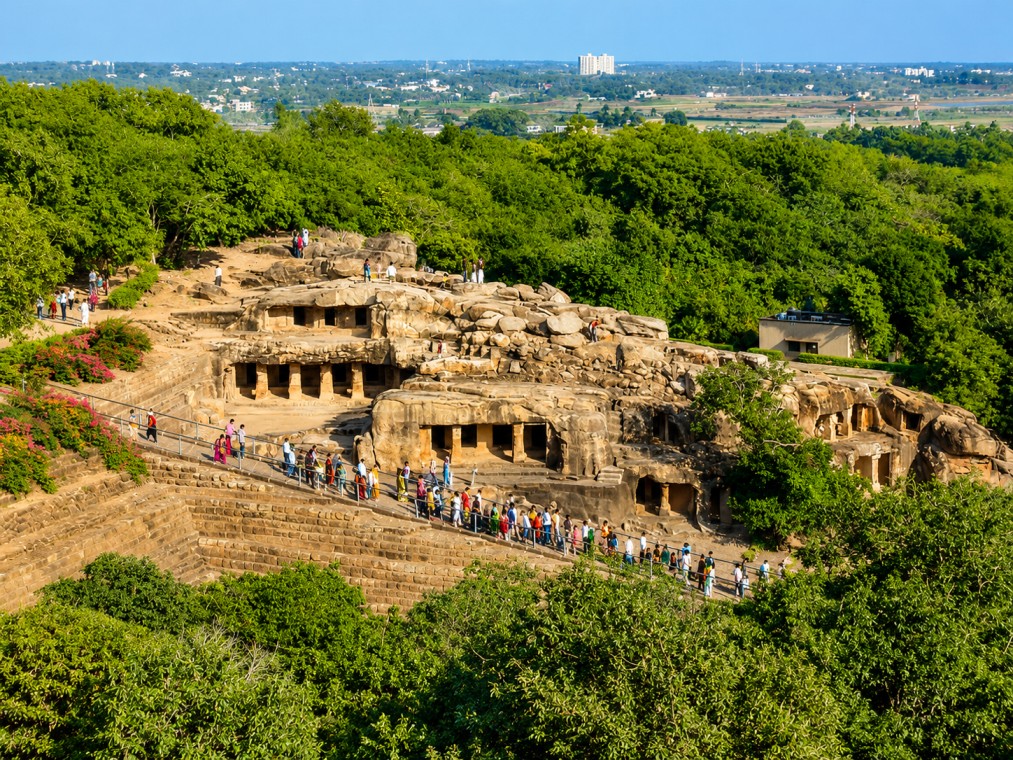
Udayagiri Cave : Where Ancient Art Meets History
Sixty kilometres from Bhopal and a short drive from the Buddhist stupas of Sanchi, a sandstone hill rises quietly from the plains of central Madhya Pradesh. On its face, carved directly into the rock over fifteen centuries ago, are twenty cave temples that represent one of the most significant — and most undervisited — archaeological sites in all of India. These are the Udayagiri Caves, and they contain some of the oldest surviving Hindu temples and iconography anywhere in the subcontinent.
🏛️ Udayagiri Caves: Where the Gupta Golden Age Left Its Mark in Stone
Udayagiri Caves: Where the Gupta Golden Age Left Its Mark in Stone
Sixty kilometres from Bhopal and a short drive from the Buddhist stupas of Sanchi, a sandstone hill rises quietly from the plains of central Madhya Pradesh. On its face, carved directly into the rock over fifteen centuries ago, are twenty cave temples that represent one of the most significant — and most undervisited — archaeological sites in all of India. These are the Udayagiri Caves, and they contain some of the oldest surviving Hindu temples and iconography anywhere in the subcontinent.
The name Udayagiri means "sunrise mountain" — and the description is earned not only for the literal beauty of dawn over these ancient hillsides, but for the role this site played as a centre of Hindu astronomical study and ritual long before its most celebrated carvings were made. For scholars, archaeologists, and travellers who have found their way here, Udayagiri offers an encounter with the Gupta Empire at its artistic and cultural zenith — a moment in Indian history that is still, more than sixteen centuries later, deeply alive in these stones.
📍 Location: Between Sanchi and Vidisha
The Udayagiri Caves are located approximately 6 kilometres from Vidisha in Madhya Pradesh, on the eastern bank of the Betwa River and near its confluence with the Bes River. The site is about 13 kilometres from Sanchi, making it a natural companion visit to the famous Buddhist monuments there, and roughly 61 kilometres from Bhopal, the state capital.
This geographic positioning is more than convenient — it is historically significant. The Udayagiri hills lie at a point where multiple civilisations and religious traditions converged over centuries: Buddhist Sanchi is nearby, the ancient city of Vidisha (Besnagar) was a major political and commercial centre, and the nearby Heliodorus pillar — erected by a Greek ambassador to the Shunga kings in the 2nd century BCE — attests to the extraordinary cosmopolitan character of this region in antiquity. Udayagiri did not exist in isolation; it was part of a rich, layered cultural landscape.
📜 Historical Background: The Gupta Golden Age
The caves at Udayagiri were primarily carved and embellished during the Gupta period, between the late 4th and early 5th centuries CE — a time widely regarded as the golden age of ancient Indian civilisation, marked by extraordinary achievements in art, literature, mathematics, astronomy, and religious philosophy.
The site is most directly associated with Chandragupta II (reigned c. 375–415 CE), one of the most powerful and culturally accomplished of all Gupta emperors. He was later given the title Vikramaditya — literally "he who is the sun of prowess" — and scholars believe Udayagiri played a specific role in the consolidation of that royal identity.
The caves contain inscriptions from his reign (dated to around 401 CE) as well as from that of his successor Kumaragupta I (an inscription dated 425 CE), making Udayagiri the only site in India that can be verifiably linked to a specific Gupta monarch through its own inscriptions.
Scholars suggest the caves served a dual purpose: they were sacred sanctuaries for Hindu and Jain worship, but they were also deliberately designed as a statement of Gupta royal ideology — establishing the king as both chakravartin (universal sovereign) and paramabhagavata (supreme devotee of Vishnu), two roles whose merger was central to Gupta political theology.
The site had been sacred long before the Gupta period, however. According to historian Michael Willis, Udayagiri functioned as a centre of Hindu astronomy and calendar-related activity from at least the 3rd century BCE, given its sculptures, sundials, and astronomical alignments. The Gupta rulers did not create a sacred site from scratch — they reworked and expanded an already-ancient place of significance.
🕉️ The Caves: Twenty Chambers, Four Traditions
The twenty caves at Udayagiri were numbered from south to north by the pioneering archaeologist Alexander Cunningham in the 19th century, though his numbering has since been revised and expanded by the Archaeological Survey of India.
The caves vary significantly in size and complexity — some are small niches, others are substantial rock-cut halls — but together they form a coherent religious and artistic programme.
Of the twenty caves, nine are dedicated to Vaishnavism (the worship of Vishnu), seven to Shaivism (Shiva), three to Shaktism (goddess worship), and one — Cave 20 — to Jainism. This remarkable religious diversity within a single complex reflects both the pluralism of Gupta religious culture and the syncretic character of the site, which served as a sacred space for multiple traditions simultaneously.
🎨 Major Cave Highlights
🐗 Cave 5: The Great Varaha — Masterpiece of Gupta Sculpture
The undisputed centrepiece of Udayagiri — and one of the most important sculptures in all of Indian art history — is the monumental Varaha relief in Cave 5.
🌌 Cave 13: The Sleeping Vishnu
Cave 13 houses a large Anantashayana panel — Vishnu reclining on the cosmic serpent Ananta (Shesha) in the pose of yogic sleep from which the universe is perpetually dreamed into existence.
🌊 Cave 19: The Largest Cave — Samudra Manthan
Cave 19 — known as the Amrita Cave — is the largest in the complex, measuring 22 feet long by over 19 feet broad.
🔱 Cave 4: Shiva Linga
Cave 4, dedicated to Shaivism, houses an impressive Shiva Linga on a rock-cut platform.
🪔 Cave 6: The Goddess and an Early Ganesha
Cave 6 is dedicated to the divine feminine — Shakti — and features a sculptural programme centred on the goddess Durga slaying the buffalo demon Mahishasura.
☸️ Cave 20: The Jain Temple
Standing apart from the Hindu caves, Cave 20 is the only Jain sanctuary in the complex, dedicated to Parshvanatha — the 23rd Jain tirthankara.
The political symbolism is deliberate. The rescue of Bhudevi — the earth — by Vishnu's avatar can be read as an allegory for Chandragupta II's own military and political achievements in reunifying and protecting India. The cosmic and the political are merged in a single image of breathtaking power.
☀️ Astronomical Significance: More Than a Temple Complex
One of the most fascinating dimensions of Udayagiri — and one that is only now being fully appreciated by scholars — is its role as a centre of Hindu astronomical observation and calculation.
The site contains evidence of sundials, and its orientation and sculptural programme appear to have been deliberately aligned with specific solar events. The name Udayagiri, meaning "sunrise mountain," is believed to reflect this astronomic function.
Scholars have suggested that Chandragupta II used Udayagiri not merely as a religious monument but as an "astro-political node" — a site where the movements of celestial bodies were tracked and used to legitimise royal authority through the religious framework of Vishnu worship.
🏺 Connections to Other Iconic Monuments
Udayagiri's influence on Indian cultural history is traceable in surprising directions.
The famous Iron Pillar now standing in the courtyard of the Quwwat-ul-Islam mosque at the Qutb Minar complex in Delhi is believed to have originally stood at Udayagiri or its immediate environs.
The Udayagiri Lion Capital, now housed in the Gwalior Fort Archaeological Museum, similarly bears inscriptions that illuminate the site's royal patronage and its connection to early Gupta imperial symbolism.
🎒 Visiting Udayagiri Caves: What to Expect
🕘 Timings
9:00 AM to 6:00 PM, open daily.
🎟️ Entry Fee
₹15 for Indian nationals; ₹200 for foreign visitors.
🌤️ Best Time to Visit
October to March, when the weather in Madhya Pradesh is mild and walking the hillside is comfortable.
🚗 Getting There
Udayagiri is 6 km from Vidisha town, which is well-connected by rail to Bhopal (about 1 hour) and beyond.
From Vidisha, a taxi or auto-rickshaw to the caves takes about 15 minutes. The nearest airport is Raja Bhoj Airport, Bhopal, approximately 61 km away.
Sanchi (13 km away) makes an excellent combined visit — a full day can be spent between Udayagiri and Sanchi to experience both the Hindu Gupta-era heritage and the Buddhist monuments of the same region.
Practical tips: Hire a guide at the site — many of the cave sculptures require context to fully appreciate, and a good guide will illuminate the iconographic programme and its political significance. Carry water and wear sunscreen for the hillside sections. Photography is permitted and the Varaha relief in Cave 5 is among the most photographed ancient sculptures in India.
✨ Why Udayagiri Caves Matter for Heritage Tourism
Udayagiri sits in the shadow of more famous neighbours — Sanchi, Khajuraho, Orchha — and is consequently far less crowded than those sites.
For the serious heritage traveller, this is a profound advantage. At Udayagiri, you can stand before one of the greatest sculptures of the ancient world — the Varaha panel — with space and silence enough to actually look at it, to follow its extraordinary detail, and to feel, with some real force, the artistic and political ambition of the civilisation that made it.
For students of Indian art history, Udayagiri is essential: the caves contain the earliest examples of fully developed Vishnu avatar iconography, some of the earliest Ganesha and Durga reliefs, and the only rock-cut site directly associated with a named Gupta monarch. For the general traveller, it is a chance to stand inside the Gupta golden age — not in a museum display case, but in the living rock itself.