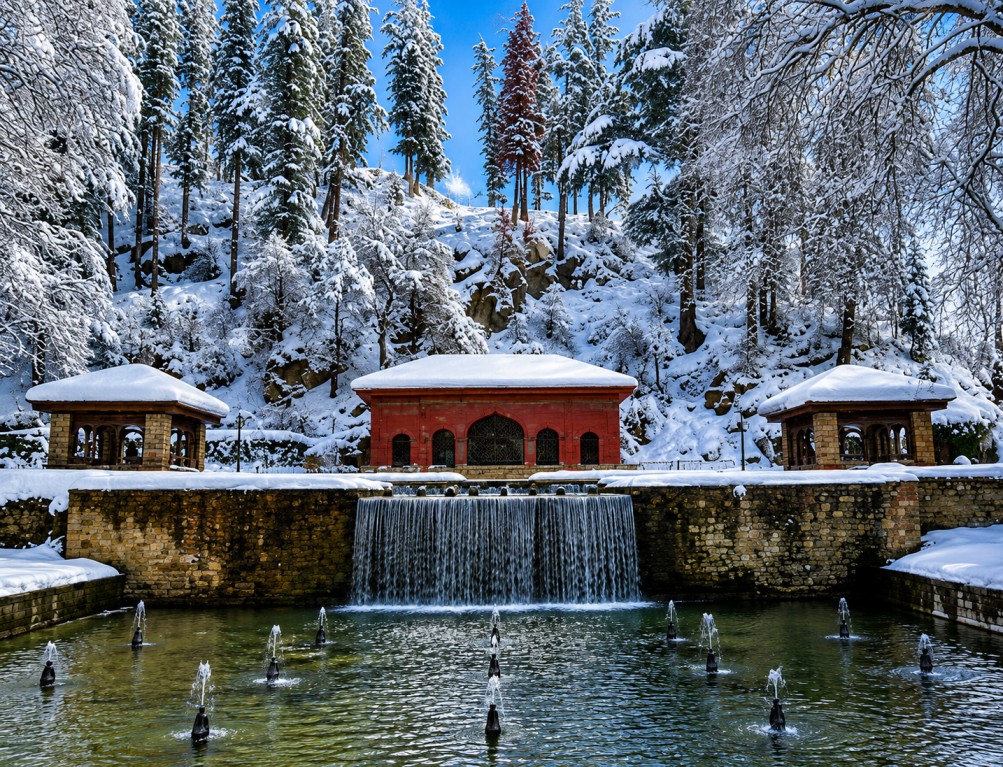
Mughal Charbagh · Circa 1620 CE
Achabal Garden — a spring-fed terrace of Mughal Kashmir
A four-tiered charbagh laid out under Empress Nur Jahan and later remodelled by Jahanara, fed continuously by a natural spring at the base of Sosanwar Hill. Located in Achabal town, southeastern Kashmir Valley.
Overview
A garden defined by hydrology, not just symmetry
Achabal Garden sits at the southeastern end of the Kashmir Valley, within the Anantnag district, and represents a blend of Persian-inspired landscaping, natural spring hydrology, and centuries of royal patronage. The charbagh was laid out around 1620 CE under Empress Nur Jahan, wife of Emperor Jahangir, and later remodelled by Jahanara, daughter of Shah Jahan.
What sets Achabal apart from other valley gardens is its largely intact original water supply — a natural spring that still feeds its channels with the same force it did four centuries ago — combined with a comparatively secluded setting at the foot of the forested Achabal-thung hill. This continuity of water, history, and landscape design distinguishes it from more visited counterparts in Srinagar.
Significance
Why the site holds up against Srinagar's better-known gardens
Spring source, layered history, and relative seclusion.
The garden's central spring gushes from the base of Sosanwar Hill with considerable force year-round. Local tradition holds it to be the underground reappearance of the Bringhi stream after it vanishes beneath a limestone fissure at nearby Wani Divalgam — a dramatic natural feature channelled through the garden as cascades and fountains, forming the core of its design.
Achabal's history predates the Mughals: ancient Kashmiri texts reference an earlier orchard garden and spring known as Achapal Nag. Later Mughal-era additions — a hamam and a mosque built by Prince Dara Shikoh — add further depth. Its proximity to Kokernag, Verinag, and the Martand Sun Temple positions it within a broader South Kashmir circuit.
Site Highlights
Four elements that structure the visit
Mapped to the garden's own ascending terrace layout.
Main Spring & Waterfall
The unmissable centrepiece — cascading into a stone-lined pool before dividing into multiple channels through the terraced landscape.
Charbagh Terraces
Four ascending levels with stepped pathways, ornamental water channels, and fountains arranged in symmetrical Mughal design.
Chinar Canopies
Dense, centuries-old chinar trees providing shade and framing views of the surrounding forested hills.
Historic Structures
Remnants of a Mughal-era hamam, pavilion ruins repaired under Maharaja Ranbir Singh, and a mosque tied to Prince Dara Shikoh.
On-Site Activities
What travellers spend time doing here
Self-paced exploration of the terraced garden, observing Mughal-era water channels, pavilion ruins, and the preserved overall layout.
Cascading water, chinar canopies, and symmetrical stone terraces offer strong compositions, particularly in soft morning light before crowds build.
A favoured weekend spot among local families for quiet, spring-fed surroundings away from Srinagar's busier gardens.
Commonly combined with Kokernag, Verinag Spring, and the Martand Sun Temple as part of a wider South Kashmir itinerary.
Seasonality
Reading the garden through the year
Spring
Vibrant bloom, fresh greenery, and blossoming flowerbeds across the terraces.
Summer
Pleasant temperatures suited to extended, unhurried exploration of the full site.
Autumn
Chinar trees turn gold and red, creating a distinct atmosphere favoured for photography.
Winter
Heavy snowfall can disrupt travel; the garden remains technically accessible for a quieter, snow-touched visit.
Access & Connectivity
Reaching Achabal from key transit points
| From | Distance / Route | Notes |
|---|---|---|
| Anantnag Town | ~8 km | Via connecting road off National Highway 44. |
| Srinagar | ~56–70 km | NH44 followed by the Achabal connecting road; private taxis and buses run regularly. |
| Sheikh-ul-Alam International Airport | Srinagar | Direct flights from Delhi, Mumbai, and Jammu; onward travel by taxi or bus. |
| Anantnag Railway Station | ~20 km | Nearest railhead to the garden. |
| Jammu Railway Station | ~90 km (wider region) | Alternative railhead for travellers approaching from outside the valley. |
Public bus frequency on this route is limited; private taxi remains the most consistent option for reaching the site.
Complete Your Trip with Nearby Attractions
- Pahalgam : Discover The Beauty Of Lidder Valley
- Baisaran Valley : The Mini Switzerland Of India
- Aru-Valley : Kashmir's Hidden Meadow Paradise
- Betaab Valley: The Green Gem of Jammu and Kashmir