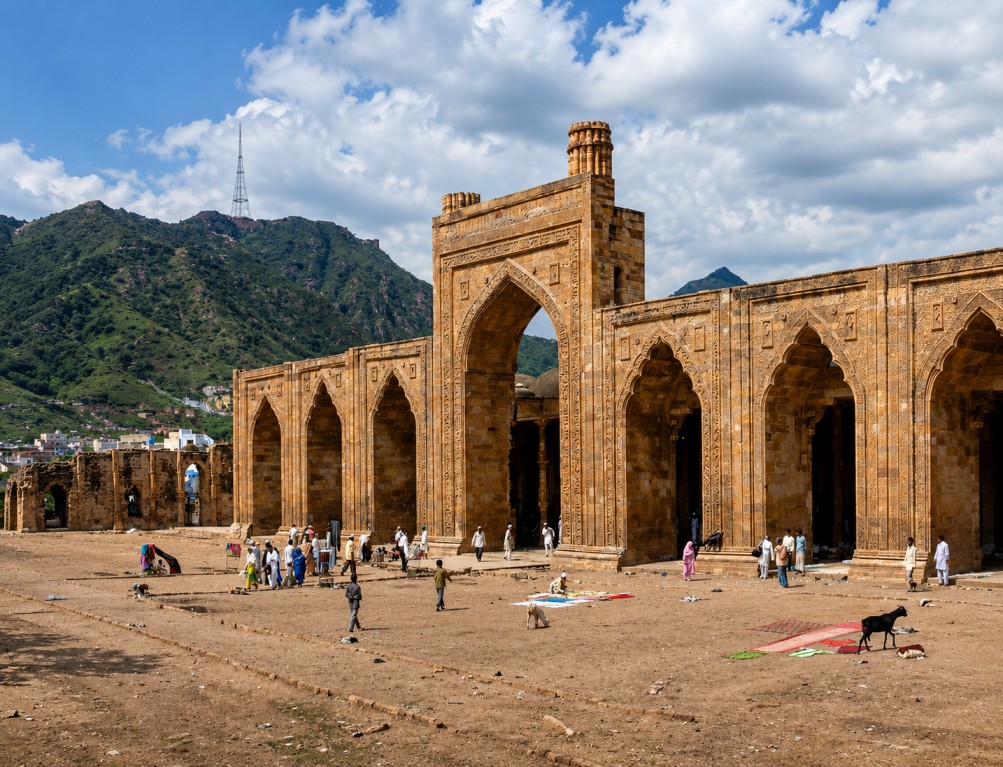
Adhai Din Ka Jhonpra
A 12th-century monument at the foothills of Taragarh Fort, Ajmer — built as a Sanskrit seat of learning, converted into a mosque under the early Delhi Sultanate, and preserved today as one of India's earliest surviving examples of Indo-Islamic architecture.
History & cultural significance
Three distinct chapters of Indian history are legible in a single structure.
The site originates in the reign of Chahamana (Chauhan) ruler Vigraharaja IV, who commissioned it in the 12th century as a Sanskrit learning center, likely tied to an earlier temple complex. Following Muhammad Ghori's conquest of Ajmer in 1192 CE, the structure was converted into a mosque under Qutb-ud-din Aibak, founder of the Delhi Sultanate. Sultan Iltutmish later added the monument's arched entrance screen.
The name — "shed of two and a half days" — traces to two competing local legends: one holding that part of the structure was raised in two and a half days, another linking it to a religious fair of the same duration. Historians treat both as folklore rather than record, but the name has stayed attached to the site for centuries. It is now protected and maintained by the Archaeological Survey of India.
Architecture & distinguishing features
A single footprint carrying Hindu, Jain and Islamic building traditions side by side, rather than in sequence.
More than 300 carved pillars stand on site, many reused from earlier temple structures, showing floral motifs, geometric patterns and celestial figures. The entrance screen added under Iltutmish carries Islamic calligraphy and inscriptions cut directly into stone. A prayer hall, open courtyard and vaulted ceiling complete the layout.
Pillared hall
Over 300 reused and newly carved pillars, densely arranged, supporting domed and vaulted ceiling sections.
Entrance screen
Arched façade added under Iltutmish, carrying calligraphic inscriptions and detailed stone relief work.
Courtyard & prayer hall
An open central courtyard flanked by the prayer hall, framed by ornamental arches on all sides.
Position within the Ajmer–Pushkar circuit
The monument sits inside a compact heritage cluster, allowing it to be routed alongside other sites without extending a standard itinerary.
Visitor pacing & photography conditions
The monument's pillared interior and open courtyard allow for an unhurried, self-paced walk-through, with carvings and inscriptions visible at close range throughout. Natural light shifts noticeably across the sandstone surfaces over the course of the day.
Local cuisine & markets
Ajmer's food and craft economy reflects a blend of Rajput and Mughal traditions, giving day itineraries additional depth beyond the monument itself.
Regional dishes
Local craft & markets
Seasonality & transport reference
| Recommended season | October to March, when Rajasthan's daytime temperatures suit extended outdoor and heritage-walk itineraries. |
| Nearest airport | Kishangarh Airport, approximately 30 km from the site. |
| Alternate airport | Jaipur International Airport, for wider domestic and international connectivity. |
| Rail access | Ajmer Junction, connected to major Indian cities, followed by taxi or auto-rickshaw to the monument. |
| On-ground authority | Site maintained under the Archaeological Survey of India; visitor conduct guidelines apply. |
Traveler segments this monument serves
One of India's earliest surviving Indo-Islamic structures, with a documented multi-dynastic history spanning three distinct periods.
Dense carved pillar work, calligraphic stone relief and a large-scale arched screen offer sustained visual material across a single site.
Self-contained historical narrative suited to guided educational framing without requiring extended background context.
Short distance from Ajmer Sharif Dargah allows the monument to be incorporated into pilgrimage-linked itineraries.
Open pacing and low visitor density relative to major circuit sites suit independent and small-group formats