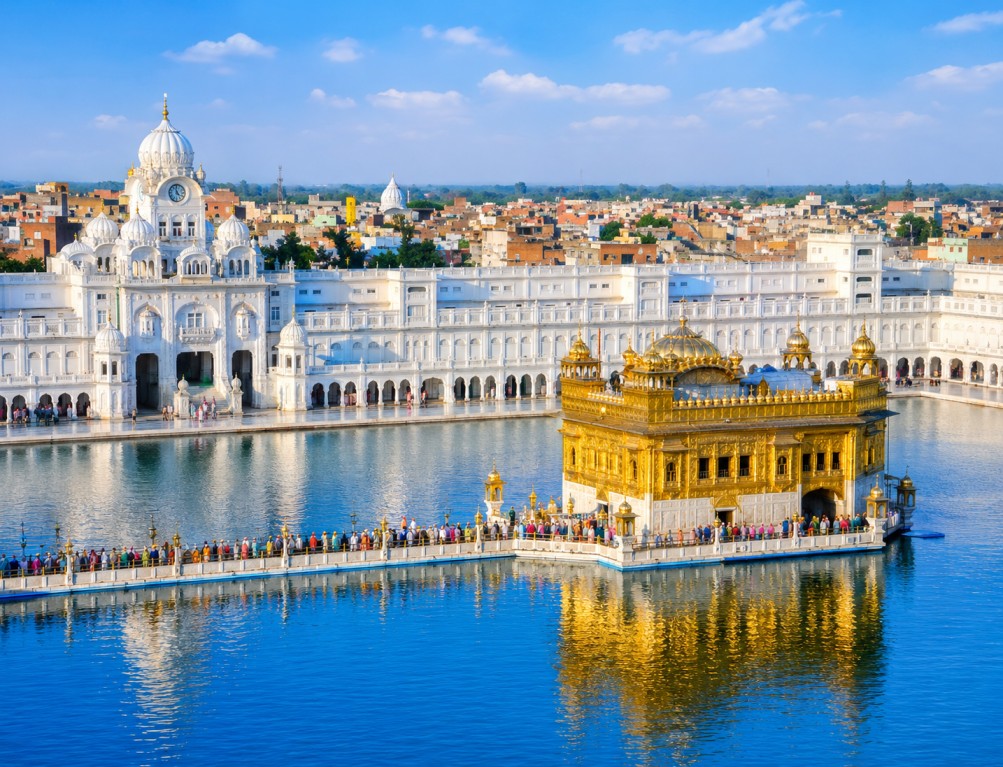
The Golden Temple stands as one of the most spiritually luminous and emotionally overwhelming destinations in India, representing the holiest shrine of the Sikh faith and a place of welcome, worship, and communal devotion that receives more visitors each day than almost any other religious site on earth. Situated at the heart of the city of Amritsar in the state of Punjab, the Golden Temple, known formally as Sri Harmandir Sahib or the Abode of God, is a destination of singular spiritual and architectural magnificence, offering a landscape defined by the gleaming gold-clad sanctum rising from the center of a sacred pool of nectar known as the Amrit Sarovar, the vast white marble causeway that connects the sanctum to the surrounding parikrama, the continuous and deeply moving recitation of Gurbani that fills the air at every hour of the day and night, and an atmosphere of profound devotional calm and universal welcome that embraces every visitor regardless of faith, background, or nationality. The destination draws Sikh pilgrims, spiritual seekers, history enthusiasts, and curious travelers from every corner of the world, offering an encounter with a living religious tradition of extraordinary vitality and a sacred architecture of breathtaking beauty that together create one of the most moving and memorable experiences available anywhere in the Indian subcontinent.
What distinguishes the Golden Temple from other religious heritage sites in India is not merely the magnificence of its gilded architecture or the depth of its spiritual significance, but the unique combination of universal welcome, living devotional practice, communal service of extraordinary scale, and the sheer emotional power of the sacred pool setting embedded within the busy urban fabric of one of Punjab's most vibrant and historically resonant cities. The complex is anchored by the Harmandir Sahib itself, its upper two storeys covered in approximately 750 kilograms of gold leaf that reflects with blinding brilliance in the waters of the Amrit Sarovar, and complemented by the Akal Takht, the temporal seat of Sikh authority, the vast langar or community kitchen that serves free meals to tens of thousands of visitors daily regardless of caste, creed, or station, and the rich complex of historical buildings, memorial shrines, and museum galleries that together compose one of the most layered and humanly significant sacred complexes in the world. This character elevates the Golden Temple beyond a simple pilgrimage site into a destination of profound spiritual, architectural, and humanitarian discovery.
Gold Leaf Used
~750 kilograms
Daily Langar Meals
Tens of thousands — free, every day
Daily Visitors
100,000+ on ordinary days
Formal Name
Sri Harmandir Sahib
Reasons to Visit Why Visit the Golden Temple
The recognition of the Golden Temple as one of the most visited sacred sites on earth, receiving an estimated one hundred thousand or more visitors on ordinary days and significantly more during festival periods, reflects its unparalleled importance within the global landscape of religious heritage and living spiritual practice. Unlike historically frozen monuments or architecturally focused heritage sites, the Golden Temple offers a cohesive experience where breathtaking sacred architecture, continuous devotional music, the egalitarian spirit of the langar, and the collective emotional energy of thousands of pilgrims and visitors together create a destination of exceptional spiritual power and human warmth.
One of the most compelling reasons to visit is the experience of the Amrit Sarovar itself, the sacred pool that surrounds the central sanctum and whose still waters reflect the golden shrine in an image of extraordinary beauty at every hour of the day. The act of walking the marble parikrama around the pool, watching the reflection of the gilded temple shift with the changing light from the pale gold of early morning to the deep amber of evening, and listening to the unbroken flow of sacred music drifting across the water, creates a sensory and emotional experience of rare depth and power that stays with the visitor long after departure.
Additionally, the Golden Temple showcases a profound expression of the Sikh principle of seva or selfless service through the langar, the free community kitchen that operates continuously through every hour of the day and night, serving simple, nourishing meals to every person who enters regardless of their identity or circumstance. Participating in the langar, whether as a recipient of the meal or as a volunteer in its preparation and service, offers an encounter with the practical expression of spiritual egalitarianism at a scale and with a consistency that is simply without parallel anywhere in the world. The combination of sacred architectural beauty, living devotional practice, historical depth, and the profound human warmth of the langar further strengthens its appeal as a destination of entirely unique and deeply moving character.
Landmarks & Attractions Key Highlights Within the Area
Among the architectural landmarks, the Harmandir Sahib itself stands out as the most iconic and visually overwhelming feature of the Golden Temple complex. Rising from the center of the Amrit Sarovar on a square marble platform, the two-storeyed sanctum is approached by the causeway known as the Guru's Bridge and presents a facade of gilded copper panels, intricate floral inlay work in the pietra dura tradition, and ornate arched entrances on all four sides that reflect the synthesis of Hindu and Islamic architectural elements central to the aesthetic vision of the Sikh Gurus who designed it. The reflection of the golden structure in the still waters of the sacred pool below, particularly in the first light of dawn and the illuminated stillness of the night, creates a visual experience of extraordinary sacred beauty that represents one of the most magnificent architectural spectacles in all of India.
The Akal Takht, standing directly opposite the main causeway entrance and serving as the supreme seat of temporal authority within the Sikh faith, is another landmark of profound significance. Its imposing white facade and the daily ceremony of the Palki Sahib, in which the Guru Granth Sahib is carried in a golden palanquin between the Harmandir Sahib and the Akal Takht at dawn and dusk each day, add a layer of living ceremonial grandeur to the complex that connects visitors directly to the continuing traditions of Sikh governance and devotional practice.
The Jallianwala Bagh, situated a short distance from the Golden Temple complex and preserved as a national memorial to the victims of the 1919 massacre, adds a dimension of profound historical and human significance to any visit to Amritsar. The bullet marks still visible on its walls and the Martyrs Well where civilians sheltered from the gunfire carry a weight of historical memory and emotional gravity that makes this one of the most affecting historical sites in northern India.
The visual experience of the Golden Temple changes dramatically with the time of day, as the pre-dawn hours bring a quality of still and luminous beauty to the complex when the illuminated sanctum reflects on the dark surface of the pool in the silence before the city awakens, while the evening brings the ceremony of the closing of the Golden Temple, known as the Palki Sahib, in an atmosphere of collective devotion and ceremonial splendor that draws thousands of pilgrims to the parikrama for one of the most moving religious ceremonies in India.
Things to Do Activities
Circumambulating the Amrit Sarovar along the marble parikrama is the most sacred and universally practiced activity within the Golden Temple complex, with pilgrims and visitors of every background completing the circuit of the sacred pool at all hours of the day and night in an act of devotional engagement with the landscape of the shrine and the continuous sacred music that accompanies every moment of the experience. The parikrama, with its views across the pool to the gilded sanctum at every point of the circuit, offers a succession of perspectives on the Harmandir Sahib that reveal the extraordinary quality of its reflection and its architectural detail across the changing light of the day.
Participating in or witnessing the langar at the Golden Temple is an experience of profound and lasting human significance, with the vast community kitchen operating on a scale that requires the preparation and service of enormous quantities of simple vegetarian food around the clock every day of the year. Sitting together on the floor of the langar hall to share a meal with pilgrims, laborers, tourists, and devotees from every background and station in a single egalitarian act of communal nourishment represents the Sikh principle of equality made physically and practically real in a manner that is genuinely unlike any other experience available at a religious site anywhere in the world.
Visiting the Central Sikh Museum located within the Golden Temple complex is a deeply informative and emotionally powerful complement to the devotional experience of the shrine, with its galleries presenting the history of the Sikh faith, the lives of the ten Gurus, and the long tradition of Sikh sacrifice and resistance through paintings, manuscripts, and artifacts of considerable historical significance. The Wagah Border ceremony, conducted each evening at the India-Pakistan border approximately 30 kilometres from Amritsar, is also widely undertaken as a complementary visit, offering a dramatically different but equally memorable experience of national pride, military ceremony, and the visible proximity of the subcontinent's partition history.
🗓️ Best Time to Visit
Ideal Season
The most favorable period to visit the Golden Temple is from October to March, when temperatures in Amritsar are pleasantly cool, the winter clarity of the northern Punjab air sharpens the views across the Amrit Sarovar, and the comfortable conditions make extended time on the marble parikrama and within the complex particularly enjoyable. During these months, the cool mornings and clear evenings create the most atmospherically beautiful conditions for experiencing the illuminated sanctum reflected on the still water of the sacred pool at the beginning and end of each day.
Festivals & Summer
The festival of Baisakhi in April, marking the founding of the Khalsa by Guru Gobind Singh in 1699, transforms the Golden Temple and the city of Amritsar into a landscape of extraordinary devotional energy and celebration, drawing enormous numbers of pilgrims from across Punjab and the global Sikh diaspora for one of the most significant and vibrant festivals in the Sikh religious calendar. The period of Gurpurabs, the birth and death anniversaries of the Sikh Gurus, similarly brings a heightened devotional intensity to the complex throughout the year, with the nighttime illumination of the shrine during these festivals creating a spectacle of sacred beauty of particular magnificence.
Summer Months (April–June)
The summer months from April to June bring considerable heat to the Punjab plains, making extended outdoor time on the marble parikrama demanding during the middle hours of the day, though the Golden Temple remains open and fully active at every hour and the early morning and evening periods remain deeply rewarding for visitors who plan their timings around the cooler parts of the day.
Getting There Connectivity
The Golden Temple is situated at the heart of Amritsar, one of the most well-connected cities in Punjab and the primary cultural and spiritual capital of the state, making it exceptionally accessible from across northern India and from international destinations with a significant Sikh diaspora community.
By Air
Sri Guru Ram Dass Jee International Airport in Amritsar offers regular domestic flights from Delhi, Mumbai, and other major Indian cities, as well as international flights connecting Amritsar directly to destinations in the United Kingdom, Canada, and the Middle East, reflecting the global significance of the city to the worldwide Sikh community.
By Rail
Rail connectivity is well established, with Amritsar Junction serving as a major railway station with regular and frequent services from Delhi, Chandigarh, Jammu, and other major cities across northern India, including several dedicated express trains that make the journey from Delhi to Amritsar in under six hours.
By Road
Road connectivity from Delhi, Chandigarh, Ludhiana, and Jalandhar is efficient and well maintained, with the national highway network placing Amritsar within a comfortable driving distance from the major urban centers of Punjab and the National Capital Region.
This makes the Golden Temple an entirely practical and deeply rewarding inclusion in any northern India travel itinerary, as well as a natural companion destination for travelers combining the spiritual experience of Amritsar with visits to the Wagah Border, the Partition Museum, the heritage havelis of the old walled city, and the broader cultural and historical landscape of the remarkable state of Punjab.