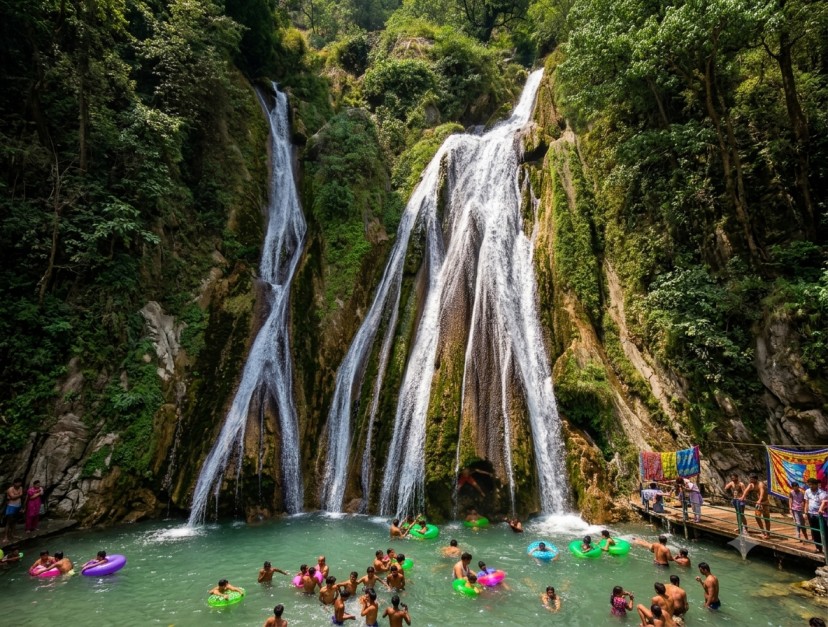
Kempty Falls
A colonial-era waterfall roughly 15 km from Mussoorie in the Garhwal Himalayas, cascading nearly 40 feet into natural pools framed by forested hills — one of northern India's most consistently visited scenic stops.
Landscape & seasonal character
A cool-climate waterfall stop that changes character sharply between monsoon and dry season.
Kempty Falls sits within rolling forested hills, with water flowing over rocky cliffs into a series of natural pools. Summer brings pleasant temperatures suited to sightseeing and pool access, while the monsoon significantly increases water volume and flow intensity, altering both the visual scale of the falls and ground conditions on surrounding paths.
Mist off the cascade, combined with green hillsides and shifting cloud cover, makes the site a consistently strong stop for scenic and portrait photography across most of the year.
Colonial-era origin
One of the few Indian hill-station attractions with a documented British-era founding story still attached to its name.
The site was developed as a picnic destination during the colonial period, associated with British officer John Mekinan. The name "Kempty" is widely linked to "Camp-Tea," referencing tea parties and camping gatherings once organised here by British officials. It has since grown into one of Uttarakhand's most consistently visited attractions, functioning as a core stop for travelers based in Mussoorie.
Falls, ropeway & the wider Mussoorie circuit
Lower pool
The main bathing and gathering area at the base of the falls, most active with families in summer.
Ropeway
An aerial ride offering panoramic views over the waterfall and surrounding valley.
Waterfall market
A cluster of eateries and souvenir stalls adjacent to the falls, forming the site's commercial core.
Mussoorie Mall Road
The town's central promenade, commonly paired with a Kempty Falls visit in a single-day plan.
Gun Hill & Lal Tibba
Elevated viewpoints over the Himalayan range, both within short reach of central Mussoorie.
Camel's Back Road & Cloud's End
Additional walking and scenic stops used to extend a Mussoorie sightseeing itinerary.
Outdoor activity & onward routing
Core activities at the site are nature walks, photography, and bathing in designated pool areas, with short hikes possible on the surrounding hillside. The location also functions as a routing point — travelers commonly continue toward broader Mussoorie sightseeing, or onward toward Yamunotri for more extensive Himalayan itineraries.
Cuisine & local craft
Regional dishes
Local market goods
Seasonality & transport reference
| Recommended season | March to June and September to November, for pleasant conditions across sightseeing and pool activities. |
| Monsoon consideration | Waterfall volume increases, but surrounding paths become slippery; routing should account for reduced ground safety margins. |
| Nearest airport | Jolly Grant Airport, Dehradun, approximately 60 km away. |
| Rail access | Dehradun Railway Station, the nearest major railhead with wide national connectivity. |
| Road access | Regular taxi, bus, and private vehicle connections from both Dehradun and Mussoorie. |
Traveler segments this destination serves
Designated pool bathing and a compact market make this a low-complexity, high-satisfaction family stop.
Proximity to Mussoorie allows the falls to anchor a short romantic getaway alongside Mall Road and viewpoint stops.
Consistent mist, greenery, and cloud movement support reliable photographic output across most of the visiting season.
Functions as a routing stop for travelers continuing toward broader Garhwal or Yamunotri itineraries.
A documented colonial-era founding narrative adds a historical layer distinct from the site's scenic draw.