🕉️ Kurukshetra, Haryana: Where Mythology Walks Alongside You
Few destinations in India carry the weight of history, philosophy, and faith as quietly — yet as powerfully — as Kurukshetra. Tucked in the northeastern corner of Haryana, about 170 km north of Delhi, this ancient city sits at the intersection of legend and landscape, where the epic Mahabharata wasn't just written but reportedly lived. For the spiritually inclined, the historically curious, and the culturally aware traveler, a visit to Kurukshetra is less a sightseeing trip and more a conversation with the Indian subcontinent's oldest stories.
Known by its Sanskrit name Dharmakshetra — the land of righteousness — Kurukshetra is widely regarded as the birthplace of the Bhagavad Gita and the site of the great Kurukshetra War between the Pandavas and Kauravas. Whether you come seeking spiritual peace, historical perspective, or simply a meaningful break from the rush of modern travel, this city earns its place on any thoughtful itinerary.
👑 A City Named After a King
The city derives its name from King Kuru, an ancestor of both the Pandavas and Kauravas in the Mahabharata, who is said to have performed supreme sacrifices on this land to bestow prosperity upon his people. The city was also historically known as Thanesar or Sthaneshwar — a Sanskrit term meaning place of God — a name that French traveler François Bernier and Mughal historian Abul Fazl both referenced in their accounts of the region. Archaeological evidence suggests that Kurukshetra was inhabited even during the pre-Harappan period, making it one of India's genuinely ancient settlements.
Over the centuries, it came under the sway of the Mauryas (Ashoka reportedly made it a centre of learning), the Guptas, the Pushyabhutis, and eventually the Mughal Empire — each era leaving its mark. Walking through Kurukshetra today, you encounter this layered past at every turn.
🌊 Sacred Waters: Brahma Sarovar and Sannihit Sarovar
The spiritual heart of Kurukshetra is the Brahma Sarovar, a vast sacred water tank believed to have been created by Lord Brahma himself. One of the largest sacred ponds in Asia, it is most breathtaking at dawn and dusk, when the water surface catches the shifting light in shades of copper and gold. Pilgrims come to bathe here, particularly during solar eclipses, when the tank draws hundreds of thousands of devotees from across the country. A shrine dedicated to Lord Shiva stands on the northern bank, with the belief that the linga inside was installed by Brahma himself.
Equally significant is the Sannihit Sarovar, believed to be the confluence of seven tributaries of the sacred Saraswati River. On Amavasya (new moon nights), pilgrims throng here in the belief that a ritual dip equals the spiritual merit of performing numerous Ashvamedha Yagnas — a highly revered Vedic ceremony. For photographers, both these water bodies offer extraordinary compositions, especially in the early morning hours when mist rises over still water.
📖 Jyotisar: Where the Gita Was Born
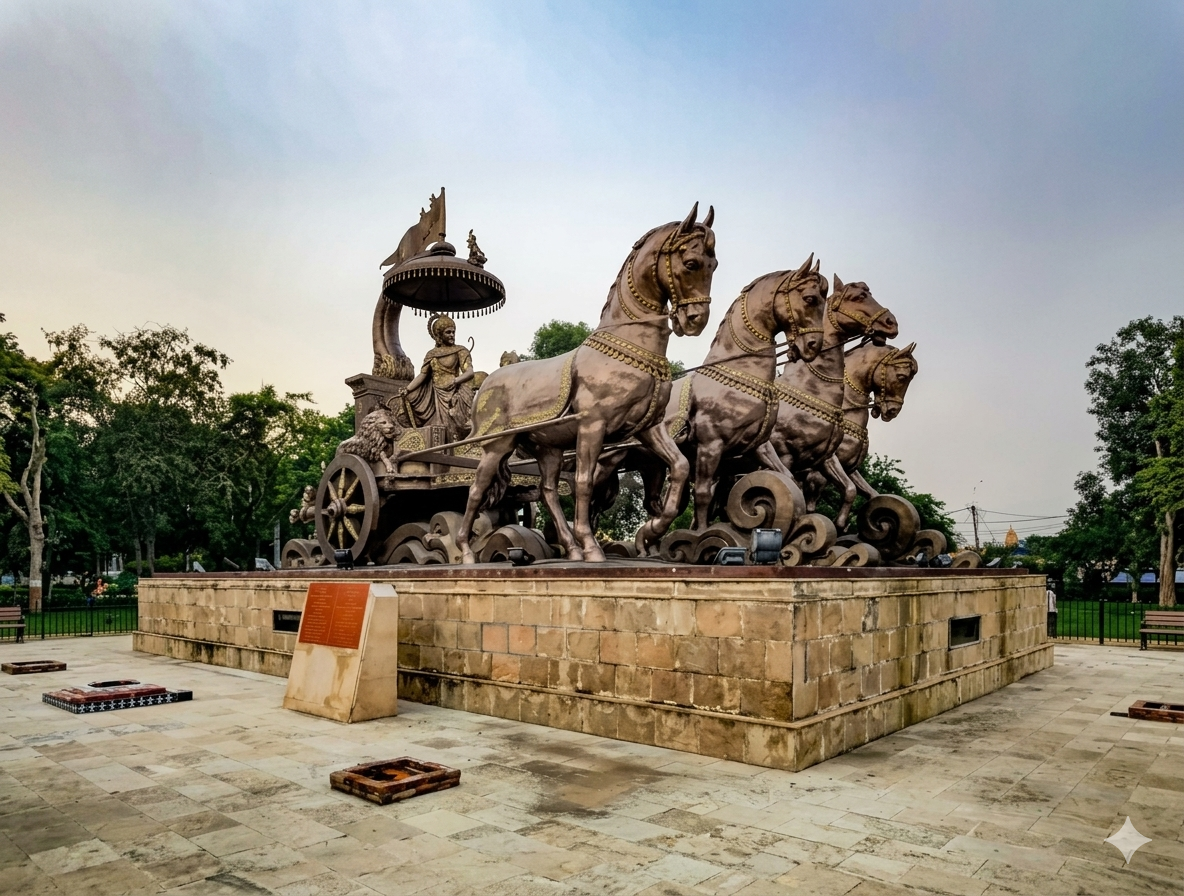
No visit to Kurukshetra is complete without standing at Jyotisar, the small but profoundly significant site where Lord Krishna is believed to have delivered the Bhagavad Gita to the warrior Arjuna before the great battle. A centuries-old banyan tree marks the sacred spot, revered by Hindus as a living witness to that divine discourse. The Haryana Tourism Department stages a compelling Light and Sound Show here after dark, narrating the moment Krishna revealed his Virat Roop (universal form) to Arjuna — a production that leaves most visitors visibly moved. The bronze chariot of Lord Krishna installed at the site makes for one of Kurukshetra's most iconic photographs.
🏛️ Major Attractions and Cultural Landmarks
Bhishma Kund at Narkatari recalls one of the Mahabharata's most poignant moments — where the great warrior Bhishma, laid on a bed of arrows, asked for water, and Arjuna shot an arrow into the ground to bring forth a spring. The water body that exists there today carries that name and that story.
Sthaneshwar Mahadev Temple, one of Kurukshetra's oldest shrines, is where the Pandavas are believed to have sought Lord Shiva's blessings before the battle. The healing tank within the temple premises adds to its spiritual reputation.
Bhadrakali Temple, one of the 51 Shakti Peethas in Hindu tradition, is another compelling stop. The Pandavas are said to have offered prayers here before the final confrontation with the Kauravas. The temple's ancient energy is palpable even to non-religious visitors.
For those interested in Mughal heritage alongside the Mahabharata narrative, Sheikh Chilli's Tomb offers a welcome change of architectural register. Built in Persian style with intricate floral designs, red sandstone construction, and beautifully maintained gardens, the complex includes a mosque, a madrasa, and an Archaeological Museum — an often-overlooked gem that rewards the patient explorer.
The Raja Harsh ka Tila is a 7th-century mound associated with the reign of Emperor Harshvardhan, excavated by archaeologist Alexander Cunningham and offering a window into one of North India's most celebrated medieval rulers.
🏺 Museums Worth Your Time
The Sri Krishna Museum houses six thoughtfully curated galleries presenting artefacts, paintings, and sculptures related to Lord Krishna and the Mahabharata, spanning from the 1st century AD to the 11th century AD. It's one of the most educational stops in the city.
The Kurukshetra Panorama and Science Centre is a standout for families and curious minds. It combines a life-like panoramic recreation of the Mahabharata battle with science exhibitions, astronomy displays, and mythology-meets-modernity presentations that make ancient stories accessible to children and adults alike.
The Kalpana Chawla Memorial Planetarium adds a forward-looking dimension to Kurukshetra's otherwise ancient identity — a fitting tribute to India's pioneering astronaut who hailed from Haryana.
The Dharohar Haryana Museum, located within Kurukshetra University, showcases the state's rich archaeological, cultural, and architectural heritage for those wanting a broader Haryana context.
🎉 Festivals: Gita Jayanti and Beyond
If you can time your visit for Gita Jayanti, usually held in November or December on the eleventh day of the waxing moon in the Hindu month of Margashirsha, you will witness Kurukshetra at its most electrifying. The city transforms into a festival of lights, religious processions, classical performances, folk music, seminars, and mass recitations of the Bhagavad Gita. Scholars and spiritual teachers gather from across India and abroad; cultural troops from other countries participate in dance and drama; and the ghats of Brahma Sarovar and Sannihit Sarovar become the backdrop for deeply moving Maha Aarti ceremonies.
Makar Sankranti in January brings another wave of pilgrims and a festive atmosphere of kite-flying, community meals, and ritual bathing.
🍲 Food: A Haryanvi Table
Kurukshetra's culinary identity is proudly rooted in the agricultural heartland of Haryana. The city is almost entirely vegetarian in its restaurant offerings, which is far less a limitation than it sounds — the local food is genuinely excellent. The everyday staple is roti made from wheat or bajra (pearl millet), served hot and best paired with Sarson ka Saag (mustard greens) in winter, Kadhi Pakora (a tangy yogurt curry with gram flour dumplings), or Singri ki Sabzi. Kachri ki Sabzi — made from a wild desert melon — is a distinctly Haryanvi preparation worth seeking out.
For dessert, Churma (crushed wheat with jaggery and ghee), Ghewar, and Kheer (creamy rice pudding) are the regional favourites. Wash everything down with a tall glass of fresh Lassi — thick, cold, and borderline restorative after a long day of temple-hopping.
🛍️ Shopping and Local Crafts
Kurukshetra's bazaars are relaxed and authentic. Look for religious items, rudraksha malas, copper and brass idols, and copies of the Bhagavad Gita in multiple languages — these make meaningful souvenirs. Phulkari embroidery from Haryana, known for its vibrant floral threadwork on fabric, is also available and represents a beautiful regional craft tradition.
📍 Nearby Attractions
Karna Lake in Karnal (36 km south) offers boating on a picturesque natural lake associated with the Mahabharata character Karna. Ambala (57 km north) is home to the Bhawani Amba Temple. The village of Amin, just a few kilometres from Kurukshetra, contains remnants of a fort believed to have belonged to Abhimanyu — a detail that would delight any Mahabharata enthusiast. Pehowa, 27 km west, is another ancient pilgrimage site with multiple sacred tanks.
❤️ Who Will Love Kurukshetra?
Pilgrims and spiritual seekers will find depth in every corner. History lovers will spend hours tracing pre-Harappan, Vedic, Mauryan, and Mughal threads. Families will appreciate the Panorama Centre and the Kalpana Chawla Planetarium. Couples looking for a peaceful, meaningful getaway far from commercial tourism will find the ghats at dawn genuinely romantic. Photographers have extraordinary material: sacred water tanks, ancient temples, ornate Mughal tombs, and festival crowds. Solo travelers can move comfortably through the compact city in one or two days, with most attractions close to one another.
📅 Practical Travel Information
🌤️ Best Time to Visit
The ideal window for visiting Kurukshetra is October to March, when temperatures are comfortable — winter ranges from around 7°C to 22°C. Summer temperatures can climb to 42°C and make outdoor exploration difficult; monsoons (June to September) are hot and humid. The Gita Jayanti period (November–December) is the most atmospheric time to visit, though accommodation books up quickly.
🚆 How to Reach Kurukshetra
Kurukshetra has its own railway junction and is well-connected to Delhi, Chandigarh, Amritsar, and other major cities. The nearest airport is Chandigarh, approximately 83 km away; Delhi's Indira Gandhi International Airport is about 173 km south. State roadways and private buses connect the city to Delhi, Chandigarh, Panipat, Ambala, and beyond. Within the city, auto-rickshaws are the most practical way to get around.
🧳 Travel Tips
- Dress modestly when visiting temples and sacred sites.
- Most major attractions are free or charge a nominal fee.
- The city is compact — two full days are enough for a thorough visit, though one day is workable.
- Early mornings at Brahma Sarovar are deeply peaceful and worth the early alarm.
- During Gita Jayanti and solar eclipses, accommodation must be booked well in advance.
- Non-vegetarian food is not widely available in the city; plan accordingly.
✨ Final Reflection
Kurukshetra doesn't announce itself with drama. It draws you in slowly, through the stillness of its sacred tanks, the weight of its stories, and the quiet dignity of a city that has been a center of civilization for thousands of years. Whether you leave with a deeper understanding of the Mahabharata, a moment of genuine stillness by the Brahma Sarovar at sunrise, or simply a bowl of Kheer that tasted unlike any you've had before, Kurukshetra tends to stay with you long after you've left.