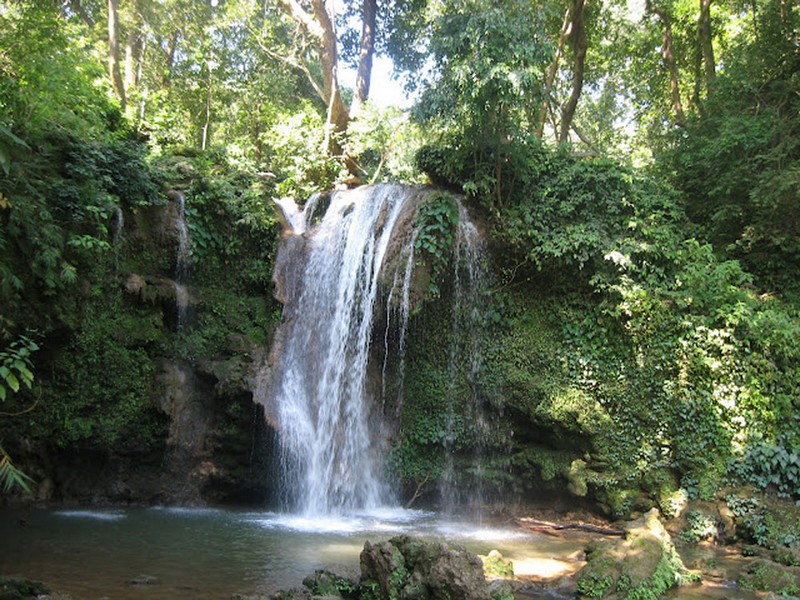
A waterfall, cave and temple site set inside working forest
Rudradhari Falls sits near Kantali village in Bageshwar district, reached by a short forest trek from the Kausani–Almora road. The site combines a cascading waterfall, caves associated with meditation by Lord Shiva and Lord Vishnu, and the Rudradhari Temple — a compact pilgrimage-and-nature stop rather than a full-day destination.
Geography and approach
The site is reached on foot from the road, through forest and terraced farmland, with the waterfall as the final point of the trail.
Forest trail
The approach passes through pine, deodar, oak and rhododendron forest and terraced fields before reaching the falls — the walk is part of the visitor experience, not incidental to it.
The waterfall
Water cascades over rocky cliffs into a clear mountain stream, framed by dense greenery — the central photographic subject of the site.
Viewpoints
Clear-day sightlines from the trail extend to snow-clad Himalayan peaks, in addition to valley views over surrounding farmland.
Religious and spiritual significance
Local tradition holds that Lord Shiva and Lord Vishnu meditated in the caves beside the falls, making the site an active place of pilgrimage rather than a purely scenic stop.
Rudradhari Temple
Dedicated to Lord Shiva and Lord Vishnu, the temple draws pilgrims for prayer in a natural setting distinct from larger, more built-up temple towns in the region.
Meditation caves
The caves surrounding the temple are traditionally associated with sages and meditation, and remain in occasional use for quiet reflection today.
Seasonal water flow
Flow volume varies through the year — a relevant planning factor for both photography product and trail-safety briefing.
Product themes
What the site supports well, organised by traveller interest.
Light trekking & nature walks
The forest trail to the falls suits hiking and nature-walk product at an easy-to-moderate grade, with strong birdwatching potential along the route.
Pilgrimage add-on
The Rudradhari Temple and meditation caves work as a devotional stop within a wider Kumaon pilgrimage or cultural circuit.
Photography
The waterfall, forest, caves, mountain backdrop and wildflowers in bloom give strong seasonal variation for photography-led itineraries.
Meditation & quiet retreat
The caves and surrounding forest support meditation and yoga in a genuinely quiet setting, distinct from purpose-built retreat centres.
Wildlife interest
Forest cover supports barking deer, Himalayan langur, Himalayan black bear in remote tracts, yellow-throated marten, Himalayan monal and migratory bird species.
Circuit positioning
Sits between Kausani and Almora with Baijnath Temple, Someshwar Valley, Binsar Wildlife Sanctuary, Anasakti Ashram and the Katyuri temples all within reach.
Access and routing
Reached by road to Kausani, followed by a short trek from road to waterfall and temple.
| Gateway | Distance / Note | Onward journey |
|---|---|---|
| Pantnagar Airport | Approx. 170 km | By road via Kausani |
| Kathgodam Railway Station | Nearest railhead | Well connected to major North Indian cities; onward by road |
| Kausani | Closest hub town | Local taxi or private vehicle, then a short trek to the falls |
Notes for itinerary planning
Practical points relevant to routing and guest briefing.
- Footwear: The forest trail is uneven underfoot; trekking shoes are necessary, particularly if scheduling during monsoon months.
- Monsoon caveat: July–August brings the strongest waterfall flow but also the slipperiest trail conditions — factor this into safety briefing and pacing.
- Temple etiquette: Modest dress is expected at the Rudradhari Temple; standard local custom applies.
- Supplies: No significant amenities at the site itself — guests should carry drinking water, snacks and rain protection.
- Local guiding: Using local guides supports the surrounding villages and improves navigation on less-marked forest stretches.
Nearby Places To Visit