```html
🏔️ Sangla Valley — The Himalayas at Their Most Untouched
A valley so beautiful, the mountains seem to have built it just to show off.
🌄 Introduction
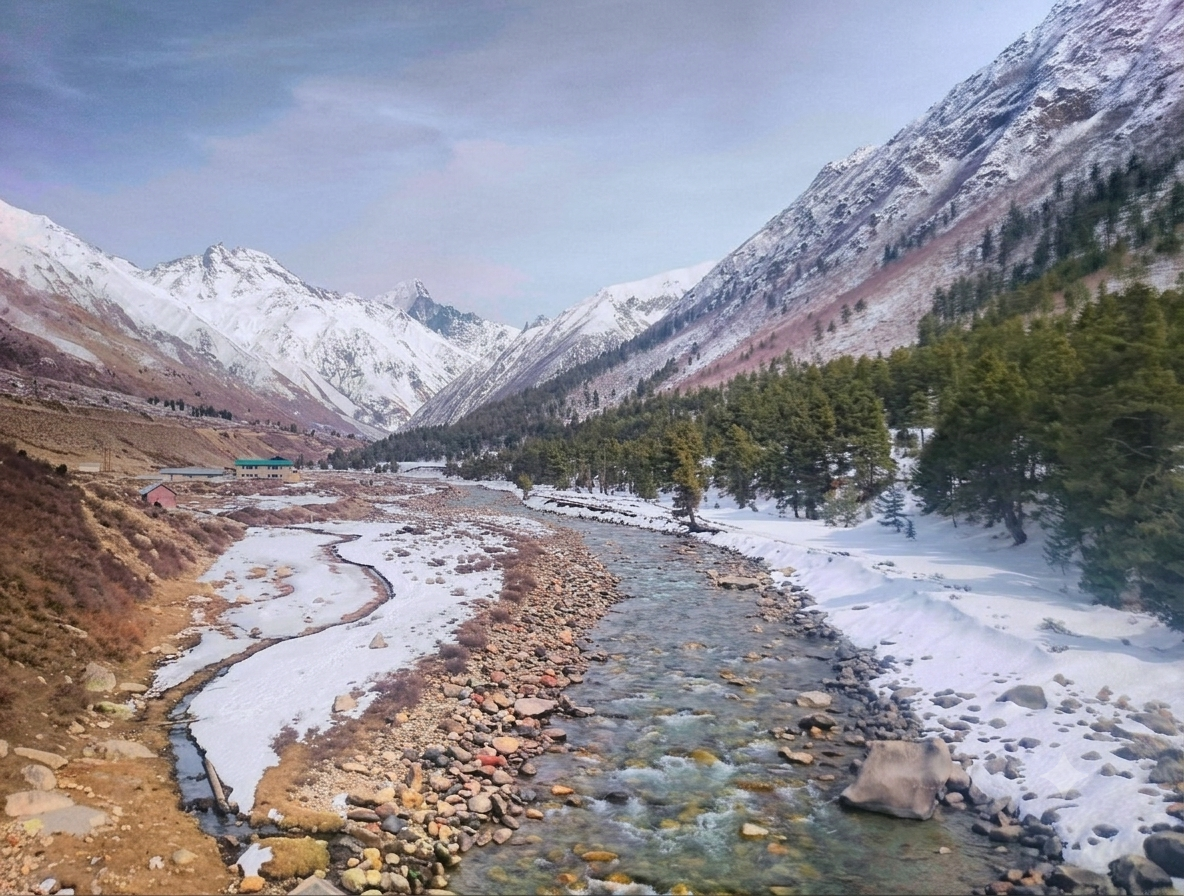
Hidden deep in the Kinnaur district of Himachal Pradesh, Sangla Valley runs along the banks of the roaring Baspa River — a tributary of the Sutlej — cutting through some of the most dramatic mountain terrain in the entire Indian Himalaya. At an altitude ranging from 8,500 to nearly 11,000 feet, the valley stretches roughly 25 kilometres from the town of Karcham at its mouth to the village of Chitkul at its head — the last inhabited village on the Indo-Tibet border and the last point any Indian citizen can reach before the border closes. In between lies a world of apple orchards heavy with fruit, ancient wooden temples with pagoda-style rooftops, tiny villages of stone and slate perched impossibly on cliffsides, and mountain walls so sheer and so enormous they seem less like geography and more like architecture. Sangla Valley is not a place that tries to impress you. It simply is what it is — and what it is happens to be one of the most beautiful places on earth.
❤️ The Soul of the Place
There is a quality to Sangla Valley that is difficult to articulate and impossible to manufacture. It is the quality of a place that has not yet decided to become a tourist destination. The villages — Sangla, Batseri, Kamru, Rakcham, Chitkul — feel lived-in and real, with locals going about the business of farming, weaving, and tending orchards with cheerful indifference to the visitors passing through. The Baspa River thunders through the valley floor, milky green with glacial silt, visible and audible from almost everywhere. The mountains above are not gentle rolling hills but vertical walls of rock and snow — Kinner Kailash, the sacred peak considered the winter home of Lord Shiva, dominates the skyline with an almost aggressive grandeur. Apple trees line the roads. Apricots dry on rooftops. Elderly women in traditional Kinnauri topis and striped woolens sit outside homes that are hundreds of years old. This is not a postcard. This is just Tuesday in Sangla Valley.
📅 Best Time to Visit
☀️ June to Mid-October
June to mid-October is the primary and most rewarding season. The roads are fully open, the valley is at peak green, the Baspa runs full and wild, and temperatures are pleasant during the day — around 15°C to 25°C — though nights turn cold quickly even in summer. July and August bring some rain, which can occasionally trigger landslides on the Hindustan-Tibet Highway, but the valley itself remains lush and accessible in most years. The apple harvest season from late August through October is a particularly magical time — the orchards turn heavy with red and golden fruit, the air smells faintly sweet, and the entire valley takes on a warm, golden-hour quality that photographers travel thousands of miles to capture.
🍂 Mid-October to November
Mid-October to November is a brief but spectacular shoulder window. The harvest is done, the crowds thin dramatically, the skies are crystal clear, and the mountains appear in their sharpest definition against an almost impossibly blue sky. Temperatures drop sharply after sunset and roads can ice over at night, but for those prepared for cold, this is arguably the most beautiful period of all — golden trees, snow-dusted peaks, empty roads.
❄️ December to May
December to May brings heavy snowfall that blocks the Hindustan-Tibet Highway, the main access road to the valley, typically from late November or December. The valley effectively closes to outsiders. Some hardy travellers attempt winter visits via helicopter or on foot, but this is strictly for the experienced and the well-equipped.
⭐ Top Things to Do
🚗 Drive to Chitkul — The End of the Road
If Sangla Valley has one unmissable experience, it is the drive to Chitkul — the last village on the Indo-Tibet border and the furthest point Indian citizens can reach along this corridor without special military permits. The road from Sangla follows the Baspa River upstream through Batseri and Rakcham, climbing steadily as the valley narrows and the mountains close in. Chitkul itself is a village of maybe 500 souls, ancient wooden homes, a centuries-old temple, and an army post beyond which the road ends and Tibet begins. The setting is staggering — surrounded on three sides by snow peaks, with the Baspa roaring below and prayer flags everywhere. Sit by the river, eat at one of the small dhabas run by local women, and let the silence do what silence does best.
🏯 Visit Kamru Fort and Temple
Above the town of Sangla, the ancient Kamru Fort watches over the valley from a rocky promontory. Built centuries ago by the local rulers, it houses a temple dedicated to Kamakhya Devi and offers sweeping views of the valley and the Baspa below. The climb up is short but steep, through a village of traditional Kinnauri homes with intricately carved wooden facades. Entry into the temple's inner sanctum requires removing leather items — belts, shoes, and wallets — in keeping with local custom. Respect it. The fort is one of the finest examples of Kinnauri wooden architecture and a window into the valley's deep cultural history.
🥾 Trek Through the Baspa Valley
The trail along the Baspa River from Sangla to Chitkul can be walked in a full day and is one of the most rewarding valley walks in Himachal Pradesh. Less strenuous than most Himalayan treks, it follows the river through forest, past waterfalls, across wooden bridges, and through apple orchards — with the mountains growing taller and closer with every kilometre. More ambitious trekkers can head upward from Chitkul toward the Charang La Pass or the Borasu Pass for high-altitude routes into Uttarakhand's Har Ki Dun region, though these require guides, permits, and proper expedition planning.
🏡 Explore Rakcham Village
Midway between Sangla and Chitkul, the tiny village of Rakcham is one of the most photographically satisfying spots in the entire valley. Old stone and wood homes cluster on a steep hillside above the river, surrounded by terraced fields and enormous pine trees. There is almost nothing to do here — which is precisely the point. Walking through Rakcham's lanes, watching village life, photographing the textured facades of homes that have stood for three centuries — this is slow travel at its finest.
🍎 Apple Orchard Walks
During harvest season, the apple orchards of Sangla and Batseri are open and extraordinary — row upon row of trees bending under the weight of fruit, with the mountains as a backdrop. Many orchard owners welcome visitors to walk through and buy fruit directly. The apples of Kinnaur are famous across North India for their flavour and crunch, and eating one straight from the tree with a Himalayan view in front of you is one of those small, perfect travel moments that no itinerary can fully plan for.
🦅 Birdwatching and Wildlife
The forests above the valley floor are home to Himalayan monals, koklass pheasants, snow pigeons, and dozens of other species. The upper reaches shelter snow leopards, Himalayan brown bears, and ibex — sightings are rare but not unheard of. The valley sits within the Rakchham-Chitkul Wildlife Sanctuary, which adds a layer of ecological significance and protection to the landscape.
🛣️ Getting There — Connectivity
The Route
Sangla Valley is accessed via the Hindustan-Tibet Highway (NH-5/NH-22), one of the most dramatic and occasionally terrifying mountain roads in India. The route runs from Shimla through Rampur and Karcham, where a turn off the main highway leads into the valley. The road is narrow, carved into cliffsides above the Sutlej and Baspa rivers, and subject to landslides and rockfalls — particularly during the monsoon months.
🚘 From Shimla (210 km)
Shimla is the most common starting point. The drive takes 7 to 9 hours depending on road conditions. Shared taxis and private cabs are available from Shimla's Rivoli Bus Stand. State buses run to Sangla and occasionally to Rakcham, but the service is infrequent and the journey considerably longer. A private cab or self-drive in a sturdy 4WD vehicle gives the most flexibility.
🚗 From Chandigarh (330 km)
Chandigarh to Sangla takes approximately 10 to 12 hours by road — a long day's drive best broken with a night halt in Rampur or Shimla. Chandigarh is the nearest city with good rail and air connectivity, making it the practical entry point for most visitors travelling from outside Himachal Pradesh.
🚆 Nearest Railway Station
Shimla on the narrow-gauge Kalka-Shimla Railway is the nearest hill station railhead. For broader connectivity, Kalka on the main Northern Railway network is the practical railhead, from where either a toy train or road connects to Shimla and onward. Rampur Bushahr on the highway has no rail connection but is a useful overnight stop on the drive in.
✈️ Nearest Airport
Shimla Airport (Jubbarhatti) is the nearest, though it operates limited flights. Chandigarh International Airport is the most practical option, with regular connections to Delhi, Mumbai, and other major cities. From Chandigarh, the drive to Sangla is a full day — ideally with a night stop en route.
🌟 Final Reflections
Sangla Valley rewards a particular kind of traveller — one who is not in a hurry, not dependent on Wi-Fi, and not looking for a curated, packaged experience. It rewards those who are willing to let a place set the pace rather than imposing their own. Drive slowly. Stop when something looks beautiful, which will be often. Talk to the apple farmers. Sit by the Baspa and listen to it. Walk to Chitkul not because it is the last village but because the road there is one of the most extraordinary you will ever walk. Let Kinner Kailash watch over you from its impossible height and feel, just briefly, the particular humility that only very large mountains can produce.
Sangla Valley will not trend on social media the way Spiti or Kasol do. It is quieter than that, deeper than that, and ultimately more rewarding than that.
Some valleys are destinations. Sangla is an experience — one that stays folded somewhere behind your ribs long after you've driven back down to the highway and re-entered the world.
Nearby Places
```