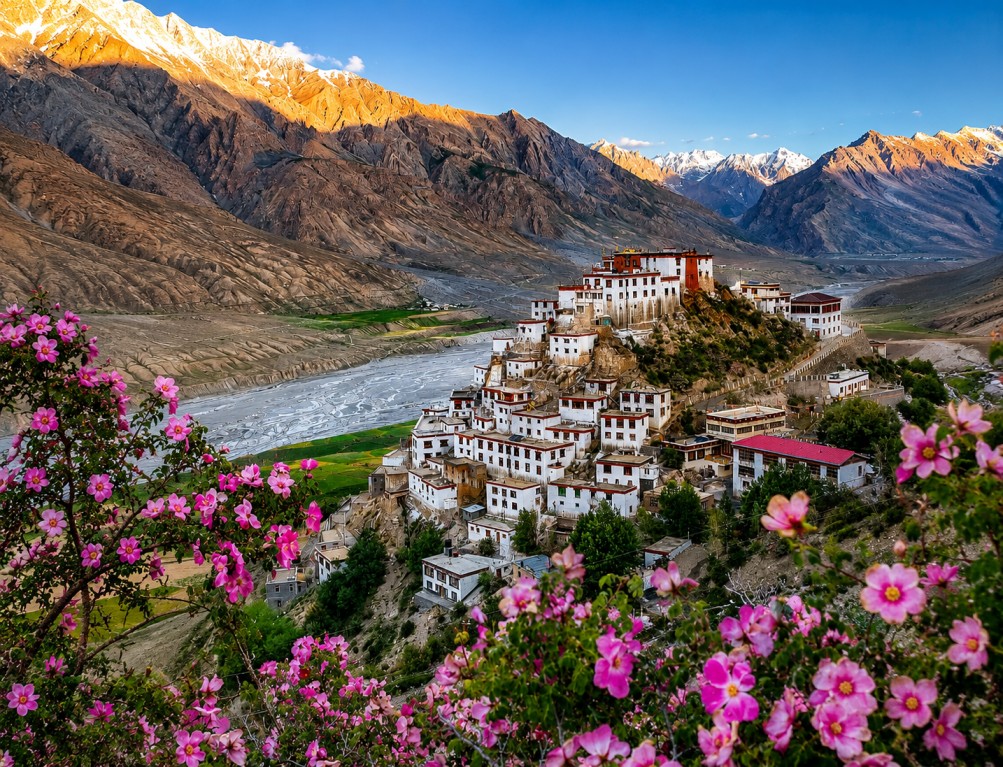
Spiti Valley
A high-altitude cold desert between Tibet and Ladakh, running 3,000 to over 5,000 metres in elevation — home to centuries-old Buddhist monasteries, glacial lakes, and some of the highest inhabited villages on earth.
Natural landscape & terrain
A cold desert profile that stands apart from the rest of Himachal Pradesh's green Himalayan valleys.
Spiti presents rocky cliffs, colourful mineral-streaked mountains, alpine meadows, and high-altitude lakes rather than forest cover. The Spiti River runs through the valley, sustaining villages built around barley fields, willow stands, and poplar plantations along its banks.
Summer brings clear skies and comfortable daytime temperatures suited to road travel and trekking. Winter closes most through-routes and brings extreme cold, but leaves the valley under sustained snow cover for a distinctly different season profile.
History & living Buddhist culture
Over a thousand years of continuous Tibetan Buddhist practice, still active rather than preserved as ruin.
Ancient monasteries, prayer flags, chortens, and mud-brick village architecture reflect Spiti's long-standing cultural ties with Tibet. Local communities sustain themselves through agriculture and animal husbandry alongside Buddhist religious practice, and welcome visitors into village life through local homestays.
Recurring festivals
Key monasteries, villages & landmarks
Key Monastery
The valley's largest and most recognisable monastery, set on a hilltop with panoramic mountain views.
Tabo Monastery
Referred to as the "Ajanta of the Himalayas," among the oldest continuously operating monasteries in the region.
Dhankar Monastery
A cliffside monastery overlooking the confluence of the Spiti and Pin rivers.
Chandratal Lake
A crescent-shaped high-altitude lake known for its turquoise water and reflective mountain backdrop.
Kaza, Langza, Hikkim, Komic
High-altitude villages; Hikkim holds the world's highest post office and Komic ranks among the highest motorable villages.
Kunzum Pass & Pin Valley
A high mountain pass connecting Spiti to Lahaul, bordering Pin Valley National Park.
Adventure & outdoor programming
Trekking routes including Pin Parvati Pass, Parang La, and the Dhankar Lake Trek run through glaciers, alpine meadows, and remote terrain. The valley also supports mountain biking, off-road driving, camping, rock climbing, and river-based photography.
Low light pollution and consistently clear night skies make Spiti one of India's strongest locations for astrophotography and Milky Way viewing. Road journeys into the valley from Manali or Shimla are themselves considered part of the Himalayan travel experience, running through high passes and dramatic cliff roads.
Wildlife, cuisine & local craft
A high-altitude ecosystem supporting rare species, alongside a compact but distinct culinary and craft economy centred on Kaza.
High-altitude species
Snow leopards, Himalayan ibex, blue sheep (bharal), red foxes, Himalayan wolves, marmots, golden eagles, and Himalayan griffon vultures. Pin Valley National Park is a noted snow leopard conservation area.
Spitian & Tibetan fare
Thukpa, momos, tingmo, butter tea, barley dishes, yak cheese, and noodle soups, largely served through homestays alongside local peas and potatoes.
Kaza market goods
Seasonality & transport reference
| Recommended season | May to October, while roads remain open and conditions support sightseeing, trekking, and road travel. |
| Nearest airport | Kullu–Manali Airport (Bhuntar). |
| Nearest railhead | Chandigarh, the closest broad-gauge railway station. |
| Route 1 | Shimla–Kinnaur road, which stays accessible for a longer portion of the year. |
| Route 2 | Manali via Kunzum Pass, generally open from late spring to early autumn only. |
| Connectivity | Mobile network coverage is restricted in many parts of the valley; offline maps recommended for routing. |
Traveler segments this destination serves
High-altitude trekking routes and off-road terrain suited to experienced adventure travelers and biking groups.
Dramatic mountain scenery combined with minimal light pollution supports both landscape and night-sky photography programming.
Active Buddhist monasteries and homestay-based village life offer immersive cultural access beyond monument viewing.
Villages such as Kaza and Langza allow for a paced, low-intensity itinerary alongside more strenuous adventure segments.
Pin Valley National Park's snow leopard habitat draws dedicated wildlife and conservation-focused travelers