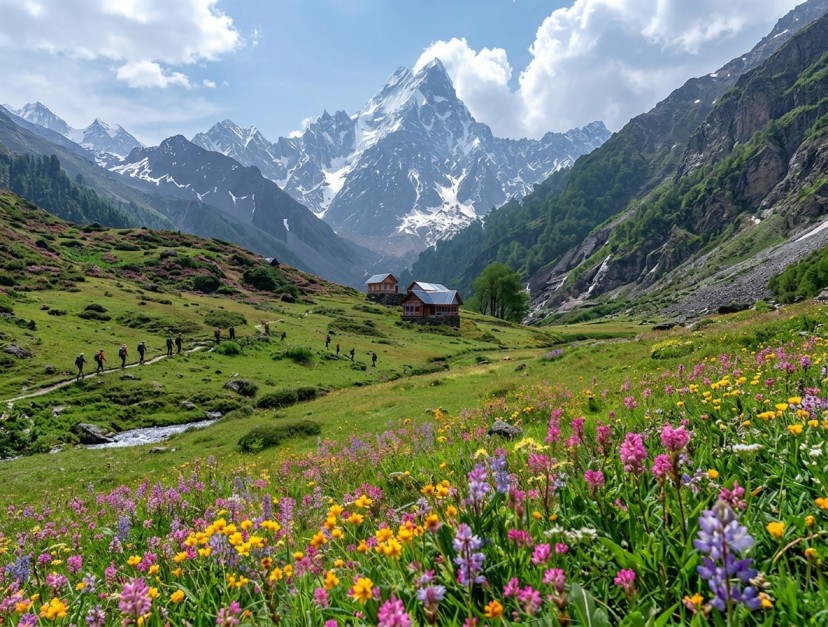
Valley of Flowers
A high-altitude alpine meadow in the Western Himalayas that transforms each summer into a dense bloom of hundreds of flower species — reachable only on foot, through a multi-day trek via Govindghat and Ghangaria.
A brief, narrow window of extraordinary bloom
The valley spends most of the year under snow, and only a few summer weeks as its namesake floral landscape.
During the blooming season, the valley floor and slopes fill with alpine flowers, with different species peaking across different weeks of the window. This shifting display is central to the destination's appeal, alongside its status as a site of significant ecological research value, home to plant species that are rare or endemic to this specific Himalayan region.
Outside the bloom season, the site's appeal and accessibility both drop sharply, making timing the single most important planning variable for any itinerary built around it.
The journey in: Govindghat to the valley
Most itineraries follow the same sequence of stops, each serving a distinct logistical function.
Where road access ends and the trekking portion of the journey begins.
Primary base for day trips into both the valley and Hemkund Sahib.
Trail network through bloom-covered meadows, framed by surrounding peaks.
High-altitude Sikh pilgrimage site beside a glacial lake, typically visited from the same base.
What the itinerary is built around
Trekking
The core multi-day journey through forest, alpine terrain, and meadow.
Nature photography
Flowers, mountain backdrops, and shifting high-altitude light across the trek and valley.
Birdwatching
High-altitude bird species observed most actively during the summer bloom months.
Pilgrimage tourism
The Hemkund Sahib trek, commonly combined with the Valley of Flowers given their proximity.
Flora, fauna & trek character
Hundreds of flowering species bloom in sequence across the summer months, adapted specifically to this high-altitude environment. The surrounding region also supports wildlife adapted to alpine conditions, adding a broader ecological dimension beyond the flowers themselves.
The trek itself is considered one of the more scenic routes in the Indian Himalayas, moving through forested lower elevations into increasingly alpine terrain before opening into the valley — a progression that is, for many visitors, as significant as the destination it leads to.
Seasonality & transport reference
| Bloom season | July to September; outside this window the valley's appeal and accessibility both decline sharply. |
| Nearest airport | Jolly Grant Airport, Dehradun, approximately 295 km away, requiring significant onward road travel. |
| Nearest railway stations | Rishikesh and Haridwar, both serving as rail gateways before onward road travel. |
| Road access | By road from Haridwar or Rishikesh to Govindghat, covering significant Himalayan terrain. |
| Local transport | Private taxis and shared jeeps for the road portion; trekking only beyond Govindghat, with no vehicular access into the park. |
| Recommended stay | 3–4 nights, covering the journey in, time at both the valley and Hemkund Sahib, and the return journey. |
Traveler segments this destination serves
A multi-day trekking journey rated among the more scenic routes in the Indian Himalayas.
UNESCO-recognised biodiversity with rare and endemic alpine plant species of scientific interest.
Dense, shifting floral displays against high-altitude mountain backdrops and variable light.
Hemkund Sahib's proximity allows the trip to combine natural and spiritual itinerary elements.
A globally recognised natural landscape suited to travelers seeking destinations of documented significance.