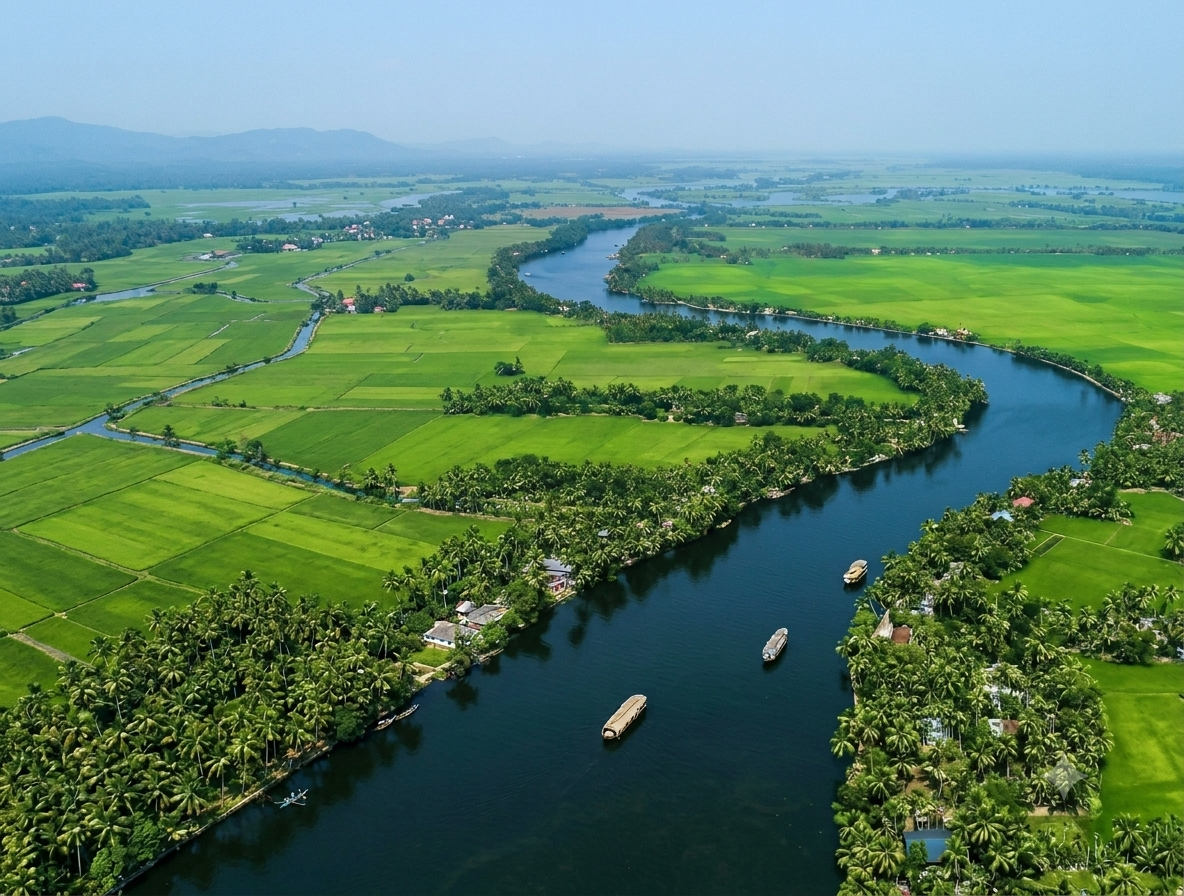
🚤 Alleppey — Alappuzha (Kerala)
🌊 Overview
Alleppey stands as one of the most evocative and distinctively Kerala destinations in India, a place where the boundaries between land and water dissolve into a landscape of canals, lagoons, lakes, and backwaters that has earned the town its celebrated comparison with Venice and its identity as the aquatic heart of God's Own Country. Officially named Alappuzha and situated in the southern part of Kerala facing the Arabian Sea, Alleppey occupies a geography defined by the meeting of the sea, the Vembanad Lake — the longest lake in India — and an intricate network of canals, rivers, and waterways that connects the town to the fishing villages, paddy fields, coir-making communities, and natural wetlands of the surrounding backwater country. The town itself is one of the oldest planned urban settlements in India, its grid of canals laid out in the nineteenth century by Raja Kesavadas under the patronage of the Travancore kingdom in a design that functioned as much for commerce as for navigation.
The history of Alleppey as a significant settlement reaches back to the first century CE, when Saint Thomas, one of the twelve apostles of Christ, is believed to have landed on this coast and established the earliest Christian communities in Kerala — a tradition that gives the town a place in the religious history of Indian Christianity that is entirely unique on the subcontinent. Through the medieval period, Alleppey developed as a significant maritime trade centre, its canals carrying spices, coir, coconut oil, and rice to the coast for loading onto the vessels of Arab, Chinese, and later European traders who called at this part of the Kerala coast. The town's importance as a commercial hub continued through the colonial period, when Lord Curzon — during his tenure as Viceroy of India — famously referred to Alleppey as the Venice of the East, a comparison that captured the visual character of its canal network and has remained attached to the town's identity ever since.
What distinguishes Alleppey from every other destination in Kerala is the completeness and authenticity of the backwater experience it offers — a world of water, green paddy fields, swaying coconut palms, and the slow rhythms of village life that unfolds along the canals in ways that feel entirely removed from the pace and character of modern India, and that can be explored from the inside, on a houseboat floating through the network, in a manner available nowhere else in the country.
⭐ Why Visit Alleppey
The most compelling reason to visit Alleppey is the houseboat experience — an overnight or multi-day journey aboard a traditionally styled kettuvallom, the converted rice barge that has become the iconic vessel of the Kerala backwaters, floating through a landscape of canals, lakes, and waterways as the shore slides by with its coconut palms, paddy fields, fishing nets, village temples, and the unhurried life of the backwater communities. There is nothing quite like this experience in India — waking on water in the middle of a landscape of extraordinary stillness and beauty, with the only sounds the call of a kingfisher and the gentle movement of the water against the hull — and the quality of the immersion it provides in the particular character of Kerala's waterway culture is of a kind that no land-based visit can approximate.
Alleppey is also one of the finest destinations in India for the witnessing of a living and deeply rooted local culture that has not been created for tourism but has simply survived alongside it. The coir industry, which weaves coconut fibre into mats, ropes, and textiles using techniques unchanged for generations, remains an active part of the backwater economy. The farming of paddy below sea level in the Kuttanad region — one of the very few places in the world where agriculture is conducted below sea level — continues to define the landscape and the livelihood of the communities along the southern backwaters. And the annual Nehru Trophy Boat Race, in which magnificent snake boats crewed by over a hundred oarsmen each race across the Punnamada Lake in a spectacle of competitive energy and cultural pride, draws enormous crowds every August and provides one of the most dramatically Indian public events available anywhere in the country.
📍 Key Highlights Within the Area
🚤 Vembanad Lake
The Vembanad Lake, stretching across approximately 2,033 square kilometres and forming the largest lake in Kerala and one of the largest in India, is the defining geographical feature of the Alleppey backwaters and the central body of water through which the houseboat routes, boat races, and bird sanctuary excursions are organised. The lake's vast surface, fringed by coconut palms and opening at intervals into the broader backwater network, creates a landscape of enormous scale and natural beauty that shifts continuously with the light and the season.
🌾 Kuttanad Region
The Kuttanad region, extending across the southern part of the Alleppey district and known as the Rice Bowl of Kerala, is one of the most distinctive agricultural landscapes in Asia — a vast expanse of paddy fields reclaimed from the backwaters and maintained below sea level by a system of bunds, sluices, and drainage canals that represent one of the most remarkable engineering achievements of traditional Kerala water management.
🦜 Pathiramanal Island
The Pathiramanal Island, rising from the waters of the Vembanad Lake approximately seven kilometres from Alleppey and accessible only by boat, is a small but ecologically significant island covered in dense vegetation that attracts a rich community of migratory and resident birds.
🚣 Nehru Trophy Boat Race
The Nehru Trophy Boat Race, held on the second Saturday of August each year on the Punnamada Lake adjacent to Alleppey town, is the most celebrated of Kerala's numerous snake boat races and one of the most spectacular sporting and cultural events in India.
🏛️ Krishnapuram Palace
The Krishnapuram Palace, situated approximately forty-seven kilometres from Alleppey near Kayamkulam and built during the eighteenth century under the reign of the Travancore Maharaja Marthanda Varma, is a double-storeyed structure of pure Kerala architectural character.
🧵 Coir Villages
The coir villages along the canal banks, where the processing of coconut fibre into rope, mats, and textiles can be observed at close quarters in small household and cooperative workshops, provide one of the most authentically engaged cultural encounters available in the Alleppey backwater area.
🚴 Activities
Houseboat cruises are the defining and most celebrated activity of Alleppey, available in configurations ranging from a simple overnight stay on a traditionally styled kettuvallom to multi-day journeys through the broader backwater network extending to Kollam, Kumarakom, and the more remote reaches of the Kuttanad waterways.
Shikara boat rides through the narrower village canals that the larger houseboats cannot access are a complementary and often more intimate form of engagement with the backwater world, moving at a pace that allows for observation of the village life along the banks.
Kayaking through the village canals and waterways of the Kuttanad region, guided by local operators who design routes through the less-visited parts of the network, is an increasingly popular activity that provides a self-powered and ecologically sensitive form of exploration.
Cycling along the bund roads of the Kuttanad paddy field area, where the raised paths run between the below-sea-level fields with water visible on both sides, provides a different and equally memorable perspective on the unique geography of the region.
☀️ Best Time to Visit
The most favorable period to visit Alleppey is from November to February, when the northeast monsoon has retreated, the skies are clear, temperatures along the Kerala coast are moderate and pleasant, and the backwater landscape is at its most visually serene and accessible.
October and November are particularly rewarding, as the landscape retains the intense lushness of the monsoon while the rain has largely subsided and the cooler air has begun to arrive.
The monsoon from June to September, while bringing rough sea conditions and persistent rainfall that makes some outdoor activities less comfortable, is the most celebrated time to witness the Nehru Trophy Boat Race and the broader cultural and sporting energy of the racing season.
The summer months from March to May bring rising temperatures and increasing humidity along the coast, and while the backwater experience remains accessible and beautiful, the heat can make long hours on the water less comfortable without adequate shade.
🚉 Connectivity
Alleppey is one of the most conveniently connected backwater destinations in Kerala, situated at the intersection of major rail and road routes between Kochi and Thiruvananthapuram.
Alleppey Railway Station, located close to the town centre and the main boat jetties, is well served by express and passenger train services from Kochi and Ernakulam, as well as from Thiruvananthapuram, Chennai, Mumbai, and other major cities.
The nearest airport is Cochin International Airport at Nedumbassery, approximately 82 kilometres from Alleppey and reachable in approximately one and a half to two hours by road.
The backwater route from Alleppey to Kollam — a full-day journey by public ferry through the most extensive section of the Kerala backwater network — is itself one of the most celebrated tourist journeys in the state and provides an alternative and extraordinarily scenic means of arriving at or departing from Alleppey.
Explore The Surroundings [Alleppey Backwaters]
- Kadamakudy : The Hidden Island Paradise Near Kochi
- Varkala : India's Most Stunning Cliffside Beach Escape
- Snake Boat Race : The Pride Of Kerela
- Munroe-Island : A Hidden Backwater Paradise In Kerela
- kathakali -The soul of keral's classical dance