🏛️ Chennai (Tamil Nadu)
Historical Heritage • Classical Arts • Beaches • Culture • Modern Metropolis
📖 Overview
Chennai stands as one of the most historically layered, culturally vibrant, and geographically dramatic metropolitan cities in India, a destination that combines the grandeur of ancient Dravidian temple architecture, the colonial heritage of the first British settlement on Indian soil, the world's longest urban beach, a classical arts tradition of extraordinary depth, and the dynamic energy of one of the fastest-growing economies in Asia — all within a single coastal city facing the Bay of Bengal on the southeastern tip of the subcontinent. Formally known as Madras until 1996 and serving as the capital of Tamil Nadu, Chennai is India's fourth-largest city and the primary cultural, commercial, educational, and administrative centre of the south, a position it has held across different forms of governance for nearly four centuries.
The region's history reaches far deeper than the colonial period. The coastal land that now constitutes the core of the city was part of the territories of the Pallava, Chola, Pandya, and Vijayanagara kingdoms across successive centuries, and the presence of the Kapaleeshwarar Temple in Mylapore — built in the Dravidian style and believed to have origins reaching back to the seventh century CE — and the Parthasarathy Temple in Triplicane, one of the oldest Vaishnavite shrines in Tamil Nadu, testify to the depth of the religious and cultural heritage that predates the city's formal founding. The modern history of Chennai begins in 1639, when Francis Day of the British East India Company negotiated a lease of land at Madrasapattinam from the Nayak ruler Damarla Venkatapathy, and Fort St. George — completed in 1644 as the first English fortress in India — was established on the coast, initiating the period of British presence that would eventually extend across the entire subcontinent. It was from this fort that the British enterprise in India grew, and the city that developed around it across the following three centuries absorbed layers of Portuguese, Dutch, French, Armenian, and British colonial influence that are still visible in its architecture, institutions, and urban character.
What distinguishes Chennai from other major metropolitan destinations in India is the extraordinary coherence and pride of its Tamil cultural identity — a civilisation of deep antiquity expressed through its classical language, its Bharatanatyam and Carnatic music traditions, its temple architecture, its cuisine, and its literature — held alongside the full infrastructure and dynamism of a major modern city in a way that makes Chennai a destination of genuine and layered depth for the culturally engaged traveller.
🌟 Why Visit Chennai
The most compelling reason to visit Chennai is the quality and completeness of the South Indian cultural experience it offers — a city where the great traditions of Tamil civilisation are not museum exhibits but living, practised, daily realities. The Margazhi Music Season in December and January, when thousands of Carnatic music concerts and Bharatanatyam dance performances are staged across the city in a celebration that has been a defining event of Chennai's cultural calendar for over a century, transforms the city into the classical music capital of India and draws audiences from across the country and the world. The experience of attending a concert at the Music Academy or one of the other famous sabhas during this season — sitting among a knowledgeable and deeply engaged audience as musicians of extraordinary accomplishment perform in the classical tradition — is one of the most distinctively Chennai experiences available anywhere in India.
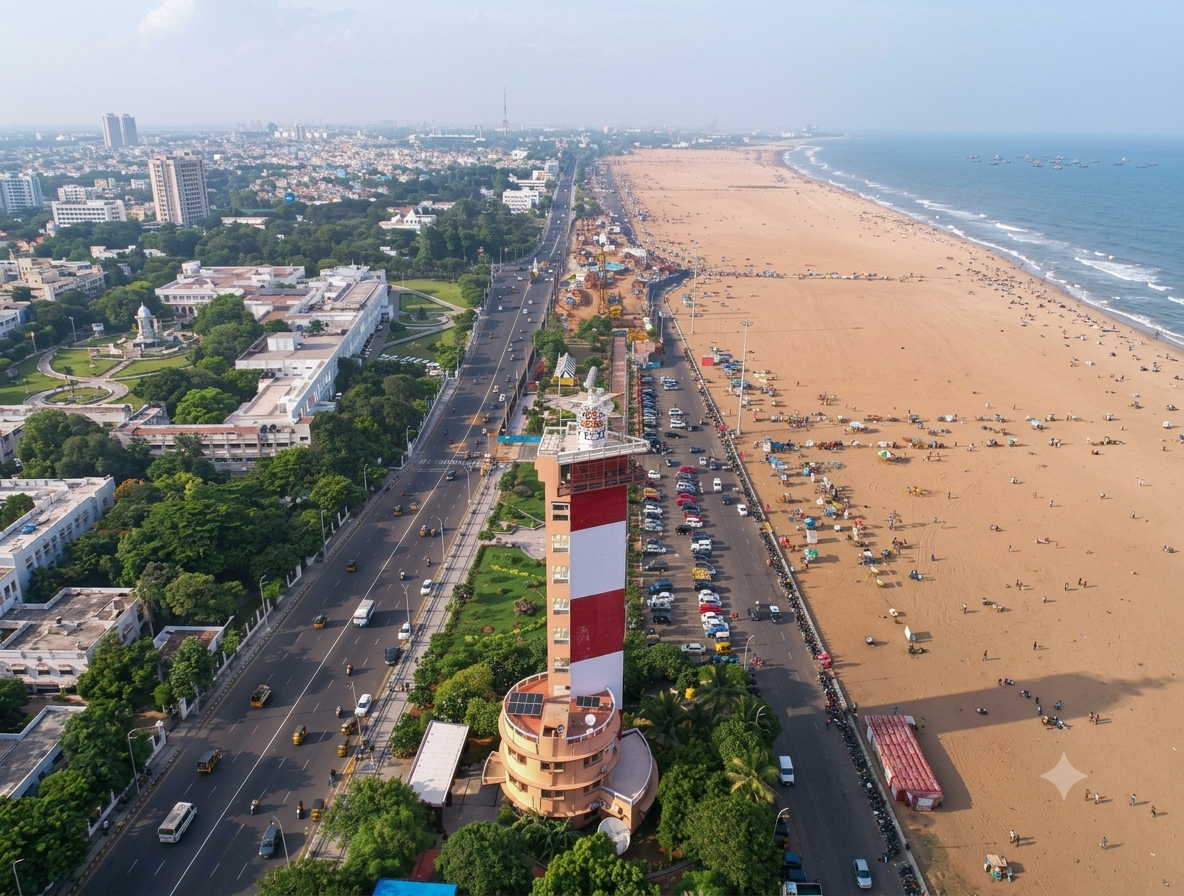
Marina Beach, stretching thirteen kilometres along the Bay of Bengal coastline and recognised as the longest natural urban beach in the world and the second longest beach in the world, is an attraction of a scale and character entirely different from any other urban waterfront in India. Its enormous expanse of sand, its lighthouse and pier, the statues of Tamil leaders and scholars that line its promenade, the vendors of sundal and murukku who work its length at every hour, and the extraordinary spectacle of the city meeting the sea across this vast unbroken shoreline make Marina one of the most democratic and characterful public spaces in any city in the country.
Chennai is also the most natural gateway to some of the most significant heritage, pilgrimage, and natural destinations in Tamil Nadu — Mahabalipuram, Kanchipuram, Tiruvannamalai, and Pondicherry all lie within comfortable day trip or short journey range of the city — making it an ideal base from which to explore the broader cultural and natural wealth of the state.
🏰 Key Highlights Within the Area
🏛️ Fort St. George
Fort St. George, completed in 1644 as the first English fortress in India and still standing in excellent condition at the heart of the city's colonial district, is the most historically significant building in Chennai and one of the most important colonial monuments in the country.
🛕 Kapaleeshwarar Temple
The Kapaleeshwarar Temple in Mylapore, dedicated to Lord Shiva in his form as Kapaleeshwara and to Goddess Karpagambal, is the most celebrated and architecturally magnificent temple in Chennai and one of the finest examples of Dravidian temple architecture in Tamil Nadu.
⛪ Santhome Cathedral Basilica
The Santhome Cathedral Basilica, built over the tomb of Saint Thomas the Apostle who is believed to have been martyred on the nearby St. Thomas Mount in 72 CE, is one of only three churches in the world built over the tomb of an apostle.
🏺 Government Museum
The Government Museum in Egmore, established in 1851 and one of the oldest museums in India, houses one of the finest collections of South Indian bronze sculptures in existence.
🌊 Marina Beach
Marina Beach carries a cultural richness that makes it far more than a simple waterfront and provides one of the most vivid and characteristically South Indian public life experiences available in any Indian city.
🎭 Kalakshetra Foundation
The Kalakshetra Foundation in Besant Nagar is one of the most significant cultural institutions in India and a centre for Bharatanatyam, weaving traditions, and classical performance.
🎯 Activities
Temple visits and cultural walks are among the most rewarding activities in Chennai, with the Kapaleeshwarar Temple in Mylapore providing the most visually magnificent and devotionally intense experience, and the broader neighbourhood of Mylapore offering a walk through the oldest and most culturally concentrated district of the city.
Attending the Margazhi Music Season concerts from mid-December to mid-January is the single most culturally distinctive and immersive experience Chennai offers to visitors, with concerts staged every morning and evening across dozens of venues throughout the city in a programme of extraordinary variety and quality.
Exploring George Town on foot or by cycle-rickshaw, moving through the layered commercial landscape of the city's oldest trading district past the High Court, the Armenian Church, the Wesleyan Church, and the dense network of wholesale bazaars that have operated here since the colonial period, is one of the most historically engaging urban walks available in Chennai.
Shopping for Kanchipuram silk sarees at the weaving cooperatives and established retailers of T. Nagar and Mylapore, for bronze sculptures and antiques in the galleries of Royapettah and Mylapore, and for the aromatic filter coffee, traditional snacks, and culinary staples at the market stalls of Pondy Bazaar and the neighbourhood shops of the old city provides a deeply local and characteristically Tamil engagement with the city's material culture.
☀️ Best Time to Visit
The most favorable period to visit Chennai is from November to February, when the northeast monsoon has retreated and the temperatures along the Bay of Bengal coast are at their most moderate and comfortable.
The northeast monsoon from October to December brings significant rainfall to the Chennai coast, as the city receives the bulk of its annual rainfall during this season — the reverse of most Indian cities that experience the southwest monsoon in June and July.
The summer months from March to June bring rising temperatures and increasing heat along the Bay of Bengal coast, and by April and May the humidity and heat can be considerable, though the sea breeze provides some coastal relief in the evenings.
🚆 Connectivity
✈️ Air Connectivity
Chennai International Airport at Meenambakkam operates one of the busiest and most extensively connected airports in the country with domestic and international services.
🚉 Rail Connectivity
Chennai Central Railway Station and Chennai Egmore Railway Station together serve as two of the most important rail hubs in southern India.
🚌 Local Transport
The Chennai Metro Rail network, city buses, suburban rail services, auto-rickshaws, and app-based cab services provide extensive urban connectivity.
🛣️ Scenic Road Access
The East Coast Road connecting Chennai to Mahabalipuram, Pondicherry, and the heritage towns of the southeastern coast is one of the most scenic and historically rewarding highway drives in Tamil Nadu.
Discover More Around [Chennai]
- Mahabalipuram - Wonder Carved By The Sea
- Vellore Fort: A Fortress of Legends and Legacy
- Gingee Fort - The Troy Of The East
- Jallikattu-Festival : The Spirit Of Tamil Tradition And Valor
- Topslip- Gateway to umtamed Wilderness