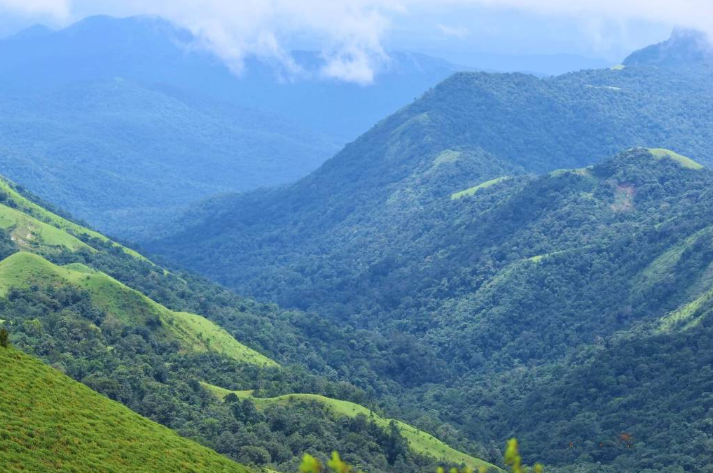
☕ Chikmagalur (Karnataka)
📖 Overview
Chikmagalur stands as one of the most richly aromatic and scenically compelling hill destinations in southern India, a district where the scent of coffee blossoms drifts through misty highland air, forested peaks rise to the highest altitudes in Karnataka, and cascading waterfalls descend through dense Western Ghats vegetation into valleys of extraordinary natural beauty. Nestled in the foothills of the Mullayangiri range in the central-western part of Karnataka, Chikmagalur occupies a landscape at the intersection of the coffee country, the dense evergreen forests of the Malnad region, and the wildlife-rich protected areas of the Western Ghats — a convergence that gives the district a depth and variety of experience that few hill destinations in the peninsula can match.
The name Chikmagalur carries a story of its own. Legend holds that the town was gifted as a dowry to the youngest daughter of Rukmangada, the ruler of Sakharayapatna — and the name itself, translated from Kannada, means the Town of the Younger Daughter, a piece of etymological poetry that has made the name one of the most evocative in Karnataka's geography. The district's history is layered with the presence of the Kadambas, Gangas, Hoysalas, and Vijayanagara Empire, and its most celebrated historical contribution to Indian culture came in the seventeenth century when the Sufi saint Baba Budan returned from a pilgrimage to Mecca carrying seven coffee beans concealed in his beard — in defiance of the Arab prohibition on exporting live coffee plants — and planted them in the hills that now bear his name. This act of quiet subversion began the Indian coffee story, and Chikmagalur has been at the centre of that story ever since, growing into the largest coffee-producing district in the country and the source of some of the finest Arabica and Robusta blends available anywhere in Asia.
What distinguishes Chikmagalur from other hill destinations in Karnataka is this rare combination of the highest peak in the state, the deepest coffee heritage in the country, one of the most significant Sufi-Hindu pilgrimage sites in the Deccan, and a natural environment of waterfalls, wildlife sanctuaries, and forested ridges that together create a destination of genuine and layered depth.
🌄 Why Visit Chikmagalur
The most compelling reason to visit Chikmagalur is the quality of total immersion it offers in a highland landscape defined by coffee — an experience that begins on the approach roads as the first plantation bungalows appear among the trees, deepens as the coffee bushes close in on both sides of the estate tracks, and reaches its fullest expression during the blossom season, when the white flowers of the coffee plants release a fragrance across the entire hillside that is as intense and as distinctive as any natural scent in India. Walking through a working coffee estate at dawn, watching the mist lift from the valley below and the light catch the dew on the dark leaves of the coffee plants, is one of the most sensually complete encounters with a living landscape that southern India offers.
Chikmagalur is also the most natural base from which to explore the highest peaks of Karnataka, including Mullayangiri at 2,000 metres and Baba Budangiri at 1,895 metres, as well as the remarkable landscape of Kemmanagundi — a hill station within the district at an altitude of approximately 1,434 metres, with botanical gardens, rose gardens, and trekking trails through the shola forests and grasslands of the Western Ghats. The district's proximity to the Hoysala temple towns of Belur and Halebidu, located approximately 25 and 38 kilometres from the town respectively, adds an outstanding architectural dimension to the travel experience, making Chikmagalur the ideal base for exploring the finest Hoysala sculptural heritage in Karnataka alongside its natural attractions.
The district also carries a living tradition of interfaith veneration at Baba Budangiri, where the dargah of the Sufi saint Baba Budan is worshipped by both Muslim and Hindu devotees — a rare and genuinely moving example of the syncretic religious culture that has characterised certain pockets of the Deccan across centuries.
🏞️ Key Highlights Within the Area
⛰️ Mullayangiri
Mullayangiri, at 2,000 metres the highest peak in Karnataka, rises above the surrounding landscape of the Chandra Drona range and offers trekking routes through mist-draped forests and grasslands to a summit from which the full sweep of the Western Ghats can be appreciated on clear mornings.
🕌 Baba Budangiri
Baba Budangiri, the second-highest peak in Karnataka at 1,895 metres and known also as Dattagiri, is the spiritual heart of the district and one of the most significant interfaith pilgrimage sites in the Deccan.
🌿 Kemmanagundi
Kemmanagundi, also known as K.R. Hills and situated approximately 55 kilometres from the town of Chikmagalur, is a hill retreat of considerable beauty at an altitude of 1,434 metres.
🐘 Kudremukh National Park
The Kudremukh National Park, covering approximately 600 square kilometres of some of the most biodiverse and ecologically sensitive terrain in the Western Ghats.
🦌 Bhadra Wildlife Sanctuary
The Bhadra Wildlife Sanctuary, a Tiger Reserve situated approximately 38 kilometres from Chikmagalur and centred around the Bhadra Reservoir.
🏛️ Belur & Halebidu
The Hoysala temples of Belur and Halebidu, within comfortable day trip range of Chikmagalur, represent the absolute pinnacle of the Hoysala sculptural tradition.
🚶 Activities
Trekking is the defining adventure activity of Chikmagalur, with the Mullayangiri trek, the Baba Budangiri trek, and the Kemmanagundi trek forming the three most celebrated routes in the district.
Coffee estate walks and plantation tours are the most characteristic and sensory-rich activity that Chikmagalur offers, providing intimate engagement with the cultivation, processing, and tasting of Arabica and Robusta coffee in estates where the tradition of growing and roasting has been practised for generations.
Wildlife safaris at Bhadra Wildlife Sanctuary and the Kudremukh National Park, the latter accessible through limited and controlled entry by the forest department, provide encounters with the natural heritage of the Western Ghats at its most intact and ecologically significant.
🌤️ Best Time to Visit
The most favorable period to visit Chikmagalur is from October to February, when the post-monsoon landscape is at its most lushly green, the waterfalls are at strong flow, the weather across the district is pleasantly cool and clear, and the trekking trails are at their most rewarding.
The coffee blossom season from January to February, when the white flowers of the coffee plants open across the entire district after the dry period and release their jasmine-like fragrance into the highland air, is one of the most sensory and visually distinctive times to visit.
March to May sees temperatures rising gradually across the district, and while the elevation keeps conditions more moderate than the surrounding plains, the landscape begins to dry and the waterfalls diminish.
The monsoon from June to September is Chikmagalur at its most dramatically alive — the forests are intensely green, the waterfalls are at their most spectacular volume, the mist moves continuously through the valleys and over the coffee estates, and the district takes on a wild and atmospheric beauty that rewards those prepared for rain and the occasional road closure.
🚗 Connectivity
Chikmagalur is accessible by road from several major cities in Karnataka and from the coastal cities of Karnataka and Kerala, and the approach through the Western Ghats from any direction is a scenic journey of considerable beauty.
The nearest airport is Mangaluru International Airport, approximately 110 kilometres from Chikmagalur, offering domestic connections from Bengaluru, Mumbai, Chennai, Delhi, Hyderabad, and a range of international connections, making it a well-connected air gateway for visitors approaching from the coast or from outside Karnataka.
The nearest railway station to the town is Kadur Junction, approximately 25 kilometres away, connected to Bengaluru, Hassan, and Mangaluru, from where hired taxis or local buses complete the remaining distance.
Within the district, private taxis, hired jeeps, and self-drive vehicles are the most flexible means of exploring the spread of attractions — from the peak trails to the wildlife sanctuaries to the Hoysala temple towns — that define.
Hidden Gems Nearby [Chikmagalur]
Kemmanagundi : The Queen Of Hills Stations In Karnataka
Kudremukh : Where Misty Mountain Touch The Clouds
Jog Waterfalls : The Majestic Waterfall Of India
Shivamogga - Where Nature Meets Adventure