🌿 Coorg — Kodagu (Karnataka)
📖 Overview
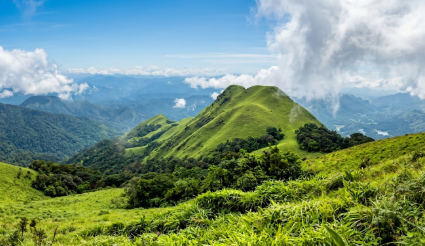
Coorg stands as one of the most beloved and atmospheric hill destinations in southern India, a landscape of mist-wrapped hills, cascading waterfalls, aromatic coffee estates, and ancient forests that has earned its place among the most celebrated natural retreats on the subcontinent. Formally known as Kodagu, the district occupies the southwestern corner of Karnataka in the Western Ghats, spread across an area of approximately 4,102 square kilometres at altitudes ranging from 900 to 1,715 metres above sea level. The town of Madikeri, known during the British period as Mercara, serves as the district headquarters and the natural hub from which the surrounding landscape of peaks, valleys, plantations, and wildlife sanctuaries is most conveniently explored.
The historical record of Kodagu reaches back to the eighth century CE, when the region came under the influence of the Ganga dynasty, and in the centuries that followed it passed through the hands of the Pandyas, Cholas, Kadambas, Chalukyas, Hoysalas, and the Vijayanagara Rayas, each leaving traces on the cultural and architectural landscape of the district. The Haleri dynasty — the Lingayat Rajas — took control of Coorg in the mid-sixteenth century and ruled for nearly three centuries until the British captured the region in 1834, incorporating it into the Madras Presidency and later into Mysore in 1953. It was the British who first recognised the landscape's potential for coffee cultivation, establishing the plantation estates that became the backbone of the local economy and would in time become among the most evocative elements of the Coorg visitor experience.
What distinguishes Coorg from other hill destinations in Karnataka is the richness of what it holds within a single, compact geography — one of India's most celebrated coffee landscapes, the sacred origin of the Kaveri River, a warrior community whose culture and traditions have shaped the identity of the district over centuries, and a natural environment of forests, rivers, and peaks of exceptional beauty. The British comparison to Scotland, born during the nineteenth century in recognition of the misty hills and temperate green valleys, has persisted in the popular imagination and gives some indication of the quality of the landscape that awaits visitors.
✨ Why Visit Coorg
The most compelling reason to visit Coorg is the quality of immersion it offers in a landscape that engages all the senses simultaneously — the sight of morning mist moving through ranks of coffee plants on a hillside, the smell of roasting beans and wild pepper carried on cool highland air, the sound of the Kaveri or one of its tributaries running fast over rocks through the forest, and the taste of Kodava cuisine prepared with the spices and pork that define the district's culinary tradition. Few hill destinations in India offer this degree of sensory completeness within such accessible reach of major cities.
The Kodava community — the indigenous people of Kodagu, known historically as brave warriors who were the only community in India exempted from the Indian Arms Act by the British in recognition of their martial heritage — bring to the district a cultural identity of unusual depth and pride. Their festivals, particularly the Kailpodh harvest festival and the Puttari rice harvest celebration, their distinctive cuisine, their traditional dress of the kupya and the peechekathi, and their characteristic warmth of hospitality create a cultural encounter that sets Coorg apart from destinations whose natural beauty is less well matched by lived human tradition.
Coorg is also the natural starting point for one of India's most significant pilgrimages, as Talacauvery in the Brahmagiri Hills within the district is the sacred origin point of the Kaveri River, drawing devotees from across Karnataka and Tamil Nadu for whom the birth of this sacred river carries deep religious significance. The combination of natural grandeur, cultural depth, spiritual significance, and easy accessibility from Bengaluru, Mysuru, and the coastal cities of Kerala makes Coorg one of the most complete and rewarding hill destinations in peninsular India.
🏞️ Key Highlights Within the Area
🌊 Talacauvery
Talacauvery, situated in the Brahmagiri Hills at an altitude of approximately 1,276 metres and approximately 48 kilometres from Madikeri, is the most sacred site in the district — the spring from which the Kaveri River is believed to originate. A small tank marks the sacred source, and the temple complex surrounding it draws pilgrims throughout the year, with the festival of Tula Sankramana in October drawing enormous crowds who come to witness the moment when the spring erupts in a sudden outpouring of water at a precise astronomical moment believed to carry extraordinary spiritual significance. The climb to the Brahmagiri Peak from Talacauvery, approximately six kilometres of trekking through dense forest, offers panoramic views over the surrounding hill ranges that reward the effort handsomely.
💦 Abbey Falls & Iruppu Falls
Abbey Falls, approximately ten kilometres from Madikeri, cascades from a height of approximately 70 feet through a forested gorge in a setting of considerable natural beauty, framed by coffee and spice plantations on the hillsides above. The falls are approached through a private coffee estate, and the walk through the plantation to the viewpoint above the gorge is an aromatic and visually rewarding prelude to the falls themselves. The Iruppu Falls, in the southern part of the district near the Kerala border and within the Brahmagiri Wildlife Sanctuary, cascade from a greater height through a forest setting of particular wildness and beauty, and carry religious significance as a site mentioned in the Ramayana.
🌄 Raja's Seat & Madikeri Fort
Raja's Seat in Madikeri town, a small terraced garden set on a hillside viewpoint that the Kodagu kings used as their favoured sunset-watching platform, overlooks the surrounding mountains and valleys in a prospect of considerable beauty, particularly at dusk when the low sun turns the mist-wrapped hills amber and gold. The Madikeri Fort, originally constructed in the seventeenth century by Muddu Raja and rebuilt in the nineteenth century, stands at the centre of the town and houses a palace, a church, a temple, and a museum within its walls — a compact and somewhat unlikely combination that reflects the layered history of the district across different periods of rule.
🐘 Wildlife & Viewpoints
The Dubare Elephant Camp on the banks of the Kaveri River, where the Karnataka Forest Department maintains a facility for the care and management of domesticated elephants, offers morning sessions during which visitors can observe the elephants being bathed, fed, and exercised at close quarters in a riverine setting of considerable charm. The Nagarhole National Park, also known as Rajiv Gandhi National Park, which borders the eastern edge of the Kodagu district, is one of the finest tiger and elephant reserves in Karnataka and offers wildlife safari experiences of the highest quality within easy reach of Coorg.
Mandalpatti Viewpoint, reached by a combination of jeep and trekking through forested hills above Madikeri, offers one of the most dramatic panoramic views in the Western Ghats — a sea of clouds rolling through the valleys below, with the peaks of the surrounding ranges emerging from the mist in a scene of extraordinary atmospheric beauty that has made it one of the most photographed natural landscapes in Karnataka.
🥾 Activities
Coffee estate walks and plantation tours are the most distinctive and characteristic activity that Coorg offers, providing a close and aromatic engagement with the cultivation, processing, and tasting of the Arabica and Robusta coffees for which the district is celebrated across India. Many of the estate homestays offer guided morning walks through the plantation before breakfast, allowing guests to observe the coffee plants, pepper vines, cardamom, and citrus that grow in the layered ecology of the estate in the company of knowledgeable hosts whose families have managed these lands for generations.
Trekking through the forested hills of the district is one of the most rewarding physical activities Coorg offers, with routes ranging from the climb to Brahmagiri Peak from Talacauvery and the demanding ascent of Tadiandamol — the highest peak in Kodagu at 1,748 metres — to shorter forest walks around the Pushpagiri Wildlife Sanctuary and the river valleys around Chelavara and Mallalli Falls. The terrain rewards those who venture beyond the main viewpoints into the quieter and less visited forested trails, where the biodiversity of the Western Ghats is most fully and intimately encountered.
White water rafting on the Barapole River, which offers stretches of Grade 3 and Grade 4 rapids through forested gorges, is a popular adventure activity that draws enthusiasts from Bengaluru and the coastal cities seeking an adrenaline-inflected encounter with the district's river landscape. Angling on the Kaveri and its tributaries, particularly for the mahseer fish, is a traditional activity with a long history in Kodagu and one that continues to draw dedicated enthusiasts from across the country to the river's pools and rapids. The wildlife safari experience at Nagarhole, accessible from the eastern edge of the district, provides a natural complement to the plantation and highland activities of the Coorg stay.
🌤️ Best Time to Visit
The most favorable period to visit Coorg is from October to May, with the cooler months of October to February offering the most comfortable temperatures, clearest skies, and most rewarding conditions for trekking, plantation walks, and outdoor exploration. During these months the coffee estates are at their most photogenic — either in the white flowering season of January and February, when the blossoms release a fragrance across the entire hillside, or in the red berry harvest season of November and December, when the plantations are at their most colourful and productive.
March to May represents the summer season and is popular with families and travellers from the plains seeking relief from the heat, with Coorg's elevation ensuring pleasant temperatures even as the surrounding lowlands become uncomfortably warm. The Summer Festival held in Madikeri adds a cultural dimension to visits during this period, drawing visitors for music, craft, and food.
The monsoon from June to September transforms Coorg into its most dramatically lush and verdant state, with the waterfalls at full roaring flow, the rivers running fast and full, and the entire landscape in an almost overwhelming intensity of green. The mist that gave rise to the Scotland of India comparison is most persistently present during these months. While heavy rainfall can make some roads and trekking trails temporarily inaccessible and the leeches of the Western Ghats become an occupational hazard of outdoor activity, many experienced travellers regard the monsoon Coorg as the most beautiful version of the destination and make the journey specifically for this season.
🚗 Connectivity
Coorg is accessible only by road, as the district has no railway station or airport within its boundaries, and this relative remoteness has been one of the factors that has preserved its unhurried character. Madikeri, the district headquarters, is approximately 265 kilometres from Bengaluru and approximately 120 kilometres from Mysuru, both of which serve as the most practical approach points by road. The drive from Bengaluru via Mysuru and the ghat roads into the hills takes approximately five to six hours, passing through scenery of steadily increasing beauty as the highway climbs into the Western Ghats.
From Mysuru, the most frequently used gateway city, the journey to Madikeri takes approximately two to three hours on a well-maintained highway, making Coorg easily reachable for visitors arriving by air or rail at Mysuru. Mysuru Airport offers limited domestic connections from Bengaluru and Chennai, while Mangaluru International Airport, approximately 135 kilometres from Madikeri and reachable via the coastal highway and the Sampaje Ghat road, provides a broader range of domestic flight connections and serves as the preferred air gateway for travellers approaching from the coast or from outside Karnataka. Regular KSRTC state bus services connect Coorg to Bengaluru, Mysuru, Mangaluru, Hassan, and several other cities, and private overnight buses are widely available for the Bengaluru–Madikeri route. Within the district, private taxis and hired jeeps from Madikeri are the most practical means of reaching the plantations, viewpoints, waterfalls, and wildlife areas spread across the surrounding countryside.
Hidden Gems Nearby [Coorg]
- Topslip- Gateway to umtamed Wilderness
- Gangaikonda : Glory Of Chola Empire
- Kodaikanal : The Princess Of Hill Stations
- Ooty: The Paradise In Thel Hils
- Jallikattu-Festival : The Spirit Of Tamil Tradition And Valor