🌊 Dhanushkodi (Tamil Nadu)
🏝️ Ghost Town • Ram Setu • Arichal Munai • Land's End Experience
📖 Overview
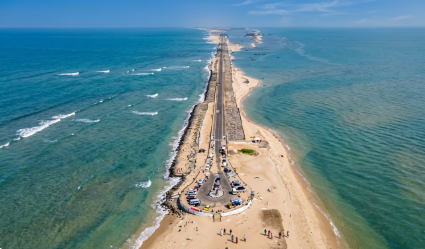
Dhanushkodi stands as one of the most hauntingly beautiful and historically layered destinations in India, a place where mythological significance, natural drama, and the memory of catastrophic loss converge at the very edge of the Indian subcontinent. Situated at the southeastern tip of Pamban Island in the Ramanathapuram district of Tamil Nadu, approximately twenty kilometres from Rameswaram, Dhanushkodi occupies a narrow strip of land barely fifty yards wide in places, flanked on one side by the Bay of Bengal and on the other by the Indian Ocean — a geography so extreme and so visually arresting that it defies easy comparison with any other destination in the country.
The name Dhanushkodi means the tip of the bow in Tamil, a reference rooted in the Ramayana, which holds that Lord Rama stood at this very point and directed the construction of the legendary Ram Setu — the chain of limestone shoals stretching fifty kilometres across the Palk Strait toward Sri Lanka's Mannar Island — as a bridge for his army to cross in pursuit of Ravana. This mythological connection places Dhanushkodi within one of the most sacred geographies of the Hindu tradition, and the site remains part of the broader Rameswaram pilgrimage circuit that draws millions of devotees each year.
What distinguishes Dhanushkodi from every other destination in Tamil Nadu is the extraordinary juxtaposition it presents — a land of ancient myth and living spiritual significance that is simultaneously a ghost town, its buildings, railway station, church, and post office obliterated by one of the most powerful cyclones ever to strike the Indian coastline on the twenty-second of December 1964. The ruins that remain, half-buried in white sand and lashed by two seas, give Dhanushkodi a quality of melancholy grandeur found nowhere else in India, a landscape where natural beauty and historical tragedy are inseparable from each other.
✨ Why Visit Dhanushkodi
The most compelling reason to visit Dhanushkodi is the sheer and irreducible singularity of the experience it offers. There is no destination in India quite like it — a narrow spit of sand at the end of the land, surrounded by two bodies of open sea, strewn with the ruins of a town that was erased in a single night, pointing across the shallow strait toward Sri Lanka, and charged with a mythological weight that has accumulated over millennia. The combination of these elements — geographical extremity, natural beauty, spiritual resonance, and the haunting atmosphere of the ruins — creates a travel experience of a kind that cannot be replicated or approximated anywhere else.
The point known as Arichal Munai at the very tip of Dhanushkodi, where the Indian Ocean meets the Bay of Bengal in a visible and audible convergence of two distinct bodies of water, is among the most geographically dramatic natural viewpoints on the subcontinent. Standing at this point, with water on all sides and the coast of Sri Lanka visible on clear days barely fifteen kilometres across the strait, carries a feeling of being at the edge of the world that is difficult to articulate and impossible to forget.
Dhanushkodi also offers the traveller a quality of solitude and unhurried quiet that has become increasingly rare at the better-known destinations of southern India. The absence of large-scale commercial infrastructure, the simplicity of the fishing community that continues to live in small numbers along the shore, and the raw, wind-swept character of the landscape create conditions for a genuinely reflective and uncommon travel experience.
⭐ Key Highlights Within the Area
🏚️ Dhanushkodi Ruins
The Dhanushkodi Ruins are the defining feature of the destination and one of the most visually extraordinary sights in Tamil Nadu. The skeletal remains of the old railway station — its platform, ticket counter, and waiting hall still partially standing after six decades — the roofless walls of the church, the collapsed post office, and the outlines of what were once houses, schools, and a hospital all rise from the sand in various states of dissolution, caught between the encroaching sea and the memory of the thriving town they once constituted. The ruins carry a stillness and a weight that photography captures only partially, and walking among them at dawn or dusk, with the sound of the sea on both sides, is an experience of considerable emotional power.
🌊 Arichal Munai
The Arichal Munai viewpoint at the absolute tip of the peninsula is the most celebrated natural landmark of Dhanushkodi and the point from which the confluence of the Bay of Bengal and the Indian Ocean is most clearly visible. The two bodies of water can be distinguished by a visible line where their colours meet and where their wave patterns converge, and the chain of Adam's Bridge — the limestone shoals of the Ram Setu stretching toward Sri Lanka — can be seen extending into the sea from this point on clear days. The spiritual significance of standing here, at the point from which the Ramayana's bridge of devotion is believed to have begun, draws pilgrims and curious travellers alike in considerable numbers.
🏖️ Dhanushkodi Beach
The Dhanushkodi Beach itself, extending approximately fifteen kilometres along the peninsula, is one of the longest and most undisturbed stretches of coastline in Tamil Nadu, its white sand unmarked by the commercial development that has altered the character of more accessible beaches elsewhere in the state. The beach witnesses powerful tides and the interplay of two seas along its length, and the sight of the waves arriving from different directions and meeting along the shore is a natural spectacle of unusual beauty. The ruins of the old Dhanushkodi Church, partially standing at the water's edge with its Gothic arched windows open to the sea and sky, is one of the most photographed sights in the region and an image that has come to represent the particular character of this ghost town with particular force.
🐬 Gulf of Mannar Marine National Park
The Gulf of Mannar Marine National Park, which encompasses the waters surrounding Pamban Island and the Dhanushkodi peninsula, is one of the richest marine biodiversity zones in India, home to coral reefs, sea turtles, dolphins, dugongs, and a wide variety of fish and invertebrate species. The park's waters are among the most biologically significant in the Indian Ocean and are the subject of ongoing conservation work that adds an ecological dimension to any visit to the area.
🌉 Adam's Bridge
Adam's Bridge, the chain of limestone shoals beginning at the Dhanushkodi tip and extending fifty kilometres across the Palk Strait to Sri Lanka's Mannar Island, separating the Gulf of Mannar from the Palk Bay, is one of the most remarkable natural formations in the subcontinent and a site of deep significance in both Hindu mythology and geological history. The shoals are largely submerged but visible from the air and partially from the shore, and their extraordinary alignment has fascinated geographers, archaeologists, and devotees for centuries.
🚙 Activities
Exploring the ruins on foot is the primary and most absorbing activity at Dhanushkodi, with the walk from the road end through the ghost town to the Arichal Munai viewpoint covering a distance of approximately two kilometres across the sandy peninsula. This walk — past the old station, the church, the collapsed buildings, and along the shore where the two seas are audible on both sides — is one of the most distinctive and atmospheric heritage walks available anywhere in Tamil Nadu and rewards a slow and attentive pace.
Visiting the Arichal Munai viewpoint at sunrise is one of the most memorable natural experiences the destination offers, with the early light falling on the convergence of the two seas, the ruins silhouetted against the horizon, and the shallow chain of Adam's Bridge visible as a line of pale water stretching toward Sri Lanka. The combination of natural and mythological significance at this hour creates an atmosphere that many travellers describe as among the most affecting they have encountered in India.
Riding in the locally operated jeeps and four-wheel-drive vehicles along the sandy track to the tip of the peninsula is both a practical necessity and a distinctive experience in itself, as the track runs along the narrow strip of land between the two seas for much of its length, with the water sometimes visible and audible on both sides simultaneously. Fishing boat rides in the surrounding waters, arranged informally with the local fishing community, offer a different perspective on the peninsula and its ruins from the sea, and birdwatching along the shore rewards patient observation with sightings of migratory and resident species including gulls, flamingos, herons, and terns.
📅 Best Time to Visit
🌤️ November to February
The most favorable period to visit Dhanushkodi is from November to February, when temperatures along the coast are moderate, the sea conditions are relatively calm, and the clear skies allow the full visual impact of the peninsula and its surroundings to be appreciated without obstruction. During these months the morning light on the ruins and the beach is particularly beautiful, and the convergence point at Arichal Munai is at its most accessible and visually striking.
🍂 October
October marks the end of the northeast monsoon and is a transitional month that can bring some rainfall but also moments of extraordinary atmospheric beauty as the storm light plays across the two seas and the ruins. The winter months of December and January represent the peak visitor season, as the pleasant weather and school holidays draw families, pilgrims, and curious travellers from across Tamil Nadu and beyond, creating a livelier atmosphere along the approach road to the ruins without significantly diminishing the sense of solitude at the peninsula's tip.
☀️ March to September
The summer months from March to May bring rising temperatures and increasing heat along the exposed coastal strip, and the lack of shade across the open sand and ruins makes extended walking uncomfortable during the middle of the day, though the early mornings remain rewarding. The monsoon from June to September brings rough seas, strong winds, and reduced visibility along the coast, and access to the tip of the peninsula can be restricted during periods of high tide and storm surge. This period is generally the least suitable for a visit, though the dramatic weather can make the ruins and the surrounding seascape particularly atmospheric for those comfortable with uncertain conditions.
🚆 Connectivity
Dhanushkodi is reached most conveniently from Rameswaram, which serves as the primary base and gateway town and lies approximately twenty kilometres to the northwest along Pamban Island. Rameswaram is connected to the mainland by the Pamban Bridge — India's first sea bridge, a remarkable engineering structure crossing the Palk Strait — and the town is accessible from the mainland by both road and rail across this bridge. Mandapam on the mainland is the nearest rail junction with direct connections, while Rameswaram Railway Station itself receives direct train services from Chennai, Madurai, Coimbatore, and several other major cities in Tamil Nadu.
The nearest airport is Madurai International Airport, approximately one hundred and seventy kilometres from Rameswaram, offering domestic connections from Chennai, Bengaluru, Mumbai, Delhi, and Hyderabad, and making Madurai the most practical air gateway for travellers approaching from outside Tamil Nadu. From Rameswaram, the road to Dhanushkodi covers approximately eighteen kilometres to the end of the surfaced road, beyond which the final two kilometres to the ruins and the Arichal Munai viewpoint are covered by locally operated jeeps and four-wheel-drive vehicles, as the sandy track and the encroachment of the tide make the route unsuitable for ordinary vehicles. Most visitors make the journey to Dhanushkodi as a day trip from Rameswaram, where a full range of accommodation options is available across all budget levels.
Attractions Around [Dhanushkodi]