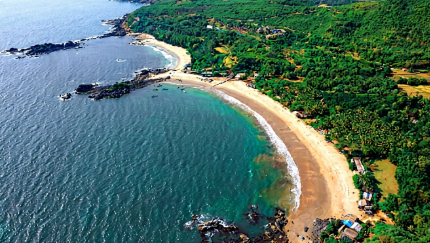
🌊 Gokarna (Karnataka)
📖 Overview
Gokarna stands as one of the most distinctive and spiritually charged coastal destinations in India, a small temple town on the Arabian Sea coast of Karnataka that holds within its modest boundaries a rare and genuinely compelling combination of ancient pilgrimage tradition, unspoiled beaches of extraordinary beauty, and a quality of unhurried coastal life that has drawn both devout Hindu pilgrims and wandering travellers from across the world for very different but equally sincere reasons. Situated in the Uttara Kannada district of Karnataka, approximately 514 kilometres from Bengaluru and 163 kilometres from Panaji in Goa, Gokarna occupies a stretch of the Karnataka coastline where the Western Ghats descend steeply to the sea, creating a landscape of forested headlands, hidden coves, and long curved beaches separated from each other by rocky promontories and connected by clifftop trails that offer views of the Arabian Sea of considerable dramatic beauty.
The name Gokarna is derived from Sanskrit and means cow's ear, a reference believed to relate either to the shape formed by the confluence of the Aganashini and Gangavali rivers at the edge of the town, which resembles the ear of a cow in the sacred Hindu tradition, or to the legend that Lord Shiva emerged from the ear of a cow at this very spot. The town's recorded history reaches back through the rule of the Kadambas and the Vijayanagara kings and into the period of Portuguese coastal influence, each leaving traces on the religious and cultural landscape of the coast. But the deepest layer of Gokarna's identity is mythological — rooted in the story of the Atmalinga, the sacred lingam that Ravana carried from Mount Kailash toward Lanka and was tricked into setting down permanently at this spot by the young boy Ganesha, thereby establishing the town's most sacred site and its reason for pilgrimage across two and a half millennia.
What distinguishes Gokarna from every other beach destination on the Karnataka coast is this rare dual identity — a living temple town of genuine pilgrimage significance that simultaneously offers five beaches of outstanding natural beauty, connected by forested clifftop paths and varying in character from the busy to the deeply remote, all within walking distance of a bazaar street whose simplicity and scale preserve the character of a small coastal market town more completely than almost anywhere else on the western seaboard.
✨ Why Visit Gokarna
The most compelling reason to visit Gokarna is the quality of the experience it offers to travellers of almost every disposition — a quality that flows directly from the coexistence of spiritual tradition and natural beauty in a setting of small-town simplicity that has not yet been overwhelmed by the kind of commercial development that has transformed more accessible coastal destinations. For the pilgrim, Gokarna is one of the holiest Shaivite sites in southern India, home to the Atmalinga housed in the Mahabaleshwara Temple and ranked alongside Kashi and Rameswaram in the hierarchy of sacred sites associated with Lord Shiva. For the traveller drawn to unspoiled beaches, the five beaches that extend southward from the town along the headland coast offer experiences ranging from the sociable to the genuinely solitary in a coastal landscape of remarkable natural beauty. And for those seeking a destination that simply feels different from the mainstream — quieter, more human in scale, more rooted in its own traditions — Gokarna offers a coastal experience of a kind that becomes rarer with each passing year.
The clifftop trail that connects all five beaches, winding through dense coastal scrub and offering intermittent views of the sea between the headlands, is one of the most rewarding short coastal walks in Karnataka, and the experience of arriving at each successive beach — each with its own character, its own curve of white sand, and its own quality of light and wave — creates a progressive journey through the coastal landscape that makes the whole greater than any individual part.
Gokarna is also one of the most naturally positioned destinations on the Karnataka coast for yoga practice, with the combination of early morning sea air, the sound of temple bells drifting from the bazaar, and the unhurried rhythms of the town creating an atmosphere of natural contemplative calm that supports a quality of practice difficult to sustain in busier environments.
🏖️ Key Highlights Within the Area
🛕 Mahabaleshwara Temple
The Mahabaleshwara Temple, dedicated to Lord Shiva and housing the Atmalinga — believed to be the original self-manifested lingam of Shiva, tricked from the demon king Ravana by the boy Ganesha and fixed permanently into the earth at this point — is the spiritual and physical heart of Gokarna and one of the most important Shaivite pilgrimage centres in the Deccan. The temple's tower, built in the characteristic Dravidian style and facing toward the Arabian Sea and Karwar city beyond, has stood for centuries as the landmark of the town and the destination of pilgrims who come to receive darshan at one of the rarest and most sacred of Shiva's self-manifested forms. The Maha Shivaratri festival, celebrated here with particular intensity and drawing enormous congregations of devotees from across Karnataka and beyond, transforms the town into a setting of extraordinary devotional energy for several days each year.
🙏 Maha Ganapathi Temple & Koti Tirtha
The Maha Ganapathi Temple, located at the entrance to the Mahabaleshwara Temple complex, is dedicated to the young Ganesha whose trickery is credited with fixing the Atmalinga at Gokarna — a story that gives this temple a particularly intimate relationship with the founding mythology of the town. The Koti Tirtha, a large sacred tank located close to the temple complex and surrounded by smaller shrines, is used for ritual bathing and for the immersion of deities during festivals, and the sight of the tank at dusk, with the lamps of the surrounding shrines reflected in its still water, is one of the more quietly atmospheric moments the town offers.
🌊 Om Beach
Om Beach, taking its name from the natural formation of its shoreline into the shape of the sacred Om symbol when seen from the headland above, is the most celebrated of Gokarna's five beaches and the most visited, with a settled population of beach shacks, small cafes, surf schools, and yoga studios that have accumulated around its twin curves over the years of its growing popularity. The beach is particularly favoured by surfers, as the configuration of the headlands creates wave patterns suited to surfing during the appropriate season, and the sunrise view from the Om-shaped shoreline looking back toward the cliffs is one of the most photographed coastal images in Karnataka.
🏝️ Kudle, Half Moon & Paradise Beaches
Kudle Beach, the largest of the five beaches and lying immediately south of the town, is a long, gently curving stretch of sand backed by green hills and approached through a short walk from the town end of the clifftop trail. Its length and the relative openness of its approach have made it the most popular with longer-stay visitors, and a modest but comfortable collection of beach guesthouses and restaurants lines its upper edge. Half Moon Beach and Paradise Beach, requiring respectively a moderate and a longer clifftop walk or a short boat ride to reach from Om Beach, are progressively more remote in character, with Paradise Beach in particular offering a quality of coastal solitude — a wide arc of sand beneath forested headlands with no permanent infrastructure — that is genuinely rare on the Karnataka coast.
🏰 Mirjan Fort
The Mirjan Fort, approximately eleven kilometres from Gokarna along the coastal highway, is a sixteenth-century coastal fortification built by Queen Chennabhairavadevi of Gersoppa — a remarkable ruler who controlled the pepper trade of this coast for several decades and defended her kingdom against the Portuguese with considerable success. The fort's laterite walls, towers, and gateways rise from a dense tangle of vegetation above a tributary of the Sharavathi River, creating a setting of romantic overgrown grandeur that rewards exploration and provides one of the most atmospheric heritage experiences within reach of Gokarna.
🚶 Activities
Beach walking and the clifftop trail connecting all five beaches are the most characteristically Gokarna activities...
Surfing at Om Beach and Kudle Beach during the appropriate season, with instruction available from several surf schools that have established themselves along the Om Beach shoreline, provides an active engagement with the Arabian Sea suited to beginners and more experienced surfers alike. Kayaking along the coastline between the beaches, snorkelling in the clearer waters near the headlands, and boat rides to the more remote Half Moon and Paradise Beaches provide further water-based activity for those wishing to engage with the sea beyond swimming and sunbathing.
Yoga and meditation sessions, offered by a range of teachers and studios that have established themselves in Gokarna over the years, are a significant draw for travellers who come specifically for the combination of spiritual environment, natural setting, and the quality of practice that the town's atmosphere supports. Attending the early morning puja at the Mahabaleshwara Temple, when the rituals of daily worship unfold in the inner sanctum to the sound of bells and chanting, provides a window into the living devotional tradition that defines Gokarna's identity as a pilgrimage town and sets it apart from any purely beach destination.
Exploring the Mirjan Fort, the coastal villages between Gokarna and Karwar, and the beaches of Karwar — a port town approximately 58 kilometres to the north that carries its own colonial history and some of the most naturally sheltered beaches on the Karnataka coast — provides a broader engagement with the landscape and heritage of this stretch of the Uttara Kannada coastline.
🌤️ Best Time to Visit
The most favorable period to visit Gokarna is from October to March, when the southwest monsoon has fully retreated, the Arabian Sea is calm and clear, and the beaches are at their most accessible and visually inviting.
The period from November to February represents the peak season...
October and November offer the post-monsoon landscape at its greenest and most lush...
March to May sees gradually rising temperatures and increasing heat along the exposed beaches...
The southwest monsoon from June to September brings heavy and sustained rainfall to the Karnataka coast...
🚗 Connectivity
Gokarna is situated on the Karnataka Konkan coast and is accessible by road, rail, and to a limited extent by air, with the most scenic approach by any mode being the train journey along the Konkan Railway that skirts the coast through tunnels and over bridges above the Arabian Sea in one of the most dramatically beautiful railway corridors in India. Gokarna Road Railway Station, located approximately nine kilometres from the town centre, is the nearest halt on the Konkan Railway line, with train services connecting it to Mumbai, Mangaluru, Goa, Bengaluru via Hubli, and other major cities on the western coastal corridor.
The nearest airport is Dabolim Airport in Goa, approximately 140 kilometres from Gokarna, offering the broadest range of domestic and international flight connections, and making Goa the most practical air gateway for travellers approaching from outside Karnataka. Mangaluru International Airport, approximately 160 kilometres to the south, is an alternative for those approaching from the direction of Kerala or arriving on certain domestic routes. By road, Gokarna is connected to Bengaluru via the National Highway through Hubli — a distance of approximately 514 kilometres — and to Panaji in Goa approximately 163 kilometres to the north, making it naturally positioned as a stop on a coastal road journey along the Konkan. Within the town and between the beaches, auto-rickshaws, hired motorcycles, and boat services along the coast provide flexible and locally characterful means of getting around.
Discover More Around [Gokarna]
- Netrani-Island : India's Hidden Marine Gem
- Dandeli : India's Wild Adventure Capital Of The Western Ghats
- Bhuta Kola : The Spirit Worship Festival Of Karnataka
- Divar-Island : A Peaceful Escape In West India
- Dandeli-Wildlife-Sanctuary : Where Adventure Meets Nature