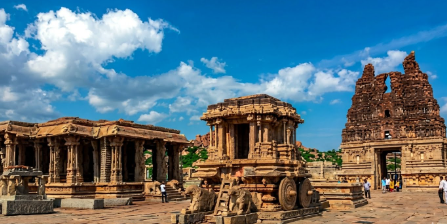
🏛️ Hampi (Karnataka)
🌄 Overview
Hampi stands as one of the most extraordinary and visually overwhelming heritage destinations in India, an ancient landscape where the ruins of one of the greatest empires in medieval Asian history lie scattered across a surreal terrain of massive granite boulders, banana plantations, and the broad, sacred waters of the Tungabhadra River. Situated in the Vijayanagara district of northern Karnataka, approximately 340 kilometres from Bengaluru, Hampi occupies the site of Vijayanagara — the City of Victory — which served as the capital of the Vijayanagara Empire from 1343 to 1565 and grew, at the peak of its power under Emperor Krishnadevaraya in the early sixteenth century, into one of the largest and richest cities in the world, a metropolis of extraordinary wealth, architectural ambition, and cultural vitality that astounded every traveller and merchant who visited it.
The empire that built Hampi controlled the cotton and spice trade routes of southern India, commanded a vast army, and extended its authority across the present-day states of Karnataka, Andhra Pradesh, Tamil Nadu, and Maharashtra. Its capital reflected this power in stone — in temples of staggering scale and intricacy, in royal enclosures, elephant stables, market streets, aqueducts, and monolithic sculptures that together represented the fullest flowering of Dravidian architectural genius. In 1565, the combined armies of the Deccan Sultanates — Bidar, Bijapur, Golconda, Ahmednagar, and Berar — defeated the Vijayanagara forces at the Battle of Talikota and proceeded to raze the city over the course of an entire year, leaving behind the ruins that now constitute one of the most remarkable open-air museums on earth.
Designated a UNESCO World Heritage Site in 1986 and covering an area of over 41 square kilometres, Hampi today presents over 500 ancient monuments spread across a landscape of granite outcrops, river valleys, and agricultural fields that has remained largely undisturbed since the city's destruction — a setting that gives the ruins a quality of romantic desolation and grandeur found nowhere else in India. The Tungabhadra River, known in the Ramayana as the Pampa and sacred in the Hindu tradition, flows through the site and gives it a spiritual as well as historical dimension of great depth.
✨ Why Visit Hampi
The most compelling reason to visit Hampi is the experience of immersion in a ruined city of truly imperial scale — a place where the ambition, artistry, and ultimate fate of one of history's great civilisations can be read directly in the stone around you. Unlike heritage sites where the monuments are isolated from their landscape, Hampi's ruins are inseparable from the terrain they inhabit.
Hampi is also a destination that rewards the kind of slow, exploratory travel that the pace of modern tourism rarely permits. With over a hundred significant monuments spread across more than 41 square kilometres, and with the possibility of crossing the Tungabhadra by coracle to explore the more relaxed and café-lined northern bank, the site offers days of unhurried discovery for those willing to move at the rhythm of the landscape rather than a checklist.
The Purandaradasa Festival, held annually in January or February at the Vittala Temple complex to celebrate the birth anniversary of the medieval poet-composer and music saint Purandaradasa, brings together musicians, devotees, and cultural enthusiasts from across Karnataka and adds a living artistic and devotional dimension to the heritage site that deepens its meaning considerably.
🏰 Key Highlights Within the Area
🚩 Vittala Temple Complex
The Vittala Temple Complex is the crowning architectural achievement of Hampi and one of the finest examples of Dravidian temple architecture anywhere in India.
🛕 Virupaksha Temple
The Virupaksha Temple, dedicated to Lord Shiva in his form as Virupaksha and standing at the western end of the Hampi Bazaar Street, is the oldest continuously active place of worship in Hampi and one of the most important in Karnataka.
👑 Royal Enclosure
The Royal Enclosure, a vast walled precinct housing the remains of the palace complex, the stepped tank, the Mahanavami Dibba and the Durbar Hall provides a direct and imposing encounter with the administrative and ceremonial heart of the Vijayanagara capital.
🌸 Lotus Mahal & Elephant Stables
The Lotus Mahal and the Elephant Stables illustrate the cosmopolitan character of the Vijayanagara court and its willingness to absorb architectural influences from the sultanates with which it coexisted and competed.
🌅 Hemakuta Hill
Hemakuta Hill offers a panoramic view over the entire boulder-strewn landscape at sunrise that is among the most memorable natural and architectural vistas available anywhere in Karnataka.
🚴 Activities
Exploring the ruins on foot and by bicycle is the most rewarding way to experience Hampi's scale and variety, with cycling routes connecting the major monuments across the open landscape and allowing visitors to arrive at temples and enclosures as the morning light changes and the heat of the day builds.
The coracle crossing of the Tungabhadra to the northern bank — the Virupapur Gaddi or hippie island — is one of the distinctive experiences of Hampi.
Rock climbing and bouldering on the extraordinary granite formations that define Hampi's landscape have attracted a growing international community of climbers who come specifically for the quality and variety of the rock.
☀️ Best Time to Visit
The most favorable period to visit Hampi is from October to March, when temperatures across the Deccan plateau are moderate and the clear skies allow for comfortable exploration of the largely open and exposed monument landscape.
The Purandaradasa Festival in January or February adds a cultural and devotional dimension to the winter visit, drawing musicians and devotees to the Vittala Temple complex for performances and celebrations that bring the heritage site to vivid life.
The summer months from March to May bring significant heat to the exposed rock-and-ruin landscape of Hampi, and by April the midday temperatures can be extreme, limiting comfortable outdoor exploration to the early morning and late evening hours.
🚗 Connectivity
🚉 Rail Connectivity
Hosapete Junction is a well-connected railway station, with direct train services from Bengaluru, Hyderabad, Goa, Mysuru, and Hubli, making rail the most convenient and comfortable approach for travellers from multiple directions.
✈️ Air Connectivity
The nearest domestic airport is Jindal Vijaynagar Airport at Toranagallu, approximately 40 kilometres from Hampi, with limited flight connectivity.
🛣️ Road Connectivity
The road journey from Bengaluru to Hampi takes approximately six to seven hours by car or bus, with both state-run KSRTC buses and private overnight sleeper buses operating regular services on this route.
Within the Hampi area, auto-rickshaws, rented bicycles, and hired motorcycles from Hampi Bazaar and Hosapete provide flexible and independently paced access to the full spread of monuments across the site.
Explore Beyond [Hampi]