```html
🌊 Kanyakumari (Tamil Nadu)
📍 Southernmost Tip of India • Confluence of Three Seas • Spiritual & Cultural Landmark
📖 Overview
Kanyakumari stands as one of the most geographically singular and spiritually resonant destinations in India, a town whose identity is shaped by the extraordinary fact of its location at the absolute southern tip of the Indian subcontinent, where the Arabian Sea, the Bay of Bengal, and the Indian Ocean converge in a meeting of waters that has held profound significance in the Indian imagination for over two thousand years. Known during the British period as Cape Comorin, and formally named Kanniyakumari in Tamil, this compact coastal town in the southernmost district of Tamil Nadu occupies a position of rare geographical drama — a land's end where the peninsula narrows to a point, the sea wraps around on three sides, and the horizon offers an unbroken sweep of open ocean in nearly every direction.
The history of Kanyakumari reaches back to the Sangam period between the third century BCE and the fourth century CE, when ancient Tamil poets and scholars celebrated its beauty and spiritual character in their writings. The town derives its name from the presiding deity Devi Kanyakumari, the virgin goddess whose temple stands at the very tip of the land and whose legend is woven into the mythology of the site with particular depth. The Sangam-era connections, the medieval Pandya and Chera dynastic associations, the arrival of Saint Francis Xavier and the subsequent growth of a significant Catholic community, and the transformative visit of Swami Vivekananda in 1892 — when he swam to the offshore rock and spent three days in deep meditation that shaped his philosophy and his mission — have together layered Kanyakumari with a historical and spiritual significance that extends well beyond its modest geographical scale.
What distinguishes Kanyakumari from other coastal destinations in southern India is not any single monument or natural feature but the cumulative power of its setting — the convergence of seas, the play of light at dawn and dusk over three bodies of open water, the coexistence of Hindu, Christian, and Jain sacred sites within a few kilometres of each other, and the feeling, standing at the southernmost point, of being at the very end and beginning of a vast land.
🌅 Why Visit Kanyakumari
The most compelling reason to visit Kanyakumari is an experience available nowhere else in India: witnessing the sunrise and the sunset from the same point on the shore, with the sun emerging from and descending into the open sea on both occasions, colouring the confluence of three oceans in a spectrum that shifts from deep violet to gold to rose and back again. On full moon evenings, the additional spectacle of the moon rising over the Bay of Bengal while the sun simultaneously sets over the Arabian Sea — visible from the Triveni Sangam viewpoint — is among the most remarkable natural phenomena that can be witnessed anywhere on the subcontinent.
Kanyakumari also carries a spiritual plurality that is unusual and genuinely moving. The Bhagavathy Amman Temple dedicated to the presiding goddess stands at the water's edge, drawing pilgrims from across the country. The Our Lady of Ransom Church, established in the fifteenth century and one of the oldest and most significant centres of Indian Catholicism, stands a short distance away. The Vivekananda Rock Memorial and the Thiruvalluvar Statue rise from the sea a few hundred metres offshore. Together, these landmarks of different faiths and different centuries create a cultural and spiritual landscape of uncommon richness for a town of Kanyakumari's size.
For the traveller completing a journey through Tamil Nadu, or indeed through southern India more broadly, Kanyakumari carries the particular emotional weight of a journey's end — a destination that marks the geographical conclusion of the subcontinent with enough natural beauty, spiritual depth, and historical character to make the arrival feel genuinely significant.
⭐ Key Highlights Within the Area
🪨 Vivekananda Rock Memorial
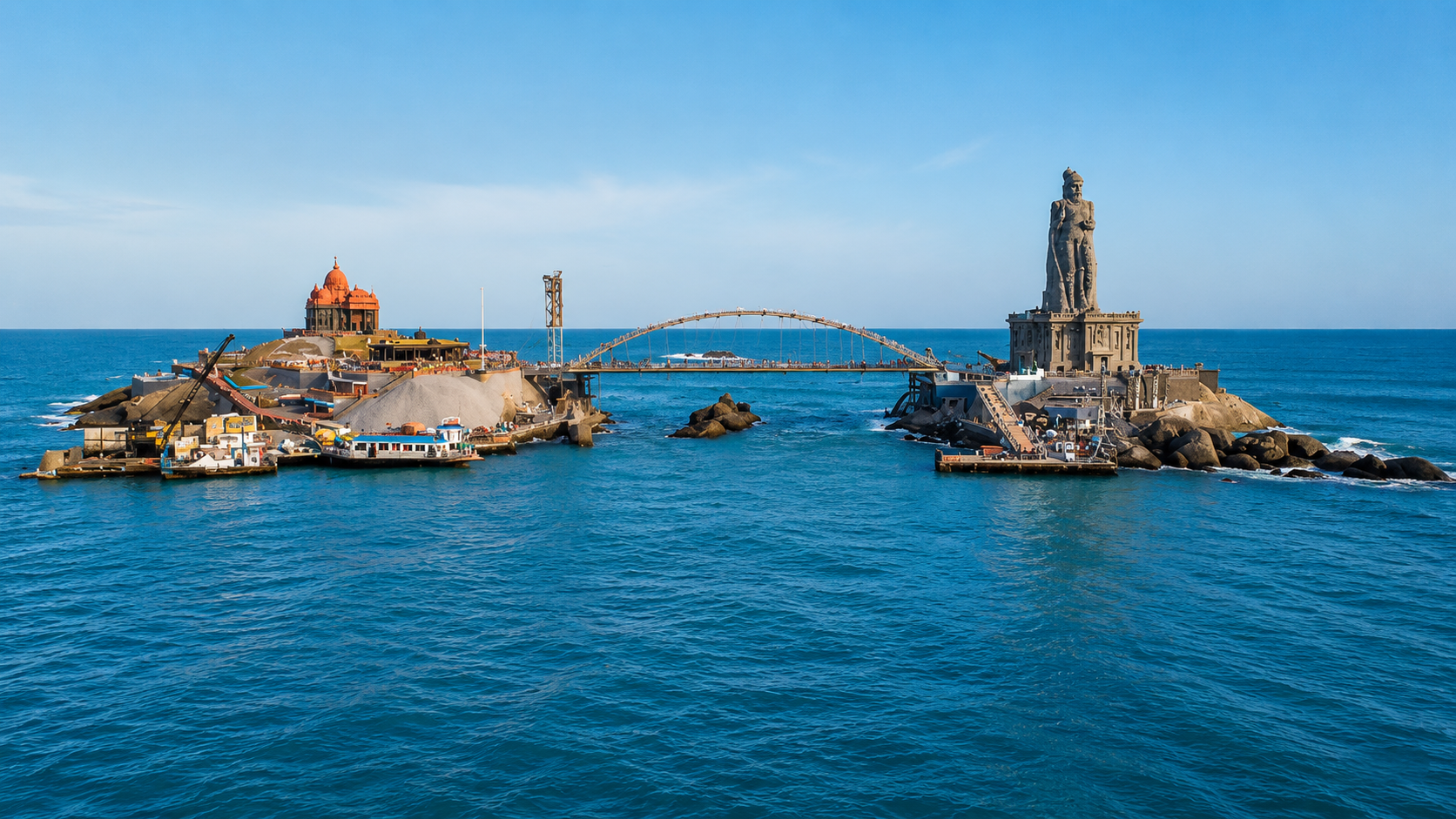
The Vivekananda Rock Memorial, built on a rocky island approximately five hundred metres offshore and consecrated in 1970, stands as the most iconic landmark of Kanyakumari and one of the most visited monuments in Tamil Nadu. The rock is the very one on which Swami Vivekananda is believed to have meditated for three days in December 1892, an experience that crystallised his understanding of India's spiritual mission and preceded his famous address at the Parliament of the World's Religions in Chicago the following year. The memorial, designed by the architect Eknath Ranade in a style that draws on temple architectural traditions from across India, houses a meditation hall and a shrine and can be reached by ferry from the mainland, with the approach by sea offering views of the coastline and the adjoining Thiruvalluvar Statue from a particularly dramatic angle.
🗿 Thiruvalluvar Statue
The Thiruvalluvar Statue, rising 133 feet from a 38-foot pedestal on a rock adjacent to the Vivekananda Memorial, honours the celebrated ancient Tamil poet and philosopher Thiruvalluvar, author of the Thirukkural — one of the most revered works in Tamil literature. The height of the statue and its pedestal are each laden with symbolic significance drawn directly from the structure of the Thirukkural, and the figure's commanding presence above the open sea makes it one of the most visually striking monumental sculptures in southern India.
🛕 Bhagavathy Amman Temple
The Bhagavathy Amman Temple, dedicated to Goddess Kanyakumari and situated at the very tip of the peninsula, is one of the 108 Shakti Peethas — the most sacred sites in the Shakta tradition — and draws a continuous stream of pilgrims from across the country. The temple's eastern gateway faces the sea, and the glow of the diamond nose ring of the presiding deity is said to be visible from the ocean, historically serving as a navigational marker for sailors approaching the cape.
🕊️ Gandhi Memorial & Vattakottai Fort
The Gandhi Memorial, built at the site where the urn containing Mahatma Gandhi's ashes was kept for public viewing before immersion at the Triveni Sangam, is designed with architectural precision so that the first rays of sunlight on Gandhi's birth anniversary, the second of October, fall directly on the spot that marks the place of the urn. The Vattakottai Fort, a well-preserved coastal fortification built by the Travancore kingdom in the eighteenth century to guard the confluence of the seas, stands at the edge of a rocky headland a few kilometres from the town and offers striking views of the open ocean from its battlements.
⛪ Our Lady of Ransom Church & Suchindram Temple
The Our Lady of Ransom Church, established in the fifteenth century and rebuilt over the following centuries into the Gothic-influenced structure visible today, is one of the most significant Catholic pilgrimage centres in India and draws devotees from across Tamil Nadu and Kerala. The Suchindram Temple, located approximately thirteen kilometres from Kanyakumari, is a remarkable example of Dravidian temple architecture housing shrines to Brahma, Vishnu, and Shiva within a single complex, and its famous musical ped from stone and producing distinct musical tones when struck — are among the most extraordinary examples of sculptural ingenuity in the temple architecture of the south.
🎯 Activities
Witnessing the sunrise and sunset from the shore or from the Vivekananda Rock Memorial is the defining activity of Kanyakumari and the experience that draws the greatest number of visitors. The ferry to the rock is operated throughout the day, but the early morning and late afternoon crossings — when the light is at its most dramatic and the sea takes on the colours of the sky — are the most rewarding. Photography at these hours, with the Thiruvalluvar Statue and the open ocean as the backdrop, produces images of considerable power.
Visiting the temple circuit of Kanyakumari and the surrounding district — taking in the Bhagavathy Amman Temple, the Suchindram Temple, and the Nagaraja Temple at Nagercoil — provides a full immersion in the Dravidian devotional and architectural traditions that have shaped this corner of Tamil Nadu over many centuries. The Thirparappu Waterfalls, approximately fifty kilometres from Kanyakumari, cascade from a considerable height into a natural pool surrounded by forest and offer a refreshing natural excursion from the coastal town.
Beachcombing along the distinctive multicoloured sand beaches of Kanyakumari — where the mineral composition of the shore creates sands of different hues at different points along the coast — is a quiet and pleasurable activity that reveals a natural curiosity unique to this stretch of coastline. The Mathoor Hanging Bridge, a cantilevered aqueduct crossing the Pahrali River approximately forty kilometres from Kanyakumari, offers a scenic and engineering point of interest within easy reach of the town. Shopping for locally produced shell crafts, stone carvings, and the distinctive hand-painted silk fabrics that have become associated with Kanyakumari's craft tradition provides a meaningful way to engage with the local artisan economy.
📅 Best Time to Visit
🍂 October to March
The most favorable period to visit Kanyakumari is from October to March, when the southwest monsoon has retreated, temperatures along the coast are moderate and comfortable, and the skies are largely clear — conditions that make the celebrated sunrise and sunset experiences fully accessible and visually at their most spectacular. The sea during these months is generally calm, the ferry service to the Vivekananda Rock runs reliably, and the cool evenings make walking along the shore and exploring the surrounding temples and monuments a genuinely pleasant experience.
🌤️ October & November
October and November are particularly rewarding, as the landscape is still fresh from the monsoon, the light over the sea is soft and atmospheric, and the crowds of the peak winter season have not yet arrived in full. December and January bring the largest visitor numbers, as school holidays and the pleasant weather draw families and pilgrims from across Tamil Nadu, Kerala, and beyond, creating a festive atmosphere along the waterfront that adds energy to the visit.
🌧️ April to September
The summer months from April to June bring significant heat to the coastal plains of the southernmost district, though the sea breeze provides some relief at the shoreline itself. The southwest monsoon from June to September brings heavy rainfall and rough sea conditions to Kanyakumari, frequently suspending the ferry service to the offshore rock and making outdoor exploration less comfortable, though the dramatic monsoon skies over the confluence of the three seas can be extraordinarily beautiful for those willing to experience them.
🚆 Connectivity
Kanyakumari is well connected to the rest of India and to the major cities of Tamil Nadu and Kerala, making it one of the most accessible extreme southern destinations on the subcontinent. Kanyakumari Railway Station, located approximately one kilometre from the shorefront, is the southernmost railway station in India and is served by trains from Chennai, Bengaluru, Mumbai, Delhi, Coimbatore, Thiruvananthapuram, and several other major cities, including a number of long-distance express services that make the journey from the north of the country directly to the southern tip in a single continuous journey.
The nearest airport is Thiruvananthapuram International Airport in Kerala, approximately ninety kilometres from Kanyakumari, offering extensive domestic connections and a growing range of international services. Trivandrum, as the city is also known, is reachable from Kanyakumari by road in approximately two hours, making it the most practical air gateway for travellers approaching from outside the region. Regular state and private bus services connect Kanyakumari to Thiruvananthapuram, Madurai, Coimbatore, Chennai, Nagercoil, and other major cities in Tamil Nadu and Kerala, and the well-maintained coastal and highway roads make road travel through this corner of the peninsula both comfortable and scenically rewarding.
Explore The Surroundings [Kanyakumari]
- Kovalam: The Coastal Paradise
- Padmanabhapuram Palace: South India's Hidden Architectural Gem
-
Megamalai-Wildlife-Sanctuary : The Hidden Gem Of The Western Ghats
-
Jallikattu-Festival : The Spirit Of Tamil Tradition And Valor
-
kathakali -The soul of keral's classical dance