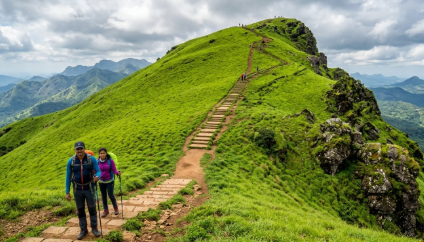
🏞️ Kudremukh (Karnataka)
One of the most ecologically extraordinary and visually magnificent destinations in the Western Ghats.
📍 Location
Chikkamagaluru District, Karnataka
⛰️ Elevation
Kudremukh Peak – 1,892 metres
🌿 National Park
Approximately 600 sq km
🚶 Main Activity
Trekking & Wildlife Exploration
📖 Overview
Kudremukh stands as one of the most ecologically extraordinary and visually magnificent destinations in the Western Ghats, a protected wilderness of rolling shola grasslands, dense tropical rainforest, cascading rivers, and mist-wrapped peaks that together constitute one of the most biologically significant landscapes in Asia. Situated in the Chikkamagaluru district of Karnataka and forming the core of a national park spanning approximately 600 square kilometres, Kudremukh occupies a position at the heart of the Western Ghats — a mountain range recognised by UNESCO as a World Heritage Site and identified as one of the world's 34 biological hotspots, a global distinction that places it among the rarest and most irreplaceable natural environments on earth.
The name Kudremukh is derived from the Kannada words meaning horse face, a reference to the distinctive profile of the main peak when viewed from a particular angle, where the contours of the mountain are said to resemble the face of a horse — an image that the local community recognised with characteristic precision. At 1,892 metres, the Kudremukh peak is the second highest in Karnataka after Mullayangiri, and the surrounding mountain range forms the watershed for three of the most significant rivers of the western Deccan — the Tunga, the Bhadra, and the Nethravathi — all of which have their origins within the boundaries of the national park, giving the landscape a hydrological importance that extends far beyond its borders into the drinking water and agricultural systems of millions of people across Karnataka and Kerala.
The history of the Kudremukh landscape in the modern period carries the marks of a significant environmental contest. The area was home to extensive iron ore mining operations conducted by the Kudremukh Iron Ore Company Limited from the 1970s onward, and the eventual cessation of all mining activities in 2005 following a Supreme Court directive — one of the most consequential conservation victories in Indian environmental history — marked the beginning of the landscape's gradual recovery and the consolidation of its identity as a protected natural destination of the highest order.
🌲 Why Visit Kudremukh
The most compelling reason to visit Kudremukh is the quality of the natural environment it offers — an environment of a wildness and biological richness that is found in very few places remaining in peninsular India. The landscape of Kudremukh is not a managed or curated natural experience but a genuinely intact forest system, one that functions as it has for millennia, with its own cycles of rainfall, river flow, animal movement, and plant succession unfolding according to rhythms that have nothing to do with the human world beyond its boundaries. Walking through its shola forests and grasslands, or standing at the edge of a ridge looking out over the mist-filled valleys below as clouds move through the tree line, is an encounter with the natural world at its most complete and most humbling.
Kudremukh is also one of the finest and most genuinely challenging trekking destinations in the Western Ghats, offering trails that move through terrain of genuine wildness and difficulty to summits and ridgelines that reward the effort with panoramic views of the surrounding mountain ranges and, on clear days, glimpses of the Arabian Sea coast to the west. Unlike the more developed and crowded trekking destinations of the Himalayas, Kudremukh's trails require forest department permits and licensed guides, a controlled access system that has maintained the integrity of the landscape and ensures that every trek retains the character of a genuine wilderness encounter.
The ecological significance of Kudremukh — as the origin of three major rivers, as one of the world's designated biodiversity hotspots, and as the last significant refuge of several endemic and endangered species — adds a dimension of conservation awareness to a visit that enriches the experience beyond the purely scenic. For those who care about the natural world and the efforts being made to protect it, Kudremukh is a destination of particular meaning.
⭐ Key Highlights Within the Area
⛰️ Kudremukh Peak
The Kudremukh Peak itself, at 1,892 metres the defining geographical feature of the national park, is the primary trekking destination and one of the most rewarding summit experiences in the Western Ghats. The ascent passes through alternating zones of dense shola forest and open rolling grassland, with the grassland sections offering unobstructed views of the surrounding ridges and the deep valleys below that gather cloud and mist in patterns of continuously shifting beauty. The summit on clear days offers a panoramic view that takes in the full sweep of the central Western Ghats, with the Bababudan range visible to the east and the coastal lowlands stretching toward the Arabian Sea to the west.
🌿 Shola Forests
The Shola forests of Kudremukh — patches of dense, stunted evergreen forest that occupy the valleys and sheltered hollows between the rolling grasslands — are among the most biodiverse plant communities in the Western Ghats, harbouring a density of endemic tree species, orchids, mosses, and ferns found nowhere else on earth.
💦 Hanuman Gundi Falls
The Hanuman Gundi Falls, located near the town of Kudremukh and surrounded by a setting of dense forest and boulders, cascade from a height of over 100 feet into a rock pool below in a sequence of dramatic drops that are particularly spectacular in the post-monsoon months when the full weight of the Western Ghats rainfall is still moving through the river system.
🏕️ Bhagavathi Nature Camp
The Bhagavathi Nature Camp, operated by the Karnataka Forest Department within the national park, serves as the primary accommodation and visitor base for those undertaking permitted treks and nature walks within the core zone.
🥾 Activities
Trekking is the defining activity of Kudremukh and the experience that draws the majority of its visitors, with the Kudremukh Peak trek being the most sought-after route in the national park. The full trek to the summit and back typically requires a full day and covers a distance of approximately 22 kilometres through forest and grassland terrain of varying difficulty.
Wildlife observation and birdwatching are deeply rewarding pursuits within the national park's forests, as the dense tree cover and the biological richness of the shola-grassland mosaic support a remarkable range of species.
Nature walks along the river banks and through the buffer zone forests around the town of Kudremukh and the Bhagavathi area provide a gentler and less physically demanding engagement with the natural environment for those who prefer to observe the landscape at a slower pace.
🌤️ Best Time to Visit
The most favorable period to visit Kudremukh is from October to February, when the monsoon has retreated and the landscape is at its most lushly green and visually spectacular, the rivers and waterfalls are still running at strong volume from the accumulated rainfall, the skies are largely clear, and the trekking trails — though occasionally muddy in the early post-monsoon weeks — are at their most rewarding in terms of scenery and wildlife activity.
December and January bring cooler and drier conditions that make the trekking experience more physically comfortable, and the clearer air of these months allows for the most extensive summit views on cloudless mornings.
The monsoon from June to September brings the full force of the southwest monsoon to the Western Ghats, and Kudremukh receives some of the highest rainfall in Karnataka during these months.
🚗 Connectivity
Kudremukh is situated in the interior of the Western Ghats and is accessible only by road, as the surrounding terrain precludes rail connectivity to the immediate area. The town of Kudremukh and the national park entrance are approximately 100 kilometres from Mangaluru, which serves as the primary gateway city, and approximately 350 kilometres from Bengaluru.
Mangaluru International Airport, approximately 100 kilometres from the park, offers a well-connected range of domestic services from Bengaluru, Mumbai, Chennai, Delhi, Hyderabad, and Kochi, as well as international connections to the Gulf and Southeast Asia, making it the most practical air gateway for visitors approaching from outside Karnataka.
Mangaluru Junction Railway Station, also approximately 100 kilometres from Kudremukh, is a significant station on the Konkan Railway and the Southern Railway network, with connections to Mumbai, Bengaluru, Chennai, Thiruvananthapuram, and other major cities.
Private taxis hired from Mangaluru, Chikmagalur, or Karkala are the most flexible and reliable means of reaching and exploring the park and its surrounding attractions, and all trekking permits and guide arrangements should be confirmed in advance through the Karnataka Forest Department at the Bhagavathi Nature Camp or through authorised eco-tourism operators.
Attractions Around [Kudremukh]