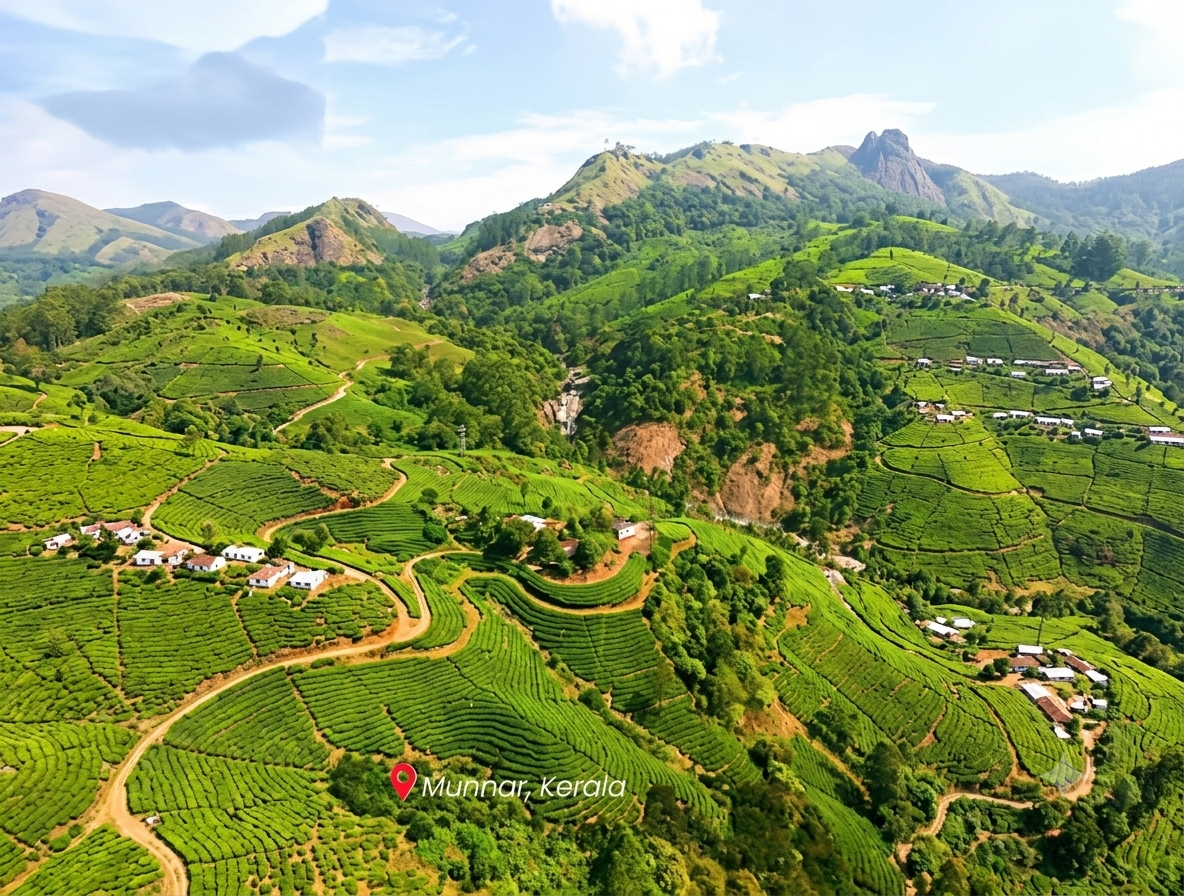
🌿 Munnar (Kerala)
🍃 Tea Gardens • Wildlife • Waterfalls • Western Ghats Highlands
📖 Overview
Munnar stands as one of the most celebrated and visually magnificent hill stations in India, a destination whose endlessly rolling carpet of tea gardens, mist-wrapped peaks, cascading waterfalls, and cool highland air have made it one of the most visited and most loved natural retreats on the subcontinent. Situated in the Idukki district of Kerala at an altitude of approximately 1,600 metres above sea level, Munnar occupies the confluence of three mountain streams — the Muthirapuzha, the Nallathanni, and the Kundala — from which its name is derived, the word meaning in Tamil three rivers meeting. The surrounding landscape rises further to the Anamudi Peak at 2,695 metres, the highest point in peninsular India outside the Himalayas, and the entire arc of hills that frames the town constitutes one of the most ecologically significant and biologically rich highland ecosystems in the Western Ghats.
The history of Munnar in its modern form begins in the 1870s, when the British first entered these hills to settle a border dispute and quickly recognised the extraordinary potential of the cool, fertile highland terrain for tea cultivation. The first tea estates were established in the 1880s under the enterprise of John Daniel Munro and A.D. Turner, and the development of the plantation economy that followed transformed the landscape of the Idukki highlands over the following decades, drawing thousands of labourers from the Tamil plains, establishing a network of bungalows, clubs, churches, and plantation infrastructure, and creating the visual character — the sweeping green hills terraced with tea — that defines Munnar to this day. Before the British arrived, these hills were the ancestral home of the Muthuvan tribal community, who lived in close and intimate relationship with the dense shola forests and highland grasslands of the Western Ghats and whose cultural heritage remains a living dimension of the district.
What distinguishes Munnar from other hill stations in Kerala and in southern India is the sheer scale and visual completeness of the tea landscape — a landscape in which the plantation estates cover the hillsides in a continuous, carefully maintained carpet of vivid green that creates one of the most intensely beautiful and compositionally satisfying natural environments in the country — combined with the ecological significance of the surrounding protected areas, the rarity of the Neelakurinji flowering phenomenon, and the presence of the highest peak in peninsular India within reach of the town.
✨ Why Visit Munnar
The most compelling reason to visit Munnar is the immersive quality of the tea landscape itself — an environment where the visual, the olfactory, and the atmospheric converge in a way that is unique among India's hill destinations. The sight of tea gardens stretching across the hillsides in every direction from the approaches to the town, the smell of freshly processed tea leaves drifting from the factory buildings, and the sound of the wind moving through the plantation — interrupted only by the distant call of a bird from the forest above — create a sensory experience that cannot be replicated at any other hill destination in the country.
Munnar is also one of the finest destinations in India for the encounter with rare and globally significant natural phenomena. The Eravikulam National Park, established specifically to protect the endangered Nilgiri Tahr — a wild mountain goat found only in the higher reaches of the Western Ghats — provides one of the most accessible and reliable wildlife encounters in Kerala, with the tahr's surprising tameness at close range making for photography opportunities of an intimacy rarely available with wild animals. And the Neelakurinji — the Strobilanthes kunthiana shrub that carpets the hills of Munnar in an extraordinary display of blue-purple flowers once every twelve years — represents one of the most remarkable botanical events in the world, a mass flowering phenomenon that transforms entire hillsides into a single unbroken field of colour in an event that draws visitors from across the globe on the rare occasions it occurs.
For honeymooners, nature lovers, wildlife enthusiasts, tea culture devotees, and travellers simply seeking a destination of outstanding natural beauty and cool highland air, Munnar offers a quality and depth of experience that justifies its reputation as one of the finest hill destinations in Asia.
⭐ Key Highlights Within the Area
🦌 Eravikulam National Park
The Eravikulam National Park, spread across 97 square kilometres of rolling high-altitude grassland and shola forest on the edge of Munnar, is the most ecologically significant protected area in Kerala and home to the largest surviving population of the endangered Nilgiri Tahr.
⛰️ Anamudi Peak
The Anamudi Peak, at 2,695 metres the highest point in peninsular India south of the Himalayas, rises above the Eravikulam National Park in a summit of considerable grandeur and ecological significance.
🍵 Tea Museum
The Tea Museum at the Nallathanni Estate, operated by the Kanan Devan Hill Plantations and representing the first tea museum established in the country, traces the history of tea cultivation in the Munnar hills from the 1880s to the present through a collection of antique machinery, historical photographs, and artefacts.
🚣 Mattupetty Dam & Lake
Mattupetty Dam and the surrounding lake, situated approximately thirteen kilometres from the town at an altitude of 1,700 metres, offer a scenic reservoir set within a landscape of forested hills and tea gardens that is particularly beautiful in the morning hours when the mist sits over the water.
🌄 Top Station
Top Station, at approximately 1,700 metres and situated 32 kilometres from Munnar on the Tamil Nadu border, is the highest point accessible by road in the district and offers a panoramic view across the Tamil Nadu plains and the surrounding Western Ghats ridges that on clear days extends to a remarkable distance.
💦 Waterfalls & Marayoor
The Attukal, Cheeyappara, and Valara Waterfalls, cascading from the hillsides along the approaches to Munnar from Kochi, are among the most immediately encountered natural features for those arriving by road and are particularly spectacular in the post-monsoon months.
🥾 Activities
Tea estate walks and factory visits are the most characteristically Munnar activities and the experiences that most directly engage visitors with the living identity of the destination. The Kanan Devan tea estates welcome visitors for guided plantation walks that move through the rows of tea bushes and observe the plucking, sorting, and processing operations that transform the leaf into the finished product, and the Tea Museum provides the historical and technical context that deepens the walk into something more than purely scenic.
Trekking through the high-altitude terrain of the Eravikulam National Park and the surrounding forest and grassland areas is one of the most rewarding outdoor activities available in Munnar, with the Anamudi Peak trek providing the most demanding and most scenically comprehensive option.
Boating on the Mattupetty and Kundala lakes provides a quieter and more relaxed engagement with the highland landscape, and the jeep safaris operating from the Rajamala area of Eravikulam National Park provide the most productive conditions for Nilgiri Tahr sightings and high-altitude wildlife encounters.
📅 Best Time to Visit
🌿 September to November
The most favorable period to visit Munnar is from September to May, with the post-monsoon months of September to November offering the landscape at its most dramatically lush and the waterfalls at their most powerful.
❄️ December to February
The cooler months of December to February provide the most comfortable conditions for outdoor exploration, trekking, and plantation walks. The air during the winter months is crisp and clean, the skies are largely clear, and the mornings carry a quality of mist and light over the tea gardens.
🌸 Neelakurinji Season
The Neelakurinji flowering season, when it occurs once every twelve years — the most recent having taken place in 2018, with the next expected in 2030 — transforms the hills of Munnar into a landscape of extraordinary and unrepeatable botanical spectacle.
🚗 Connectivity
Munnar is situated in the interior of the Western Ghats in the Idukki district of Kerala and is accessible only by road, as the surrounding terrain and the hill station's highland position preclude rail or air connectivity to the immediate area.
Cochin International Airport at Nedumbassery, approximately 110 kilometres from Munnar, is the nearest and most practically connected airport, offering extensive domestic services and international connections.
The nearest railway stations are Ernakulam and Aluva in Kochi, well connected to all major cities on the Indian Railways network. Regular KSRTC bus services operate from Kochi, Ernakulam, Coimbatore, and Thrissur to Munnar, and private taxis and shared jeep services provide flexible travel options.
Explore The Surroundings [Munnar]
- Devikulam : The Serene Hill Retreat Of Kerela
- Rajamala Hill : The Green Crown Of Munnar
- Theyyam: A Sacred Dance Tradition Of Kerela
- Anamudi Viewpoint : The Roof Of South India
- kathakali -The soul of keral's classical dance