📖 Overview
Mysuru stands as one of the most regally beautiful and culturally distinguished cities in southern India, a destination whose layered identity as a seat of royal power, a centre of classical arts and learning, a city of palaces and gardens, and a living repository of Karnataka's finest craft traditions has made it one of the most visited and beloved heritage cities in the country. Formerly known as Mysore and officially renamed Mysuru in 2014, the city is situated in the southern part of Karnataka at the foothills of the Chamundi Hills, approximately 147 kilometres southwest of Bengaluru. It is the third most populous city in the state and carries the informal titles of the City of Palaces, the Sandalwood City, and the City of Yoga — each reflecting a distinct and genuine dimension of what the city offers to its visitors.
The history of Mysuru as a significant settlement reaches back over six centuries, with the Wadiyar dynasty establishing their kingdom here in 1399 and ruling — with two notable interruptions — until Indian independence in 1947. It was under the Wadiyars that the city grew into one of the most prosperous and administratively refined princely states in the British Empire, and it was their patronage of architecture, music, silk weaving, and the visual arts that gave Mysuru its enduring character as a city of cultural refinement and aesthetic sensibility. The two interruptions in Wadiyar rule — first by Hyder Ali, who seized power in the latter half of the eighteenth century, and then by his son Tipu Sultan, the Tiger of Mysore, whose resistance to British expansion ended with his death in the Fourth Anglo-Mysore War of 1799 — added a further chapter of military and political drama to the city's history that deepened its significance in the broader narrative of India's encounter with colonialism.
What distinguishes Mysuru from other heritage cities in Karnataka is the coherence and completeness of the experience it offers — a palace of truly international grandeur, a bazaar district of old-world richness, gardens of the finest Mughal design, a hilltop temple of deep pilgrimage significance, and a festival that ranks among the most spectacular public celebrations in all of Asia, all held together by a city whose streets retain a grace and unhurried quality that makes extended exploration a genuine pleasure.
✨ Why Visit Mysuru
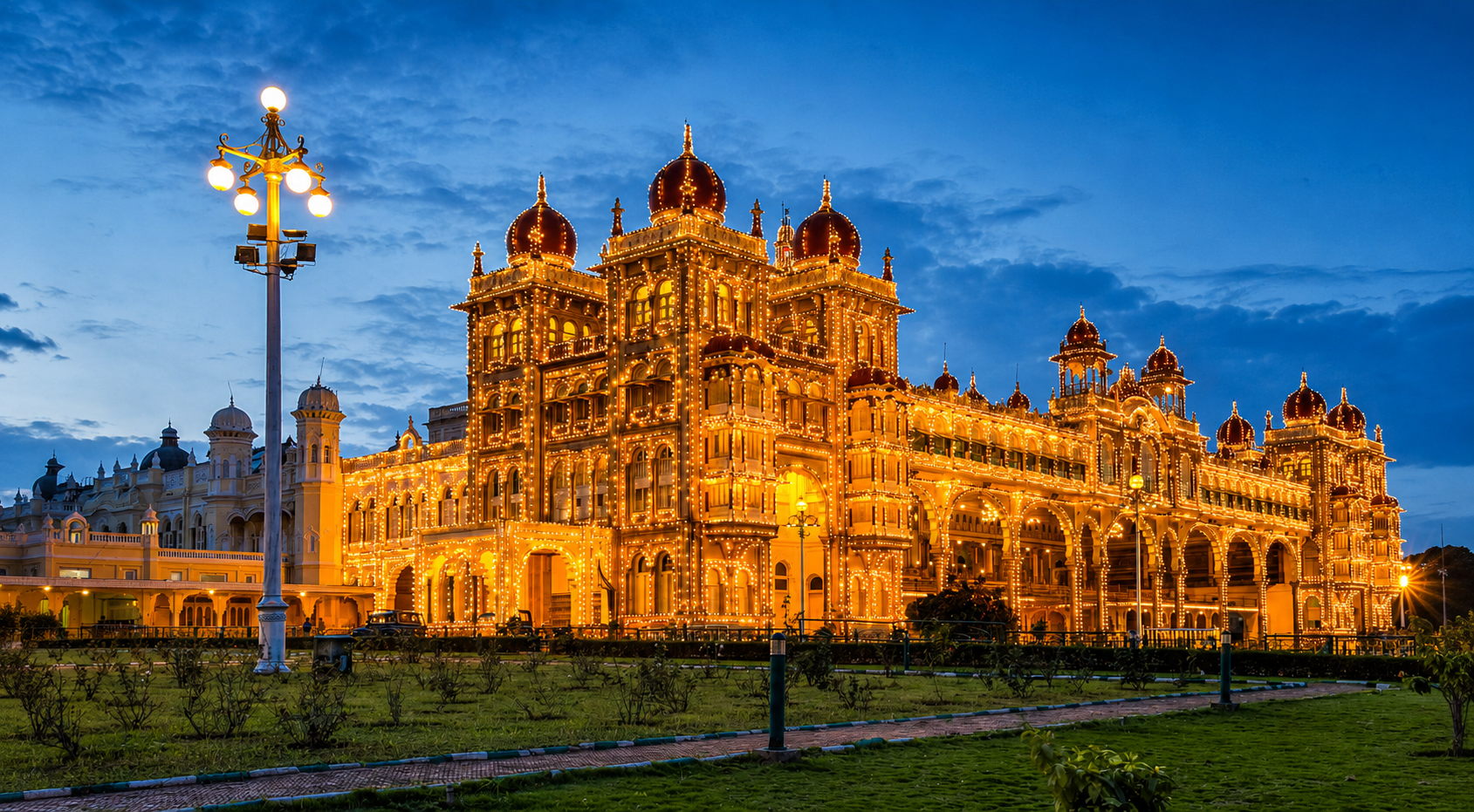
The most compelling reason to visit Mysuru is the Mysore Palace — formally known as the Amba Vilas Palace — which stands as one of the most magnificent royal buildings in India and one of the most visited monuments in the country after the Taj Mahal. The palace's blend of Indo-Saracenic, Dravidian, Rajput, and Gothic architectural influences, its interiors of stained glass, carved teak, mosaic floors, and ornate silver doors, and the extraordinary spectacle of its illumination on Sunday evenings — when nearly a hundred thousand lightbulbs outline every turret, dome, and archway against the night sky — create an experience of royal splendour that is difficult to overstate and impossible to forget.
Mysuru is also one of the finest cities in India for the unhurried pleasures of cultural exploration — wandering through the Devaraja Market with its mounds of jasmine, kumkum, silk, and spices, watching the weavers at a Mysore silk cooperative, attending a classical Carnatic music performance, or learning the fundamentals of Ashtanga yoga at one of the schools that have made the city a destination for practitioners from across the world. This combination of monumental heritage and living cultural tradition in a city of clean streets and manageable scale makes Mysuru one of the most rewarding places in Karnataka for those who seek a destination that engages both the eye and the mind.
The Mysuru Dasara, celebrated across ten days in October during the festival of Navaratri and culminating in the Vijayadashami procession, is the state festival of Karnataka and one of the most spectacular public events in India. The illuminated palace, the golden throne displayed to the public, the caparisoned elephants carrying the royal deity through the city streets, the cavalry, folk dancers, musicians, and tableaux that form the procession, and the vast and joyous crowds that fill every vantage point together create a celebration of a scale and splendour that few festivals anywhere in the country can match.
📍 Key Highlights Within the Area
🏰 Mysore Palace
The Mysore Palace, set within landscaped gardens in the heart of the city and approached through a ceremonial gate flanked by the statue of Maharaja Chamarajendra Wadiyar, is the defining landmark of the city and the visual symbol that the Wadiyar dynasty's centuries of rule have left as their most enduring contribution to Karnataka's heritage. The palace was rebuilt in its current form between 1897 and 1912 following a fire that destroyed its predecessor, to the design of the English architect Henry Irwin, and the scale and intricacy of the completed building — with its domes, turrets, arched corridors, and the magnificent Kalyana Mantapa or marriage pavilion with its peacock-shaped cast iron pillars — place it firmly among the finest examples of Indo-Saracenic architecture in the world.
⛰️ Chamundi Hills
The Chamundi Hills, rising approximately 1,000 metres above the city and visible from most parts of Mysuru, are crowned by the Chamundeshwari Temple, one of the most important Shakti temples in Karnataka, dedicated to the goddess Chamundeshwari who is the presiding deity of the Wadiyar dynasty and the city that bears her name. The thousand-step stairway ascending the hill, flanked by carved stone lamps and punctuated at the midpoint by the enormous Nandi Bull monolith, is a pilgrimage and recreational route of long tradition, and the views from the hilltop across the city and the surrounding plains are among the finest in the region.
🌺 Brindavan Gardens
The Brindavan Gardens at the Krishnarajasagara Dam, approximately nineteen kilometres from the city, are among the most elaborately designed and maintained botanical gardens in India, laid out in terraced Mughal style along the downstream face of the dam with fountains, flowerbeds, cypress avenues, and a famous musical fountain illuminated after dark in a display of light, water, and music that has made the evening visit one of the most popular excursions from Mysuru for generations of visitors.
🎨 Cultural Landmarks
The Jaganmohan Palace, built in 1861 and now housing the Sri Jayachamarajendra Art Gallery, displays a collection of paintings, musical instruments, ivory work, porcelain, and decorative arts that reflects the breadth of the Wadiyar dynasty's cultural patronage. The St. Philomena's Cathedral, built between 1933 and 1941 in the Neo-Gothic style and one of the largest churches in India, rises dramatically above the surrounding streets with twin spires that can be seen from considerable distances across the city.
🦜 Nature & Heritage
The Ranganathittu Bird Sanctuary, situated approximately sixteen kilometres from Mysuru on a series of islands in the Kaveri River, is one of the finest and most accessible birdwatching destinations in Karnataka, home to a large breeding colony of painted storks, open-billed storks, spoonbills, cormorants, herons, and egrets, as well as marsh crocodiles that can be observed from the boats that navigate between the islands.
The Somanathapur Chennakeshava Temple, approximately thirty-five kilometres from Mysuru and built in 1268 CE during the Hoysala period, is one of the finest surviving examples of Hoysala temple architecture — a trikuta shrine of extraordinary sculptural richness covering every surface of its star-shaped platform with friezes of elephants, horses, scrolling foliage, mythological scenes, and deity figures of remarkable delicacy and detail.
🎭 Activities
Palace visits and heritage walks are the most naturally rewarding activities in Mysuru, with the Mysore Palace and its surrounding gardens, the Jaganmohan Palace, and the Lalitha Mahal Palace — built in 1921 to accommodate the Viceroy of India during his visits to Mysore and now operating as a heritage hotel — providing a sequence of royal architecture of the highest order. The Sunday evening illumination of the Mysore Palace, when the building is outlined in lights from dusk until approximately nine-thirty in the evening, is one of the most famous and most visited public spectacles in Karnataka and should be planned for if the visit falls on a Sunday.
The Devaraja Market in the old city, established during the Wadiyar period and still operating in its original covered market hall, is one of the finest traditional urban markets in South India — a place of extraordinary sensory richness where stalls selling fresh flowers, silk sarees, sandalwood products, spices, coconut oil, Mysore pak sweets, and incense are compressed into a dense and aromatic landscape that rewards unhurried wandering and photography in equal measure. Attending a performance of Yakshagana, the traditional folk theatre form of coastal Karnataka that is occasionally staged in the city, or a classical Carnatic music or Bharatanatyam dance performance at one of Mysuru's cultural institutions, provides a living encounter with the artistic traditions the Wadiyar court sustained and celebrated for centuries.
Yoga practice and study at one of the Ashtanga yoga schools and institutes for which Mysuru has become an international destination — the tradition of Pattabhi Jois having originated here — draws practitioners from across the world for courses ranging from a few days to several months. Shopping for Mysore silk sarees, which are woven exclusively within the district and carry a Geographical Indication tag, sandalwood carvings, rosewood inlay work, and the distinctive aromatic sandalwood products for which the city is celebrated across India provides a window into the craft traditions that have defined the city's economic and artistic identity for generations.
🌤️ Best Time to Visit
The most favorable period to visit Mysuru is from October to February, when temperatures across the Karnataka plateau are moderate and pleasant, the skies are largely clear, and the city's heritage sites and gardens can be explored comfortably on foot. The October Dasara festival represents the single most spectacular time to be in Mysuru, with the city illuminated, the palace at its most publicly accessible and celebratory, and the ten-day sequence of cultural events, markets, and processions creating an atmosphere of festivity that transforms the experience of the city entirely. Visitors wishing to attend the Dasara should plan accommodation and travel well in advance, as the festival draws enormous numbers from across Karnataka, India, and internationally.
November to February offers the most comfortable exploration conditions, with cool mornings, moderate afternoons, and the pleasant evenings that make the palace illumination on Sunday nights and the Brindavan Gardens musical fountain particularly enjoyable. The gardens and botanical spaces around the city are at their greenest in this period, and the birdwatching at Ranganathittu is most productive in the cooler months when the breeding colonies are most active.
March to May sees rising temperatures across the region and the city becomes progressively warmer, though the elevated heritage buildings and shaded garden areas remain tolerable in the morning and evening hours. The monsoon from June to September brings welcome rainfall, cooler temperatures, and a lushly green version of the city, with reduced visitor numbers that can make palace visits and market exploration more relaxed, though some outdoor excursions are better postponed until the rains subside.
🚆 Connectivity
Mysuru is one of the most conveniently connected heritage cities in Karnataka, accessible by rail, road, and air from Bengaluru and from multiple cities across southern India. Mysuru Railway Station, situated close to the city centre, is well served by direct and express train services from Bengaluru, Chennai, Coimbatore, Mangaluru, Hubballi, and several other major cities, with the Shatabdi and Intercity Express services from Bengaluru completing the journey in approximately two hours and providing the most comfortable and time-efficient approach for day visitors and short-stay travellers.
Mysuru Airport at Mandakalli, approximately twelve kilometres from the city centre, offers limited domestic services connecting the city to Bengaluru, Chennai, and a small number of other cities, and plans for the expansion of its connectivity have been under consideration for some time. Kempegowda International Airport in Bengaluru, approximately 170 kilometres away, remains the most practical air gateway for travellers arriving from outside Karnataka, with the onward road or rail journey from Bengaluru to Mysuru adding a further two to three hours. The expressway and national highway connecting Bengaluru to Mysuru is one of the most well-maintained road corridors in Karnataka, and private taxis, KSRTC Volvo buses, and private sleeper buses on this route are frequent, comfortable, and reliable. Within Mysuru, auto-rickshaws, city buses, app-based cabs, and hired taxis from the railway station and city centre provide convenient access to all major heritage sites, gardens, and excursion destinations in the surrounding district.
Explore Beyond [Mysore]