🏔️ Ooty — Udhagamandalam (Tamil Nadu)
Queen of Hill Stations • Nilgiri Hills • Tea Gardens • Heritage Railway
📖 Overview
Ooty stands as one of the most beloved and enduringly celebrated hill stations in India, a destination whose combination of cool highland air, rolling tea gardens, colonial heritage, and sweeping Nilgiri landscapes has drawn travellers, nature lovers, and honeymooners for well over two centuries. Formally known as Udhagamandalam and popularly called Ooty, the town sits at an altitude of approximately 2,240 metres above sea level in the Nilgiris district of Tamil Nadu, nestled within a landscape of forested hills, mist-draped valleys, and terraced gardens that together create one of the most visually satisfying natural environments in peninsular India.
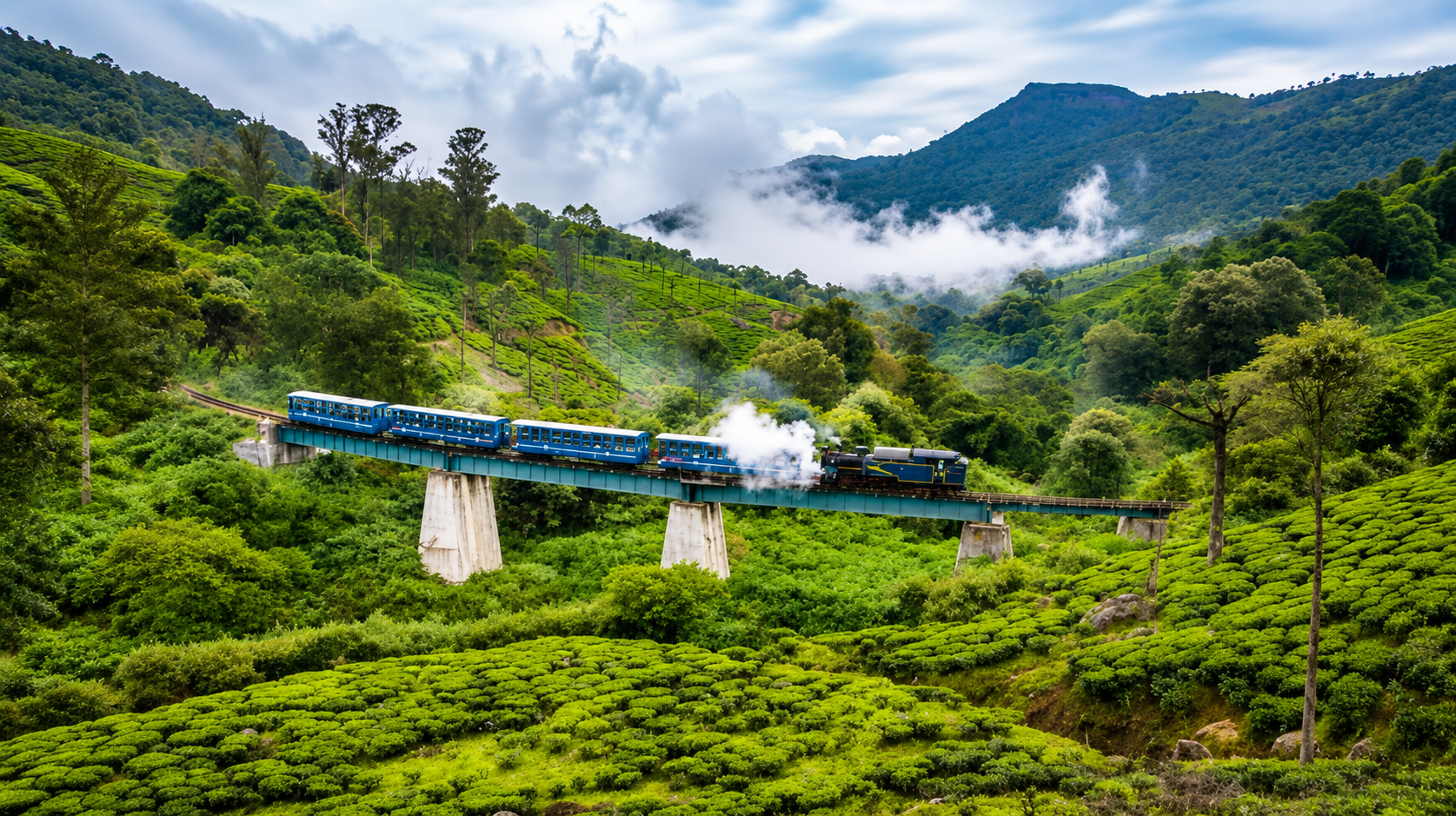
The history of Ooty as a formal settlement begins with John Sullivan, the Collector of Coimbatore, who discovered the plateau in 1819 and recognised its potential as a retreat from the punishing heat of the plains below. The British developed it rapidly as a hill station, and it served as the summer capital of the Madras Presidency through much of the colonial era, leaving behind a legacy of Victorian bungalows, botanical gardens, a club of considerable historical note, and the Nilgiri Mountain Railway — completed in 1908 and now designated a UNESCO World Heritage Site — that continues to carry travellers up the hillside through tunnels and over bridges in one of the most charming heritage rail journeys in Asia.
What distinguishes Ooty from other hill stations of the south is the richness of what it holds within a compact and accessible geography — a UNESCO railway, the highest peak in Tamil Nadu, one of the largest botanical gardens in the country, a thriving tea culture, and the cultural traditions of the Toda and Badaga tribal communities whose presence in these hills long predates the colonial era. This layered identity, where natural grandeur, colonial character, tribal heritage, and horticultural beauty coexist, earns Ooty its informal title as the Queen of Hill Stations.
🌄 Why Visit Ooty
The most compelling reason to visit Ooty is the totality of the experience it offers — a destination where the journey is as rewarding as the arrival, the mornings carry a quality of light and air rarely encountered in southern India, and the landscape rewards slow and attentive exploration at every turn. The Nilgiri Mountain Railway journey from Mettupalayam to Ooty, climbing through forty-six kilometres of forested hillside via rack-and-pinion track, is an experience that frames the arrival beautifully and offers a continuously unfolding panorama of the Western Ghats that no road journey can replicate.
Ooty also carries a quality of seasonal distinctiveness unusual among southern Indian destinations. The Summer Festival in May, when the Botanical Gardens host a spectacular flower show drawing entries from across the country, transforms the town into a celebration of colour and horticultural craft. The cooler months bring a misty, atmospheric quality to the hills that makes walking through the tea estates and pine forests an experience of considerable quiet beauty, while the monsoon months — though wet — deepen the green of the surrounding landscape to an intensity that rewards those who brave the rain.
The destination is also the natural gateway to some of Tamil Nadu's most significant wildlife habitats. Mudumalai National Park, part of the larger Nilgiri Biosphere Reserve and one of the most biodiverse protected forests in peninsular India, lies at the foot of the Nilgiris and can be visited as a day excursion from Ooty, adding a wildlife dimension to the stay that broadens the overall experience considerably.
⭐ Key Highlights Within the Area
🌺 Government Botanical Garden
The Government Botanical Garden, spread across 55 acres on the slopes below Doddabetta Peak and laid out in 1847 during the colonial period, is one of the finest and most extensively maintained botanical gardens in India. Its terraced Italian-style lawns, rare tree ferns, orchid house, fossil of a tree estimated at twenty million years old, and annual flower show held every May draw visitors throughout the year and provide a beautifully designed environment for leisurely exploration.
⛰️ Doddabetta Peak
Doddabetta Peak, at 2,623 metres the highest point in the Nilgiris and in the state of Tamil Nadu, sits approximately ten kilometres from Ooty town at the junction of the Western and Eastern Ghats. The drive and short trek to the summit offer panoramic views across the surrounding hills, valleys, and on clear days far into the plains below, and the telescope house at the summit provides an additional vantage point for appreciating the scale of the Nilgiri landscape.
🚣 Ooty Lake
Ooty Lake, an artificial body of water created by John Sullivan in 1824 and extending across 65 acres, sits at the heart of the town and has long been its most central leisure landmark. Boating on the lake — by pedal boat, rowboat, or motor launch — against a backdrop of eucalyptus and pine-covered hills is one of Ooty's most popular and enduring activities, and the lakeside gardens and promenade add a further element of pleasant, unhurried recreation.
🚂 Nilgiri Mountain Railway
The Nilgiri Mountain Railway, running between Mettupalayam and Ooty through a total of sixteen tunnels and over two hundred and fifty bridges, is both a heritage monument and a living transport link, and the experience of riding its narrow-gauge carriages behind a steam locomotive through forests and past waterfalls and hillside villages is widely regarded as one of the finest heritage rail journeys in Asia.
🍃 Tea Museum & Estates
The Tea Museum and factory estates of the Nilgiris offer a detailed and immersive account of tea cultivation, processing, and tasting, tracing a tradition that has shaped the identity of these hills since the early nineteenth century.
🌹 Rose Garden
The Rose Garden, laid out in terraces and housing over twenty thousand varieties of roses, provides a visual spectacle of colour and fragrance that is at its most extraordinary during the flowering season.
💦 Pykara Lake and Waterfalls
The Pykara Lake and Waterfalls, set within a forested landscape approximately twenty kilometres from Ooty, offer a serene contrast to the town itself — a calm dam lake suitable for boating surrounded by dense shola forest, with the cascading falls providing a natural focal point for photography and picnicking in a setting of considerable natural beauty.
🥾 Activities
Trekking through the Nilgiri Hills is one of the most rewarding activities in the area, with trails ranging from the well-marked route to Doddabetta Peak to longer forest walks through shola grasslands toward viewpoints and waterfalls that see relatively few visitors. The Upper Bhavani Lake, Avalanche Lake, and the Emerald Lake areas offer trekking routes of varying difficulty through landscapes of outstanding natural beauty, with the forested paths providing frequent opportunities for birdwatching in one of India's richest avifauna zones.
The Nilgiri Mountain Railway journey, whether taken in full from Mettupalayam or in part between Coonoor and Ooty, is an activity in its own right and one of the most memorable single experiences the destination offers. The combination of the vintage carriages, the rack-and-pinion mechanism visible on the steepest gradients, and the continuously changing scenery through forests and past waterfalls makes the journey a deeply pleasurable and unhurried passage through the hills.
Tea estate visits and tasting sessions allow travellers to understand the cultivation and processing of Nilgiri tea at close quarters, and the Highfield and other estates near Ooty welcome visitors for guided tours that move from the plucking fields through the processing facility to a tasting room where the distinctive character of Nilgiri tea can be appreciated directly. Boating at Ooty Lake and Pykara Lake, horse riding on the hillside paths near the Botanical Gardens, and cycling through the quieter roads of the surrounding countryside provide further options for outdoor recreation.
Shopping for locally produced Nilgiri tea, handmade chocolates for which the town has developed a dedicated local industry, aromatic eucalyptus and lavender oils, and the distinctive handicrafts of the Toda community provides a meaningful and flavourful way to engage with the local economy and bring home genuinely representative products of the Nilgiris.
📅 Best Time to Visit
❄️ October to February
The most favorable period to visit Ooty is from October to June, with the cooler months of October to February offering the most bracing and atmospherically distinctive highland experience. During these months the skies are generally clear, the mornings are cool and crisp, the surrounding hills are vivid with greenery, and the quality of the light on the tea gardens and forested slopes is particularly beautiful. The Rose Garden is at its finest between November and January when the blooms are at their most prolific.
☀️ March to May
March to May represents the peak tourist season, when families and holidaymakers from across Tamil Nadu, Karnataka, and Kerala arrive in large numbers, and the Summer Festival and Flower Show in May add a celebratory dimension to the visit. The weather during these months is warm during the day and pleasantly cool in the evenings, making outdoor exploration comfortable and rewarding.
🌧️ July to September
The monsoon from July to September brings heavy rainfall to the Nilgiris, as the Western Ghats receive significant precipitation from both the southwest and northeast monsoons. While the landscape reaches its most intensely lush and green during these months and the waterfalls are at full flow, outdoor activities are more limited and the roads can be slippery. Travellers who visit during the monsoon should be prepared for extended periods of rain but will find an Ooty of uncommon atmospheric beauty in return.
🚗 Connectivity
Ooty is most conveniently reached from Coimbatore, which serves as the primary gateway city and the most practical starting point for the approach by both road and rail. Coimbatore International Airport, located approximately 104 kilometres from Ooty, operates regular domestic flights from Chennai, Bengaluru, Mumbai, Delhi, and Hyderabad, as well as select international connections, and serves as the primary air gateway for travellers approaching from outside the region.
The Nilgiri Mountain Railway connects Mettupalayam — which is reached from Coimbatore in approximately an hour by road or rail — to Ooty through a five-hour heritage journey that is as much a destination experience as a mode of transport. The railway is fully operational and bookable through the Indian Railways network, and advance reservation is strongly recommended during peak months. By road, Ooty is connected to Coimbatore via the Mettupalayam ghat road, to Mysuru in Karnataka via the Gudalur route, and to Kozhikode and Calicut in Kerala via the Gudalur–Ooty highway, all of which offer scenic drives through the forests of the Western Ghats. Regular state bus services connect Ooty to Coimbatore, Chennai, Bengaluru, Mysuru, Kozhikode, Madurai, and Trichy, and private taxis and hired vehicles are widely available for customised onward travel within the Nilgiris district.
Discover More Around [Ooty]
- Kotagiri : The Serene Hill Station Of Tamil Nadu
- Wayanad : The Green Paradise Of Kerela
- Mysore : The Royal Heritage City Of India
- Coorg : The Scotland Of India
- Jallikattu-Festival : The Spirit Of Tamil Tradition And Valor