🏛️ Thanjavur — Tanjore (Tamil Nadu)
📜 Overview
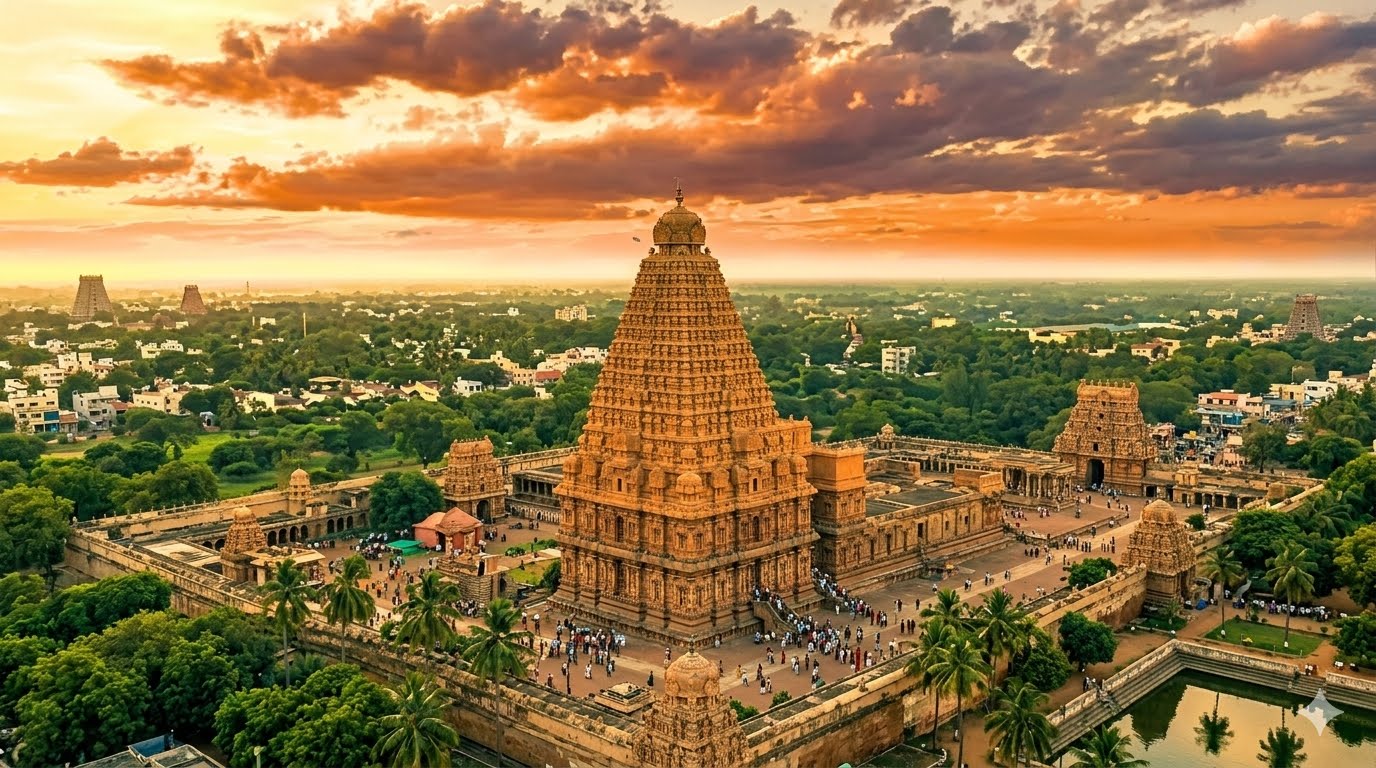
Thanjavur stands as one of the most culturally magnificent and historically consequential destinations in India, a city whose identity as the seat of the mighty Chola Empire at the peak of its power between the ninth and thirteenth centuries CE has left behind a legacy of temple architecture, classical art, sacred music, bronze sculpture, and literary scholarship that places it among the most important cultural capitals in the history of Asian civilisation. Known also as Tanjore — the anglicised form of its name — and celebrated as the cultural capital of Tamil Nadu, the city sits in the fertile delta of the Kaveri River in the southeastern part of the state, surrounded by the rice fields that have earned it the additional designation of the Rice Bowl of Tamil Nadu, and dominated by the soaring tower of the Brihadeeswarar Temple, whose dark granite vimana rising to a height of sixty-six metres has served as the most visible symbol of Chola imperial ambition for over a thousand years.
The history of Thanjavur as a significant settlement reaches back well before the Chola period, and its name itself carries the memory of a deeper mythological past — the city is believed to have been named after the asura Tanjan, whom Lord Vishnu is said to have slain at this spot, giving the place its sacred character before any dynastic power recognised and built upon it. The Mutharayars were the earliest rulers of historical record to make Thanjavur their capital, but it was the Chola dynasty — particularly under the emperors Rajaraja Chola I and his son Rajendra Chola I in the early eleventh century CE — that elevated the city to a position of continental significance, ruling an empire that extended across the entire Indian subcontinent, Sri Lanka, parts of Southeast Asia, and the Maldives, and channelling the extraordinary wealth of that dominion into a programme of temple construction, bronze casting, literary patronage, and musical scholarship whose products continue to define the cultural heritage of Tamil Nadu. After the Cholas, Thanjavur passed through the hands of the Pandyas, the Delhi Sultanate, the Vijayanagara kings, the Nayakas, the Marathas, and finally the British — each dynasty adding its own layer to the city's remarkable accumulation of architectural and cultural heritage.
🌏 Cultural Significance
What distinguishes Thanjavur from every other heritage city in Tamil Nadu is the breadth and depth of the civilisational achievement it contains — a UNESCO World Heritage temple of global architectural significance, one of the oldest manuscript libraries in Asia, the birthplace of the Tanjore painting tradition and the Tanjore Bharatanatyam style, the most celebrated bronze sculpture tradition in the world, and a living continuity of Carnatic music scholarship that has persisted unbroken for over three centuries in this single city.
✨ Why Visit Thanjavur
The most compelling reason to visit Thanjavur is the Brihadeeswarar Temple — a monument of such architectural ambition, engineering precision, and artistic richness that every visit, however informed, produces new moments of astonishment. Built entirely of granite without the use of mortar, with its vimana rising sixty-six metres from a double-walled courtyard of extraordinary scale, and its walls covered with frescoes, sculptures, and inscriptions that constitute one of the most comprehensive artistic and historical records of the Chola period in existence, the temple is not merely a religious site or even a heritage monument but a complete statement of what a civilisation at the height of its powers believed itself to be. Standing before the vimana in the morning light, or walking the inner courtyard past the enormous Nandi monolith and the painted pillars of the mandapa, is one of the most genuinely humbling encounters with the human past available anywhere in India.
Thanjavur also offers the traveller an encounter with living artistic traditions of the highest order. The Tanjore painting — a classical style characterised by rich gold foil work, vivid mineral colours, and the depiction of Hindu deities in a formal and hieratic style — continues to be practised by skilled artists in the city's workshops and galleries, and the opportunity to observe the creation of these works and to acquire examples of genuine quality is one that the city's long tradition of patronage and craft makes uniquely available here. The Carnatic music tradition of the city, sustained across centuries by the patronage of successive dynasties and by the composers and performers who have made Thanjavur their home, gives the destination a musical depth that rewards those who come during the performance season or visit the music institutions that continue this heritage.
⭐ Key Highlights Within the Area
🛕 Brihadeeswarar Temple
The Brihadeeswarar Temple, also known as the Big Temple or Peruvudaiyar Kovil, is the crowning achievement of Chola architecture and one of the most important monuments in the history of world architecture, designated a UNESCO World Heritage Site in 1987 as part of the Great Living Chola Temples ensemble. Built by Emperor Rajaraja Chola I and consecrated in 1010 CE, the temple stands within a vast rectangular courtyard enclosed by a high outer wall and approached through two successive towering gopurams. The inner sanctum houses a massive Shivalingam of considerable height, and the walls of the vimana carry some of the finest examples of Chola sculptural and fresco work in existence, including the celebrated paintings discovered beneath later layers of Nayaka-period plasterwork that have revealed the full brilliance of Chola mural painting to scholars and visitors. The fourteen-tonne capstone at the summit of the vimana — raised without the use of ramps or modern equipment, a feat whose engineering logic continues to fascinate historians — and the shadow of the tower that falls within the courtyard at noon without touching the outer wall are two of the most celebrated technical achievements of the entire structure.
🏰 Thanjavur Royal Palace
The Thanjavur Royal Palace, a complex of considerable scale built and expanded under successive dynasties from the Nayaka period through the Maratha era, contains within its walled precincts the Saraswathi Mahal Library — one of the most remarkable manuscript libraries in Asia, housing over 66,000 manuscripts in Sanskrit, Tamil, Marathi, and Telugu covering subjects ranging from Ayurveda, music, dance, and astronomy to mythology, philosophy, and erotic literature — the Royal Museum, the Durbar Hall, and the Art Gallery that displays an outstanding collection of Chola bronze sculptures, stone images, and archaeological finds.
Explore Beyond [Thanjavur]
- Brihadeeswara Temple- The Timeless Dravidian Masterpeice
- Gangaikonda : Glory Of Chola Empire
- Topslip- Gateway to umtamed Wilderness
- Jallikattu-Festival : The Spirit Of Tamil Tradition And Valor