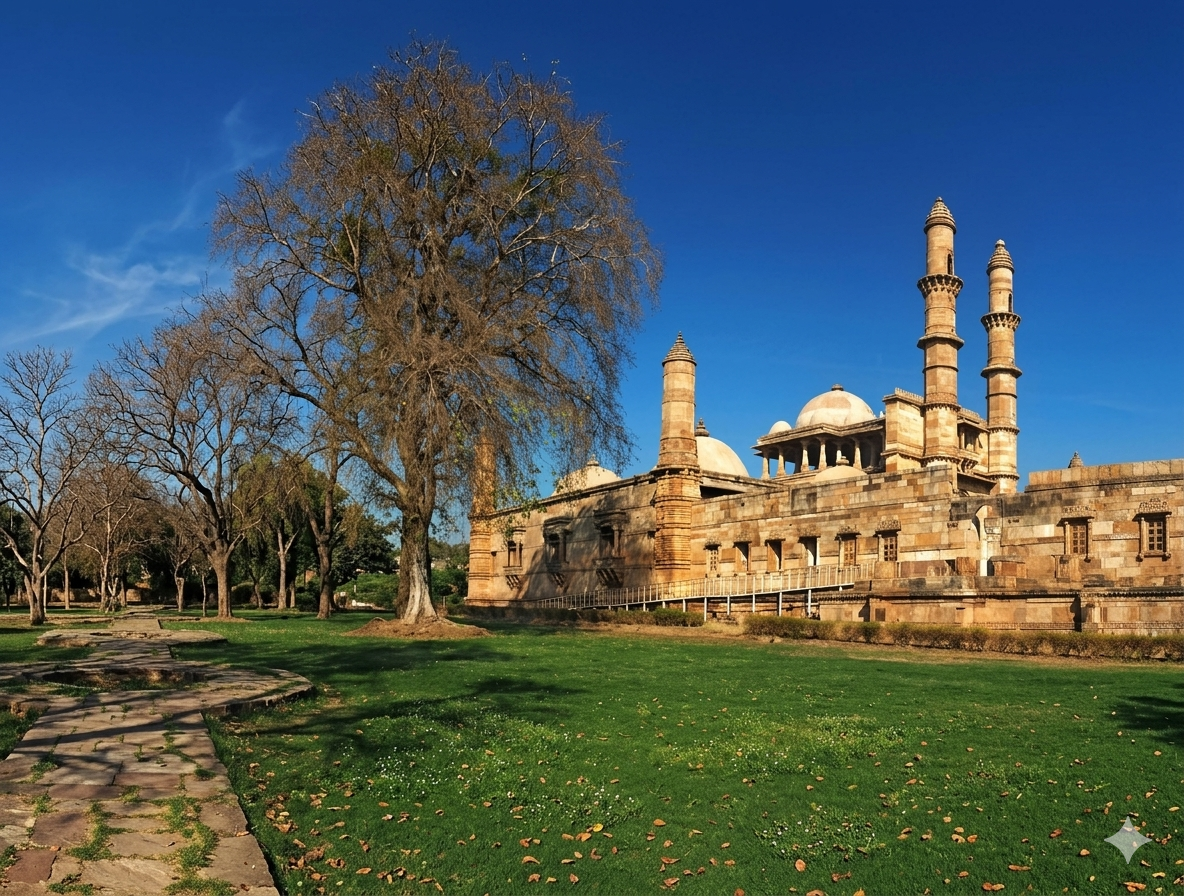
🏛 Champaner-Pavagadh Archaeological Park
Where Empires Left Their Mark
There are places in India where history does not merely linger — it accumulates, layer upon layer, century upon century, until the very ground beneath your feet feels dense with human story. Champaner-Pavagadh in the Panchmahal district of Gujarat is one such place. Designated a UNESCO World Heritage Site in 2004, it is the only complete and unchanged Islamic pre-Mughal city still standing in India, set against the dramatic backdrop of the ancient Pavagadh Hill, whose own history stretches back far beyond the Islamic period into the deep Hindu and Jain past. To visit Champaner-Pavagadh is to move through several civilisations at once — empires that rose, flourished, clashed, and left behind an architectural legacy of extraordinary richness and variety.
The site encompasses a remarkable collection of historic structures spread across approximately 114 square kilometres — fortifications, palaces, mosques, temples, stepwells, tombs, and residential remains, many in a remarkable state of preservation and many still being excavated. It is not a single monument but an entire urban landscape frozen in time, a city that was once the capital of the Gujarat Sultanate and one of the most important centres of power in medieval India, then abandoned and swallowed by the forest over the centuries until its gradual rediscovery. The result is a destination that rewards slow, curious exploration in a way that few heritage sites in India can match.
⛰ The Hill That Holds Everything
Before there was a city at Champaner, there was the hill at Pavagadh. Rising steeply from the flat Gujarati plain to a height of approximately 820 metres, Pavagadh is one of the most sacred sites in Gujarat — a place of pilgrimage, legend, and spiritual power that predates the arrival of Islam in the region by many centuries. At its summit stands the Kalikamata Temple, dedicated to the goddess Kali, which draws a steady stream of pilgrims year-round and is considered one of the 51 Shakti Peethas of India — the sacred sites associated with the goddess Shakti that are among Hinduism's most venerated destinations.
The ascent of Pavagadh is an experience in its own right. A ropeway carries visitors most of the way up, but those who choose to climb on foot pass through dense forest, ancient stone steps worn smooth by centuries of pilgrim feet, and a series of remarkable viewpoints that open up progressively wider vistas across the plains below. Near the summit, the remains of Hindu and Jain temples from the 10th to 14th centuries sit alongside later Islamic structures in a layered architectural landscape that makes the hill itself a kind of vertical museum of religious and cultural history. The view from the top — across the archaeological park, the plains, and on clear days to the distant shimmer of the horizon — is among the finest in Gujarat.
👑 The City of the Sultans
The city of Champaner at the base of the hill was built by Sultan Mahmud Begada of the Gujarat Sultanate, who captured Pavagadh from the Khichi Chauhan Rajputs in 1484 after a long and brutal siege. Determined to create a new capital worthy of his ambition, Mahmud Begada spent the next quarter century constructing one of the most refined Islamic cities in India. He named it Muhammadabad and declared it the capital of Gujarat, pouring resources, craftsmen, and vision into its creation. The result was a city of remarkable architectural sophistication — blending the traditions of Islamic architecture with local Gujarati Hindu and Jain craft sensibilities in a synthesis that was entirely its own.
The defining achievement of Champaner is the Jama Masjid, considered one of the finest mosques in India and a masterpiece of the Indo-Islamic architectural tradition. Built in the early sixteenth century, it combines the grand scale and geometric precision of Islamic design with the elaborate stone carving, decorative detail, and spatial richness of the Gujarati craftsmen who built it. The intricate jali screens that filter light into the prayer hall, the carved stone minarets flanking the main façade, and the serene colonnaded courtyard create an interior atmosphere of extraordinary calm and beauty. It is a building that achieves the rare quality of being simultaneously monumental and intimate — vast in scale, but human in its detail.
🕌 Mosques, Temples, and Stepwells
The Jama Masjid is only the beginning. Scattered across the archaeological park are dozens of significant structures, each with its own character and its own story to tell. The Kevada Masjid, smaller and more ornate, is notable for its elaborately carved exterior and its unusual circular minarets — a design element found almost nowhere else in Islamic architecture. The Nagina Masjid, hidden deeper within the ruins, has an intimacy and refinement that makes it a favourite among architectural scholars. The Lila Gumbaj ki Masjid and the Ek Minar ki Masjid each offer their own variations on the Champaner architectural vocabulary — a style so distinctive that it was recognised as a unique regional achievement in its own right.
Beyond the mosques, the park contains the remains of palaces, granaries, and residential quarters that give texture to daily life in the Sultanate capital. Ancient stepwells, carved with the same extraordinary craftsmanship seen in the mosques, descend in geometric stages toward the water below. Hindu temples from the pre-Sultanate period, some partially intact, stand in quiet dignity among the later Islamic structures, bearing witness to the civilisations that came before. Together, these layers of architecture create a site of genuine intellectual depth — a place where the story of India's medieval history becomes legible in stone.
📅 Best Time to Visit
October to March is the ideal season, when temperatures across the Panchmahal district are cool and comfortable and the landscape around the ruins is green from the retreating monsoon. The morning light on the carved stone facades of the mosques and temples is particularly beautiful in these months — low, golden, and directional in a way that brings out the depth of the carving in extraordinary detail.
🏕 Recommended Stay: 1 Night
One night allows for an unhurried afternoon exploring the main city ruins, an early morning ascent of Pavagadh to catch the sunrise from the temple summit, and a second circuit through the archaeological park before the heat of the day builds. Champaner-Pavagadh is less than 50 kilometres from Vadodara, making it an accessible but deeply rewarding extension of any Gujarat itinerary. It asks for a little time and a little patience — and gives back far more than it asks.
Explore Beyond [Champaner Pavagadh Archaeological Park]
Statue Of Unity
Sardar Sarovar Dam: India's River Of dreams
Lakshmi Vilas Palace
Patan
Rann Of Kutch : The Desert Festival Of Gujrat
Rann-Utsav : The White Desert's Grand Celebration