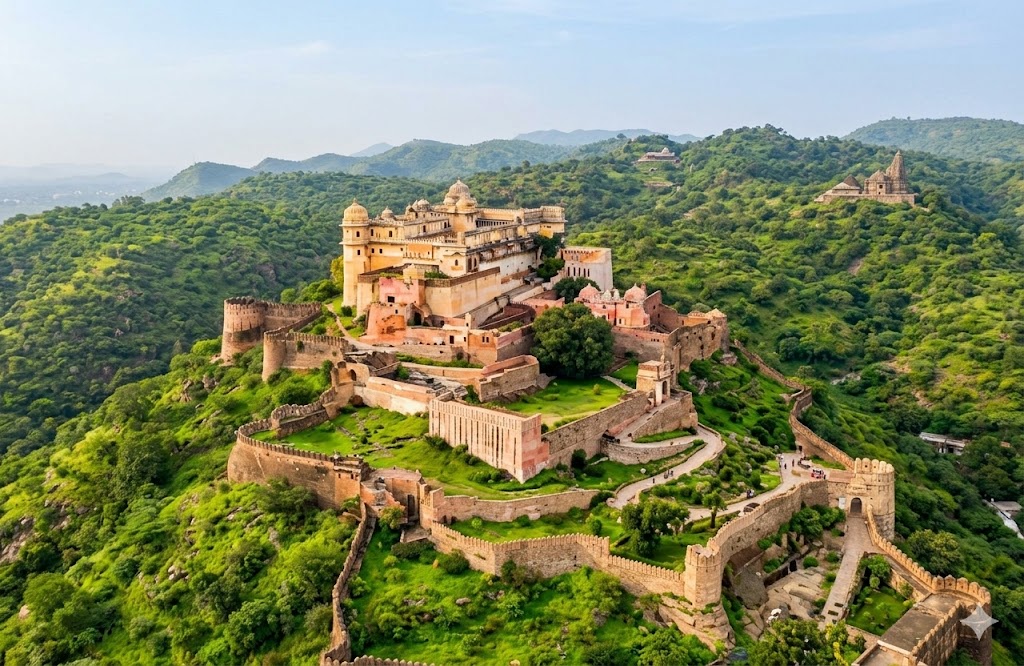
🏰 Chittorgarh Fort, Rajasthan: The Fort That Refused to Surrender and Still Stands Proud
📜 An Introduction — A Fort That Carries the Weight of a Nation's Soul
There are places in India that are beautiful. There are places that are historically significant. And then there are places that are both of those things and something more — places that carry an emotional weight, a moral seriousness, a sense of human story so large and so profound that standing in them changes something in you, quietly and permanently. Chittorgarh Fort is that kind of place.
Rising from a massive rocky hill that lifts it 180 metres above the plains of southern Rajasthan, Chittorgarh Fort is not merely a heritage monument. It is the physical embodiment of Rajput values — of honour, sacrifice, courage, and an absolute refusal to bend the knee to overwhelming force. The stories that happened within these walls are not the comfortable stories of victory and celebration. They are the harder, more necessary stories of loss endured with dignity, of women who chose fire over surrender, of warriors who rode out of those gates knowing they were not coming back and doing it anyway because some things matter more than survival. These are the stories that a civilisation remembers when it needs to remember what it is made of, and Chittorgarh is where those stories live in stone.
At 700 acres, it is the largest fort in India and one of the largest in Asia. It has survived three catastrophic sieges. It has watched three Jauhars — the collective self-immolation of Rajput women that remains one of the most haunting acts of mass sacrifice in recorded history. It has been conquered and abandoned and reclaimed and finally given to the care of history, and it stands today on its great hill above the plains as it has always stood — immovable, magnificent, and absolutely impossible to look at without feeling something.
⚔️ History and Interesting Facts
The history of Chittorgarh Fort stretches back to the seventh century CE, when it is believed to have been built by the Maurya ruler Chitranga — from whose name the fort and the city take their own.
Over the following centuries it passed through several dynasties before becoming the capital of the Sisodia Mewar clan, the Rajput dynasty whose resistance to Muslim invasion became the defining epic of Rajput history and whose descendants still live in Udaipur today.
🔥 The Three Great Sieges
The fort witnessed three sieges that are seared into Rajasthani cultural memory.
The first came in 1303 when Alauddin Khilji, the Sultan of Delhi, attacked Chittorgarh...
The second siege came in 1535 when Bahadur Shah of Gujarat attacked the fort during the regency of Rani Karnavati...
The third and final siege came in 1567 when the Emperor Akbar himself led an army against Chittorgarh...
After 1567 the Mewar capital shifted to Udaipur, and Chittorgarh was never again a seat of power.
One remarkable historical footnote concerns the poet-saint Mirabai, one of the most beloved figures in the bhakti devotional tradition of medieval India.
🏯 What to Do at Chittorgarh Fort
🏆 Vijay Stambha
The Vijay Stambha — the Tower of Victory — is the architectural masterpiece of Chittorgarh and one of the finest medieval monuments in India.
🕍 Kirti Stambha
The Kirti Stambha — the Tower of Fame — is smaller than the Vijay Stambha but arguably more refined in its architectural detail.
👑 Rani Padmini Palace
The Rani Padmini Palace, at the southern end of the fort, is a three-storey structure built partly over a lotus pool and surrounded by a moat.
🎵 Mira Mandir
The Mira Mandir, dedicated to the poet-saint Mirabai, is a relatively modest structure compared to the grand military and civic monuments of the fort.
🏛️ Kumbha Palace
The Kumbha Palace, the ruined complex where the Mewar rulers lived during the fort's period of greatest power.
🛕 Ancient Temples
The fort contains numerous temples — to Shiva, Vishnu, the goddess Kali, and various other deities.
🍛 Local Culture and Cuisine — The Honest Food of Mewar
Dal Baati Churma, as always in Rajasthan, is the meal that most completely expresses the culture of the place.
Laal Maas, the fierce red lamb curry of Rajasthan, is prepared with particular boldness in this part of the state.
Gatte Ki Sabzi — chickpea flour dumplings in a yoghurt-based curry — and Ker Sangri — the desert berry and dried bean preparation unique to Rajasthan.
Street food around the base of the fort and in the city market is worth exploring with appetite and curiosity.
🌤️ Best Time to Visit
🍂 October – March
The best time to visit Chittorgarh Fort is between October and March.
🎉 Jauhar Mela
The Jauhar Mela, held annually in March on the occasion of the Holi festival.
☀️ Summer
April to June brings intense heat that makes extensive outdoor exploration genuinely uncomfortable.
🌧️ Monsoon
The monsoon from July to September brings relief from the heat and turns the surrounding countryside green.
🚗 How to Reach Chittorgarh Fort
The nearest airport is Maharana Pratap Airport in Udaipur, approximately 115 kilometres from Chittorgarh.
Chittorgarh Railway Station is the nearest major railhead, located at the base of the fort hill about two kilometres from the main entrance.
By road, Chittorgarh is 115 kilometres from Udaipur — approximately two and a half hours.
🎒 Travel Tips
Allocate a full day for Chittorgarh Fort — not a rushed half-day, but a proper, unhurried full day.
Carry plenty of water and wear comfortable, sturdy footwear because the fort plateau involves extensive walking over uneven ground.
The sound and light show in the evening is worth attending.
Chittorgarh is a city rather than a tourist resort, and your accommodation options reflect that reality.
📍 Nearby Places to Explore
🏞️ Udaipur
Udaipur, 115 kilometres away, is the most obvious and rewarding companion.
🛡️ Kumbhalgarh Fort
Kumbhalgarh Fort is the other great Mewar fort and the birthplace of Maharana Pratap.
🕍 Ranakpur
Ranakpur contains one of the most spectacular Jain temple complexes in India.
🏡 Bijaipur & Begun
Bijaipur and Begun offer heritage hotel experiences in restored royal residences.
⭐ Why You Should Visit Chittorgarh Fort
Chittorgarh Fort will not give you the comfortable beauty of Udaipur's lake palaces or the dazzling opulence of Jaipur's City Palace.
What it will give you is something harder to find and more lasting — a confrontation with human history at its most serious and its most stirring.
These are stories worth knowing. Chittorgarh is the place where they become real.
That is the gift of Chittorgarh. It is extraordinary. And it is waiting for you on its great hill above the plains of Rajasthan, exactly as it has always been.
Discover More Around
Lake Pichola: The Timeless Beauty of Udaipur
Kumbhalgarh Fort
Garh Palace
Taragarh Fort
Jaisamand Lake: Explore One of Asia's Largest Artificial Lakes