```html
🏛️ Ellora Caves, Maharashtra: Where Three Faiths Carved Their Devotion Into Stone
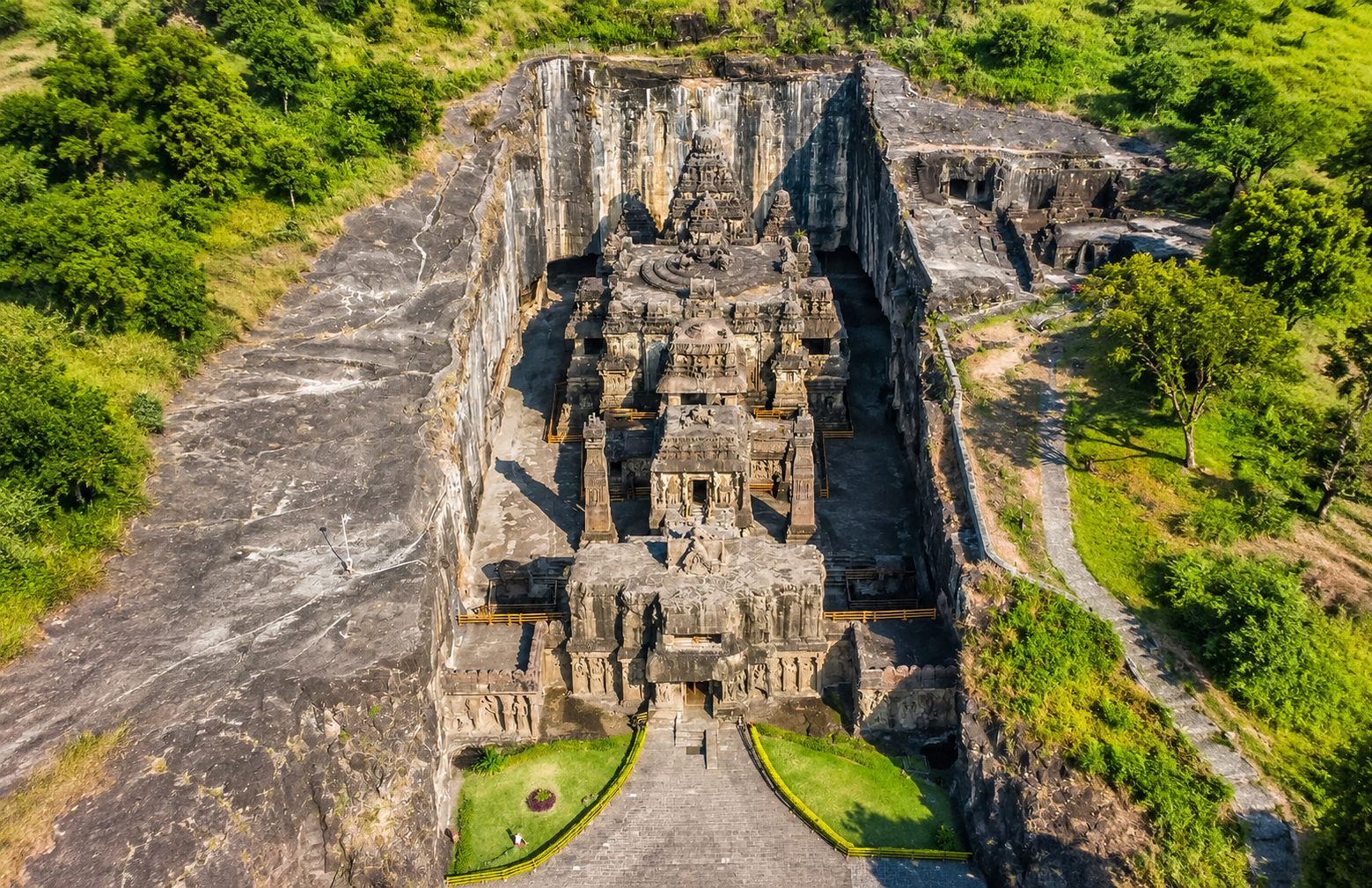
Imagine standing at the base of a temple and realizing it wasn't built brick by brick — it was carved downward out of a single mountain, top to bottom, by people who had to imagine the entire finished structure before they'd even removed the first slab of rock. No blueprints in the modern sense, no margin for error, just centuries of accumulated skill and unimaginable patience. That's the Kailasa Temple at Ellora, and it's just one of 34 reasons this place leaves visitors speechless.
Tucked into the basalt cliffs of the Charanandri Hills, about 30 km from Aurangabad in Maharashtra, the Ellora Caves are one of India's most remarkable UNESCO World Heritage Sites — a place where Buddhist, Hindu, and Jain artisans worked side by side across centuries to create something that still feels impossible to fully comprehend, even when you're standing right in front of it.
✨ Why Ellora Caves Is So Special
Most ancient sites tell one story. Ellora tells three, side by side, in perfect harmony. The 34 caves here represent Buddhist monasteries, Hindu temples, and Jain shrines, all carved into the same stretch of rock, reflecting an era of remarkable religious tolerance and coexistence in ancient India. Walking from one cave to the next, you literally walk through centuries of shifting faith and changing artistic style — and somehow it all sits together as one breathtaking complex.
Then there's Cave 16, the legendary Kailasa Temple — not a cave at all, really, but a free-standing, multi-story temple complex carved entirely from a single rock face, top-down, without a single brick laid. It's widely considered one of the greatest examples of rock-cut architecture on the planet, and locals will tell you, with justified pride, that nothing else in the world quite matches it. Even if you've seen a hundred temples before, Ellora has a way of resetting your sense of what's humanly possible.
📜 History and Interesting Facts
Ellora's caves were carved over centuries, primarily during the rule of the Rashtrakuta and Yadava dynasties, with construction spanning roughly the 6th to 10th centuries CE. The caves served not only as places of worship but also as resting stops for pilgrims and traders, thanks to their strategic location on an important South Asian trade route.
Here's a detail that surprises most first-time visitors: the Kailasa Temple alone is estimated to have required the removal of over 200,000 tonnes of rock — all chiseled away by hand, without modern tools or machinery, by generations of artisans working from the top of the rock downward instead of building upward. Locally, Ellora is also known as "Verul Leni," and along with Ajanta, it's recognized as one of the most significant heritage sites in the world.
The caves are carved from basalt rock formed by ancient volcanic activity in the Deccan Plateau — the same dark, durable stone that has allowed this incredible artistry to survive over a thousand years of weather, time, and history.
🌟 Major Attractions and Activities
🏰 Kailasa Temple (Cave 16)
The undisputed showstopper. Set aside extra time here; photographs genuinely cannot capture its scale.
🧘 Buddhist Caves (1–12)
Quiet, contemplative monastery halls and prayer chambers, including the multi-story Vishvakarma cave with its striking Buddha sculpture.
🕉️ Hindu Caves (13–29)
Elaborately carved temples dedicated to Shiva and other deities, dense with sculptural detail and mythological storytelling.
☸️ Jain Caves (30–34)
Smaller but exquisitely detailed, showcasing intricate carvings reflecting Jain philosophy and aesthetics.
📸 Photography Behind Kailasa Temple
An often-overlooked spot offering one of the most striking and underrated views of the entire complex.
🎓 Guided Heritage Tours
ASI-certified guides bring deep context to the carvings, dynasties, and symbolism that's easy to miss on your own.
🍛 Local Culture and Cuisine
The Marathwada region surrounding Ellora carries a rich blend of Maharashtrian and Deccan culinary traditions. Don't leave without trying misal pav, a spicy sprouted-lentil curry served with bread, or the rich, slow-cooked Aurangabadi naan-qorma, a local specialty born from generations of Mughlai influence blending with Marathi flavors. For something sweet, puran poli — a stuffed jaggery-and-lentil flatbread — is a regional favorite worth seeking out. Aurangabad is also celebrated for its centuries-old Himroo weaving tradition, producing beautiful silk-and-cotton textiles that make for a meaningful keepsake from your trip.
🌤️ Best Time to Visit
The most pleasant time to visit Ellora Caves is from October to February, when the weather is cool and comfortable for walking between cave complexes. The monsoon months, roughly June to September, are also a wonderful time to visit, as the surrounding hills turn lush and green, and waterfalls often appear near the caves, adding a dramatic, cinematic backdrop to the ancient architecture. Summers can get quite hot, so if you're visiting between March and May, plan your exploration for early morning. Keep in mind that Ellora Caves remain closed on Tuesdays, so plan your itinerary accordingly.
🚗 How to Reach Ellora Caves
✈️ By Air
The nearest airport is Chhatrapati Sambhaji Maharaj Airport in Aurangabad, just around 30 km away, making Ellora one of the most easily accessible heritage sites in the region. The airport receives direct and connecting flights from major Indian cities including Mumbai, Delhi, Kolkata, and Bangalore. From the airport, it's roughly a 45-minute drive by taxi straight to the caves.
🚆 By Rail
Aurangabad Railway Station is the nearest railhead, located about 28–30 km from Ellora, and is well connected to major cities like Mumbai, Pune, Delhi, Hyderabad, and Nashik through express and superfast trains. Once you arrive, taxis and auto-rickshaws are easily available right outside the station for the onward journey to the caves.
🛣️ By Road
Ellora is wonderfully well connected by road. From Aurangabad, regular MSRTC state buses and private operators run frequent services to the caves, with the drive taking about an hour. If you're road-tripping from Mumbai, the Mumbai–Aurangabad highway offers a scenic journey through ghats and towns like Nashik and Shirdi, making the drive itself part of the adventure.
💡 Travel Tips for First-Timers
- Wear sturdy, comfortable footwear — there's considerable walking across uneven stone surfaces between caves.
- Carry water, sunscreen, and a hat, since much of the walking happens under open sky with limited shade.
- Hire an ASI-certified guide at the entrance for a small fee — the historical and architectural context adds enormous value.
- Plan for at least three to four hours to do the major caves justice, especially Kailasa Temple.
- Avoid Tuesdays, as the site remains closed that day.
- Combine your trip with Ajanta Caves, located about 100 km away, but plan separate days for each — both sites deserve unhurried exploration.
📍 Nearby Places to Explore
🏛️ Ajanta Caves
Another UNESCO World Heritage Site about 100 km away, renowned for its extraordinary ancient Buddhist paintings and murals.
🏰 Daulatabad Fort
A formidable medieval hill fortress located between Aurangabad and Ellora, famous for its ingenious defensive architecture.
🕌 Bibi Ka Maqbara
Often called the "Mini Taj Mahal," this graceful mausoleum in Aurangabad makes for a lovely half-day visit.
🔱 Grishneshwar Temple
One of the twelve sacred Jyotirlinga shrines dedicated to Lord Shiva, located right next to Ellora Caves.
💧 Panchakki (Water Mill)
A fascinating 17th-century water-powered grinding mill with a peaceful garden, located in Aurangabad city.
❤️ Why You Should Visit Ellora Caves
Because Ellora doesn't just preserve history — it embodies the very best of human imagination, devotion, and collaboration across generations and faiths. Few places on Earth let you witness three different religious traditions expressed so beautifully, in the same stone, within walking distance of each other. And nothing — no photo, no documentary, no description — fully prepares you for the moment you step in front of the Kailasa Temple for the first time.
Whether you're drawn here for the history, the architecture, the spirituality, or simply the thrill of seeing something truly unlike anywhere else in the world, Ellora rewards every kind of traveler. It's not just a destination; it's a reminder of what people are capable of building when faith, skill, and time come together.
So plan your trip, bring your sense of wonder, and let Ellora show you exactly what devotion looks like when it's carved into a mountain
Recommended places