🏰 Hawa Mahal, Jaipur, Rajasthan: The Palace of Winds That Stops You in Your Tracks
🌸 An Introduction — A Facade That Becomes a Feeling
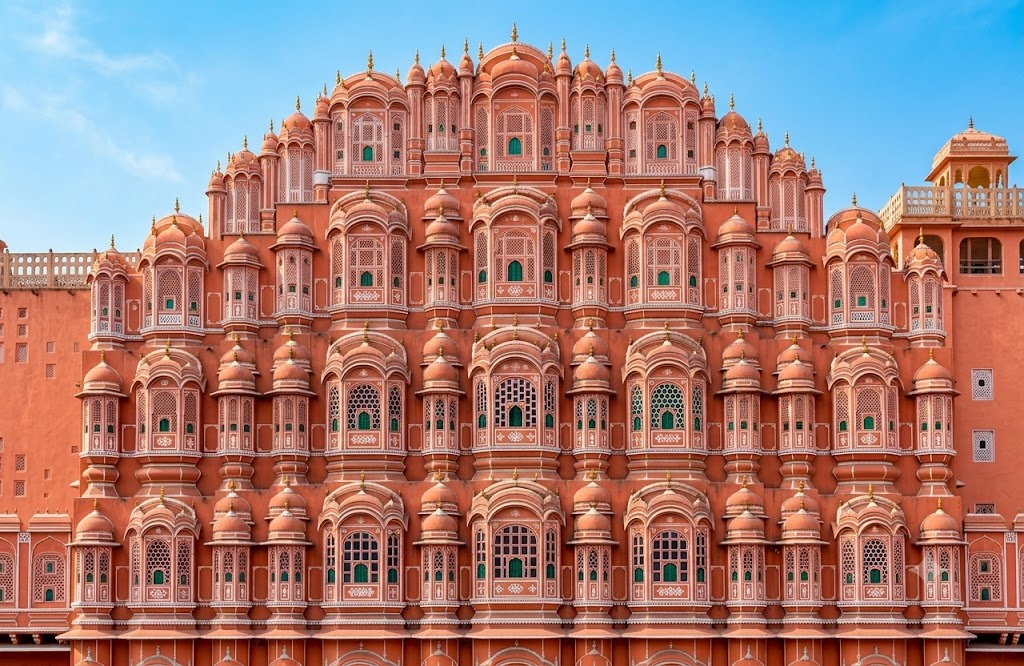
There are buildings you photograph and buildings you feel. Hawa Mahal is both, but it is the feeling that stays longest. You are walking through the old bazaar of Jaipur, the street noisy and fragrant and completely alive around you, and then you turn a corner and there it is — rising five storeys above the pink sandstone streetscape like a crown someone left balanced on the edge of the city, its 953 intricately carved windows catching the morning light and throwing it back in a thousand different directions at once. And you stop. You actually stop walking, which almost never happens on a busy Indian street, because what is in front of you is so unexpectedly beautiful that your feet make the decision before your brain does.
Hawa Mahal — the Palace of Winds — is one of the most recognisable buildings in India and one of the most photographed facades in Asia, and yet it manages, despite all that attention and all those images, to surprise nearly everyone who sees it for the first time. No photograph fully prepares you for the scale of it, or the delicacy of the carving, or the way the pink sandstone shifts colour through the day from pale rose in the morning to deep amber in the afternoon to a warm burnished gold just before the sun goes down behind the Aravalli Hills. It is a building that performs differently in different light, and the pleasure of watching that performance — from a rooftop cafe across the street, from the bazaar below, from the interior chambers — is one that does not diminish no matter how many times you return to it.
But Hawa Mahal is more than a beautiful facade. It is a story about Rajput women, about royal life in eighteenth century Jaipur, about a culture that found an architectural solution to a social restriction and made that solution so beautiful it became iconic. Understanding that story changes the way you look at the building, and looking at the building changes the way you understand the story. That combination — of extraordinary visual beauty and genuinely interesting human history — is what makes Hawa Mahal not just a landmark but a destination in the fullest sense of the word.
📜 History and Interesting Facts
Hawa Mahal was built in 1799 by Maharaja Sawai Pratap Singh of the Kachhwaha Rajput dynasty, the grandson of the great city planner Maharaja Sawai Jai Singh II who founded Jaipur itself in 1727.
Pratap Singh was not only a warrior and ruler but a deeply cultivated man with a genuine passion for poetry and the arts, and Hawa Mahal reflects that sensibility — it is a building conceived and executed as much for beauty as for function, in a tradition of royal patronage that understood architecture as one of the highest forms of cultural expression.
The building was designed by the architect Lal Chand Ustad, who drew his inspiration from the shape of the crown of Lord Krishna, the deity to whom Pratap Singh was particularly devoted.
The distinctive honeycomb facade, with its tiered rows of projecting oriels — small screened balconies — rising in a curved, tapering silhouette that narrows toward the top, does indeed bear a resemblance to a crown when seen straight on, and the devotional origin of that design gives the building a spiritual dimension that its purely aesthetic qualities alone would not suggest.
The purpose of those 953 small windows — jharokhas — was both practical and social.
The women of the royal zenana, the inner household of the palace, lived under the purdah system that restricted their public appearances.
But they were also members of a royal court in one of the most vibrant and culturally active cities in Rajputana, and the desire to participate in the life of the city — to watch the street processions, the festivals, the markets, the daily theatre of Jaipur's bazaar — was entirely natural and human.
Hawa Mahal was the architectural answer to that desire.
The honeycombed screens of the jharokhas allowed the women inside to see everything happening on the street below while themselves remaining invisible to the public eye.
The screens also served a purely practical function in the fierce heat of Rajasthan — the multiple small openings created a natural ventilation system, drawing cool air through the chambers in a way that made the upper floors bearable even in summer.
It is this combination of social function and climatic intelligence wrapped in extraordinary beauty that makes Hawa Mahal one of the cleverest buildings in India as well as one of the most beautiful.
A fact that surprises most visitors when they learn it is that Hawa Mahal, despite its five-storey height and its enormously grand exterior, is in fact only one room deep for most of its structure.
The famous facade is essentially that — a facade — with narrow chambers behind it rather than the palatial interior that the outside suggests.
This architectural sleight of hand, achieving such monumental visual impact with such relatively modest actual mass, is a piece of design intelligence that architects still discuss and study today.
The building is constructed from the distinctive red and pink sandstone of the Kachhwaha quarries near Jaipur — the same material that gives the entire old city its characteristic colour and earned Jaipur the name the Pink City.
The stone was worked by craftsmen of extraordinary skill, and the level of carved detail in the jharokhas — each one slightly different from its neighbours, decorated with floral motifs, geometric patterns, and miniature architectural elements — represents an investment of artisanal labour that is genuinely staggering to contemplate when you look closely at the building and begin to register the individual quality of each carved element.
🎯 What to Do at Hawa Mahal
The first experience of Hawa Mahal for most visitors is standing in the bazaar directly in front of it and simply looking.
This is not a passive or unproductive activity — it is, in fact, one of the finest ways to spend fifteen or twenty minutes in Jaipur, and the rooftop cafes and restaurant terraces on the opposite side of the street exist specifically to facilitate extended looking from a comfortable seated position.
Ordering a cup of chai and a plate of something local from one of these rooftop establishments and watching the facade of Hawa Mahal change colour through the morning or afternoon light is a genuinely meditative experience, and it gives you a perspective on the building that the interior cannot.
Entering the building is a different experience entirely, and a necessary one.
The entrance is actually around the back of the building — from the main facade facing the bazaar, you walk around to the rear entrance on Hawa Mahal Road, which opens into a large courtyard that gives you your first sense of the building's actual scale and the relationship between the grand exterior and the relatively modest interior structure.
The courtyard is surrounded by the building's chambers on three sides, with an archaeological museum in one wing that contains sculptures, artefacts, and historical objects related to the palace and its history.
Climbing through the palace's five storeys is an engaging experience, with each level offering a slightly different perspective on the interior and the exterior views.
The chambers on each floor are connected by ramps rather than staircases — an architectural provision that was made to accommodate the movement of the women of the zenana, for whom climbing steep stairs in the elaborate dress of the period would have been impractical.
This small detail, when you notice it, suddenly makes the building feel very human — you can imagine the daily movement of people through these spaces, the sightlines they had from each window, the particular view of the bazaar below that each jharokha framed.
🍛 Local Culture and Cuisine — Eating Jaipur the Right Way
🥟 Pyaaz Kachori
Pyaaz Kachori is Jaipur's most famous street food and the thing you must eat on your first morning in the city.
🍲 Dal Baati Churma
Dal Baati Churma, the ceremonial centrepiece of Rajasthani cuisine, takes on a particular significance in Jaipur where it is served at restaurants ranging from simple dhabas to rooftop establishments with views of the palace.
🌶️ Laal Maas
Laal Maas, the fierce red lamb curry of Rajasthan, is available at meat-eating restaurants throughout the city and in its best versions is a genuinely transcendent dish.
🍯 Ghevar
Ghevar, Jaipur's most famous sweet, is a disc-shaped confection made from flour, ghee, and sugar syrup with a distinctive latticed honeycomb texture.
🔥 Mirchi Bada
Mirchi Bada — the large green chilli stuffed with spiced potato and deep-fried in chickpea batter — is an essential snack that appears at stalls throughout the old city.
📅 Best Time to Visit
🌤 October – March
The best time to visit Hawa Mahal and Jaipur is from October to March.
📚 Jaipur Literature Festival
The Jaipur Literature Festival, one of the largest and most celebrated literary events in the world, takes place in late January.
🎉 Teej & Gangaur
The Teej Festival in July-August and the Gangaur Festival in March-April are both deeply Jaipuri celebrations.
☀ Summer Season
April to June brings the heat of the Rajasthan summer — temperatures regularly exceed 40 degrees Celsius.
🚆 How to Reach Hawa Mahal, Jaipur
✈️ By Air
The nearest airport is Jaipur International Airport, also known as Sanganer Airport, located approximately 13 kilometres from Hawa Mahal in the southern part of the city.
🚉 By Train
The nearest railway station is Jaipur Railway Station, located approximately 5 kilometres from Hawa Mahal in the western part of the city.
🛣 By Road
By road, Jaipur is 280 kilometres from Delhi — approximately five hours by car on NH48 or by the Delhi-Jaipur Expressway.
💡 Travel Tips
Hawa Mahal is best photographed from the street in front of it — the famous exterior shot that appears in every travel guide — in the morning when the sun hits the facade directly and the pink sandstone is most luminous.
The light is best between seven and ten in the morning.
Arrive at the back entrance to go inside shortly after it opens at ten o'clock to beat the crowds that build through the day.
The entry fee is modest — around fifty rupees for Indian nationals and two hundred rupees for foreign visitors — and includes access to the museum.
Photography inside the palace is permitted, and the views through the jharokha screens offer some of the most interesting and unusual photographic perspectives in Jaipur.
Wear comfortable shoes as the palace involves climbing through multiple levels and the floors are uneven in places.
📍 Nearby Places to Explore
🏛 City Palace
The City Palace, just five minutes walk from Hawa Mahal, is one of the finest royal palaces in India.
🔭 Jantar Mantar
The Jantar Mantar observatory, adjacent to City Palace, has already been mentioned and is non-negotiable.
🏰 Amber Fort
Amber Fort, about 11 kilometres from Jaipur on the road north toward the Aravalli Hills, is one of the most spectacular and historically significant forts in Rajasthan.
⛰ Nahargarh & Jaigarh Fort
Nahargarh Fort and Jaigarh Fort, on the ridge above the city, both offer panoramic views and historical interest.
🛕 Birla Mandir & Galtaji
Birla Mandir and Galtaji are among Jaipur's most atmospheric destinations and worthwhile additions to the itinerary.
Hidden Gems Nearby
city Palace Jaipur : A Legacy of Maharajas and Majesty
Amber Fort : The Crown Jewel of Rajasthan
Jal Mahal : Where a Palace Floats Between Water and Sky
Jaisalmer- Desert- Festival
Keoladeo-Ghana-National-Park