```html
🏜️ Jaisalmer Fort, Rajasthan: The Golden Fortress That Rises from the Desert Like a Dream
✨ An Introduction — A Fort That Is Still Alive
Most forts in India are empty. You walk through grand gateways, past crumbling palaces and dry courtyards, reading plaques that tell you what used to happen here, and you try to imagine the life that once filled these walls. Jaisalmer Fort asks nothing of your imagination. It is still alive — still breathing, still inhabited, still humming with the sounds of daily life in a way that no other fort in Rajasthan, perhaps in all of India, can claim. Nearly three thousand people live inside its walls today. Families have called it home for generations. Shops sell spices and silver. Children run through medieval lanes. Temples ring with bells in the early morning. And all of this happens inside a fortress that is over 850 years old, rising from the Thar Desert like a sandcastle built by the gods and left standing as proof that some things are simply too beautiful to abandon.
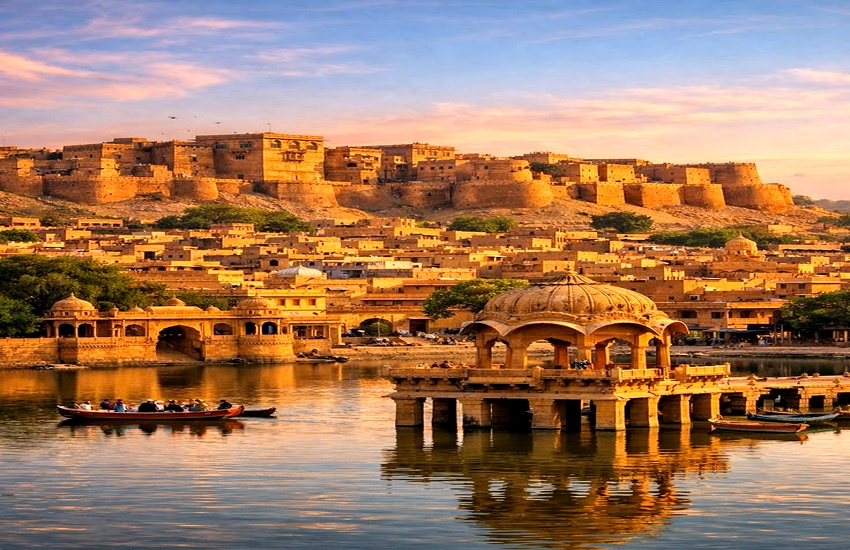
Jaisalmer Fort — locally and lovingly called Sonar Quila, the Golden Fort — sits on Trikuta Hill in the heart of Jaisalmer city in western Rajasthan. Built from golden yellow sandstone that glows amber in the afternoon sun and turns a deep, burnished gold at sunset, it is one of the largest fully preserved medieval forts in the world and a UNESCO World Heritage Site that earns every word of its reputation. When the desert light hits those walls in the hour before evening, the fort does not look like a human construction at all. It looks like something the desert itself pushed up from the earth — ancient, organic, and completely inevitable.
🏰 History and Interesting Facts
Jaisalmer Fort was founded in 1156 CE by Rawal Jaisal, a Rajput ruler of the Bhati clan, who chose the strategic flat-topped hill of Trikuta as the site for his new capital. The Bhati Rajputs were warriors and traders, and their fort controlled one of the most important caravan routes of medieval India — the Silk Road trade corridor that connected Central Asia to the subcontinent, carrying silk, spices, gems, and gold across the Thar Desert.
The wealth generated by this trade financed the extraordinary architecture you see within the fort today — the elaborate palaces, the intricately carved Jain temples, the ornate havelis, and the merchant mansions whose stone filigree work is so delicate it seems impossible that human hands carved it from rock.
Over the centuries, Jaisalmer Fort withstood multiple sieges and invasions, including attacks by the Delhi Sultanate and the Mughal Empire. The Bhati Rajputs defended it with fierce determination, and the fort became as much a symbol of Rajput pride and identity as it was a military installation.
The tradition of Jauhar — the practice of self-immolation by Rajput women to avoid capture during military defeats — is said to have been performed within these walls on at least two occasions, lending the fort a weight of history that goes beyond its stone and mortar.
📍 Founded
1156 CE
👑 Founder
Rawal Jaisal
🛡️ Bastions
99 Bastions
📏 Height
Approximately 76 metres
One of the most remarkable facts about Jaisalmer Fort is that it has never been fully abandoned. While most Indian forts became museums or ruins after independence, Sonar Quila remained a living settlement, its population continuing unbroken from medieval times to the present day.
The fort encompasses a perimeter of nearly one and a half kilometres, has 99 bastions along its walls — 92 of which were built between 1633 and 1647 — and rises approximately 76 metres above the surrounding plain.
🚶 What to Do at Jaisalmer Fort
🚪 The Four Gateways
The fort has four main gateways — Ganesh Pol, Akha Pol, Suraj Pol, and Hawa Pol — and entering through any of them deposits you into a world that operates at a pace and on a scale that feels entirely removed from the twenty-first century.
🏛️ Raj Mahal
The Royal Palace — Raj Mahal — is an essential stop and offers one of the most spectacular views in all of Rajasthan from its upper terraces.
🛕 Jain Temples
The Jain Temples inside the fort are perhaps the most breathtaking architectural achievement in Jaisalmer and consistently astonish visitors who expect the palaces to be the main attraction.
🌅 Sunset Walk
Walking the fort's outer walls at sunset is an experience that justifies an entire journey to Jaisalmer by itself.
🏘️ Residential Quarters
The narrow lanes of the residential quarters inside the fort are another world entirely.
🎭 Local Culture and Cuisine — Tasting Rajasthan in the Desert
The culture of Jaisalmer is the culture of the desert — shaped by scarcity, defined by resilience, and made beautiful by a human refusal to let harsh conditions flatten the joy of living.
🍲 Dal Baati Churma
🌵 Ker Sangri
🌶️ Laal Maas
🥟 Pyaaz Kachori
☕ Masala Chai
🍯 Ghevar
The food of Jaisalmer is the food of the desert, and it is extraordinary in its own deeply specific way.
📅 Best Time to Visit
✅ Ideal Season
October to March
🌡️ Winter Temperature
12°C to 25°C
🎉 Festival
Jaisalmer Desert Festival (February)
The best time to visit Jaisalmer Fort and the city of Jaisalmer is from October to March.
✈️ How to Reach Jaisalmer Fort
✈️ Airport
Jaisalmer Airport
🚆 Railway Station
Jaisalmer Railway Station
🚗 Jaipur Distance
575 Kilometres
🛣️ Jodhpur Distance
285 Kilometres
🧳 Travel Tips
Carry sufficient cash because while Jaisalmer's main tourist areas have ATMs and many hotels and restaurants accept cards, the smaller shops and dhaba stalls inside and around the fort operate on cash only.
Drink plenty of water throughout the day, even in winter when the desert air is dry and deceptively dehydrating.
Wear light, breathable clothing in layers — desert days can be warm even in December, but evenings drop considerably and you will want a shawl or light jacket after sunset.
📍 Nearby Places to Explore
🐪 Sam Sand Dunes
🌅 Khuri Dunes
🏛️ Patwon Ki Haveli
🏘️ Salim Singh Ki Haveli
🏰 Nathmal Ki Haveli
💧 Gadisar Lake
👻 Kuldhara
❤️ Why You Should Visit Jaisalmer Fort
Jaisalmer Fort is not just one of the finest heritage sites in India — it is one of the finest heritage sites in the world, and it offers something that almost no other ancient monument on earth can claim: the experience of a living medieval city.
The fort will give you history and architecture and beauty and food and craft and culture and stories.
Come to Jaisalmer Fort once and you will spend years thinking about going back. That is the nature of the golden fortress. It does not let you go easily, and it is not supposed
Discover Nearby Destinations
Sam Sand Dunes: The Desert Beauty
Desert-National-Park : The Golden Wilderness Of Rajasthan
Jaisalmer- Desert- Festival
Pushkar : The Vibrant Camel Fair Of Rajasthan
Clay-Stove-Experience