📖 Overview
There's a particular energy you feel the moment you step out into Mumbai — the honking taxis, the smell of fried snacks drifting from a roadside stall, waves crashing against the Marine Drive promenade, and millions of people moving with a purpose that's somehow both chaotic and oddly comforting. Mumbai doesn't ease you in gently. It grabs your hand and pulls you straight into the rhythm of its streets, and within a day, you'll understand exactly why people fall in love with this city, frustrations and all.
Spread along the western coast of Maharashtra, Mumbai is India's financial capital, its entertainment powerhouse, and arguably its most fascinating city — a place where Bollywood glamour, colonial-era architecture, ancient cave temples, fishing villages, and gleaming skyscrapers all exist within a few kilometers of each other.
✨ Why Mumbai Is So Special
Mumbai's magic lies in its contradictions. This is a city where you can stand inside a 2,000-year-old cave temple in the morning and watch a Bollywood film premiere by evening. Where billion-dollar skyscrapers rise right beside Asia's largest slum, and five-star hotels sit a stone's throw from century-old fish markets. Nowhere else in India do so many different worlds coexist so seamlessly, often on the very same street.
It's also a city built almost entirely on ambition. Mumbai has long been the place Indians from every corner of the country come to chase a dream — whether that's a film career, a business opportunity, or simply a better life. That collective hustle gives the city an electric, anything-is-possible energy that's genuinely infectious, even for visitors just passing through.
🏛️ History and Interesting Facts
Mumbai's history is a layered one. Originally a cluster of seven islands inhabited by fishing communities, the area was gradually reclaimed and joined together over centuries, eventually forming the single landmass the city sits on today — a feat of engineering that quietly reshaped the entire coastline. The islands passed through Portuguese hands before being given to the British as part of a royal dowry in the 17th century, eventually growing into one of colonial India's most important trading ports.
Here's a fact that surprises a lot of visitors: Mumbai is home to the Elephanta Caves, a UNESCO World Heritage Site located on an island just off the coast, featuring magnificent rock-cut sculptures dedicated to Lord Shiva dating back to around the 5th to 8th centuries CE. Long before skyscrapers defined the skyline, this city was already home to extraordinary ancient art.
And of course, no conversation about Mumbai's history is complete without mentioning cinema — the city is the heart of Bollywood, the largest film industry in the world by number of films produced annually, churning out hundreds of movies a year that shape entertainment and pop culture across South Asia and beyond.
📍 Major Attractions and Activities
🕌 Gateway of India
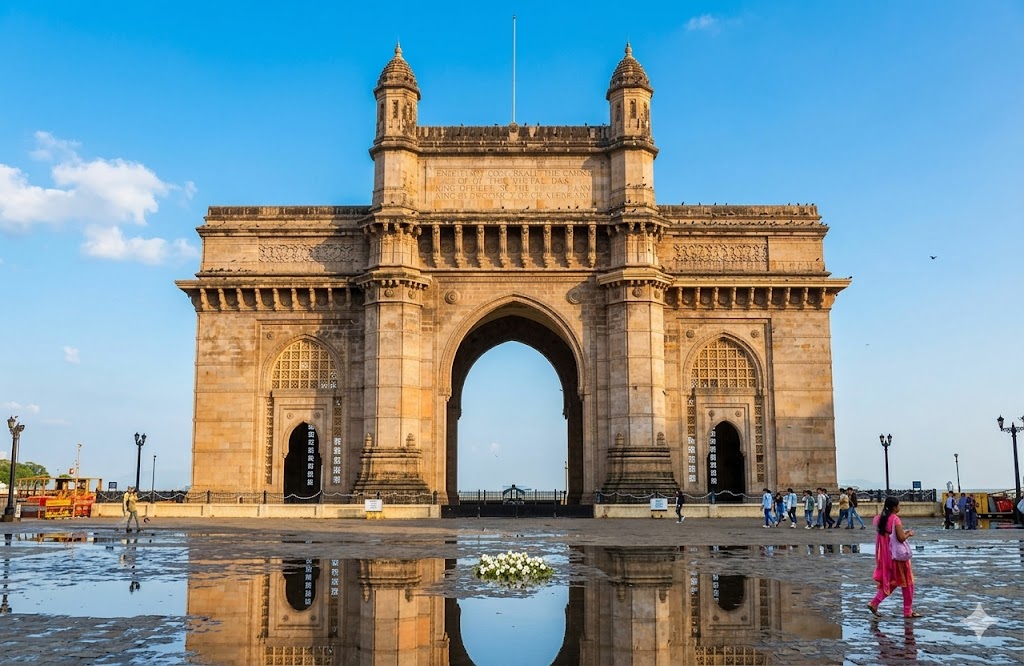
Mumbai's most iconic landmark, an arch monument overlooking the Arabian Sea, built to commemorate the visit of King George V in 1911.
🌊 Marine Drive
A sweeping seaside promenade famously nicknamed the "Queen's Necklace" for the way its streetlights curve along the coastline at night.
🏺 Elephanta Caves
A short ferry ride from the Gateway of India leads to these stunning ancient rock-cut cave temples, well worth a half-day trip.
🚉 CSMT
Chhatrapati Shivaji Maharaj Terminus (CSMT) – A UNESCO World Heritage Site in its own right, this Victorian Gothic railway station is as much an architectural marvel as a functioning transit hub.
🛍️ Colaba Causeway
A lively street for shopping, street food, and people-watching, packed with everything from antiques to trendy cafes.
🌅 Juhu Beach & Sea Link
Juhu Beach and Bandra-Worli Sea Link – Perfect spots for an evening walk, sunset views, and a glimpse of Mumbai's relaxed coastal side.
🎬 Bollywood Tours
Film City and Bollywood Tours – For movie lovers, guided tours offer a peek into how India's biggest film industry actually operates.
🌳 National Park
Sanjay Gandhi National Park – A surprising green escape within city limits, home to the ancient Kanheri Caves and scenic walking trails.
🍽️ Local Culture and Cuisine
Mumbai's culture is shaped by the sheer diversity of people who call it home — Marathi locals, Gujarati traders, Parsi families, South Indian communities, and migrants from every state in India have all left their mark on the city's food, festivals, and rhythm of life. Ganesh Chaturthi here is an experience unlike anywhere else, with massive processions and elaborately decorated idols filling the streets each year.
And then there's the food — Mumbai is, without exaggeration, a street food paradise. You simply cannot leave without trying vada pav, the city's beloved spiced potato fritter sandwich, or pav bhaji, a buttery vegetable mash served with soft bread rolls. Seek out bhel puri and pani puri from a roadside stall for an authentic taste of local snacking culture, and if you're near the coast, fresh Bombay-style seafood thalis are an absolute must. For something distinctly Mumbai, try Parsi-style dhansak or a classic Irani café chai with bun maska — simple pleasures the city has perfected over generations.
🌤️ Best Time to Visit
The best time to visit Mumbai is between October and March, when the weather is pleasant, humidity drops, and the city is at its most comfortable for sightseeing and walking tours. Summers, from March to June, can get hot and sticky, while the monsoon season, June to September, brings heavy rains that flood streets and slow down the city — though it also brings a unique, dramatic charm if you don't mind getting wet and plan accordingly.
🚆 How to Reach Mumbai
✈️ By Air
By Air: Mumbai is served by Chhatrapati Shivaji Maharaj International Airport (BOM), one of India's busiest and best-connected airports, with extensive domestic routes and direct international flights to destinations including New York, London, Dubai, and Singapore. The airport has two terminals — Terminal 1 for domestic flights and Terminal 2 for international and select domestic flights — so it's worth confirming your terminal in advance. From the airport, taxis, app-based cabs, and the Mumbai Metro all offer convenient onward travel into the city.
🚉 By Rail
By Rail: Mumbai's main railway hub is Chhatrapati Shivaji Maharaj Terminus (CSMT), a stunning Victorian Gothic structure and UNESCO World Heritage Site that also functions as one of India's busiest railway stations. Long-distance trains also originate from Mumbai Central, Dadar, Lokmanya Tilak Terminus, Bandra Terminus, and Borivali, connecting the city to virtually every major destination across India. Within the city, the famous Mumbai Suburban Railway, locally called "the locals," is the lifeline that keeps the metropolis moving.
🚗 By Road
By Road: Mumbai is connected to the rest of India through an extensive highway network, including the Mumbai-Pune Expressway, NH48, and NH66, making road trips from neighboring cities like Pune, Nashik, and Goa relatively smooth. State-run and private buses, along with self-driven and hired cars, are all popular ways to arrive by road.
🧳 Travel Tips for First-Timers
- Confirm your airport terminal in advance — Terminal 1 and Terminal 2 are some distance apart, and switching between them takes time.
- Use the Mumbai Metro or local trains during the day, as they're often faster than road travel given the city's heavy traffic.
- Avoid the suburban train system during peak rush hours (roughly 8–11 AM and 6–9 PM) unless you're prepared for serious crowds.
- Carry an umbrella during monsoon season, and check weather and waterlogging updates before heading out.
- Keep cash handy for street food and local markets, though most cabs and restaurants accept digital payments.
- Book Elephanta Caves ferry tickets early in the day, as the last boats back to the mainland leave in the early evening.
📌 Nearby Places to Explore
- Elephanta Caves – A short ferry ride away, offering ancient rock-cut temples and a peaceful break from the city buzz.
- Lonavala and Khandala – Popular hill stations just a couple of hours away, perfect for waterfalls and cooler weather.
- Alibaug – A relaxed coastal getaway across the harbor, known for its beaches and laid-back charm.
- Matheran – A car-free hill station offering a quiet, old-world retreat amid the Sahyadri hills.
- Nashik – Famous for its vineyards and temples, a comfortable road trip from Mumbai.
❤️ Why You Should Visit Mumbai
Because Mumbai isn't a destination you simply see — it's one you experience with all your senses at once. The honking traffic, the smell of street food, the roar of waves at Marine Drive, the quiet grandeur of ancient cave temples, the glow of neon signs in Bollywood-obsessed neighborhoods — it all adds up to a city that refuses to be boring, even for a single moment.
Whether you're chasing history, culture, food, nightlife, or simply the thrill of a city that never quite slows down, Mumbai delivers an experience that's loud, layered, and utterly unforgettable.
So pack your curiosity, bring an appetite for street food, and let Mumbai show you why it's called the City of Dreams.
Attractions Around [Mumbai]
Kanheri Caves
Lohagad Fort
Matheran
Harihar Fort
Raigad Fort