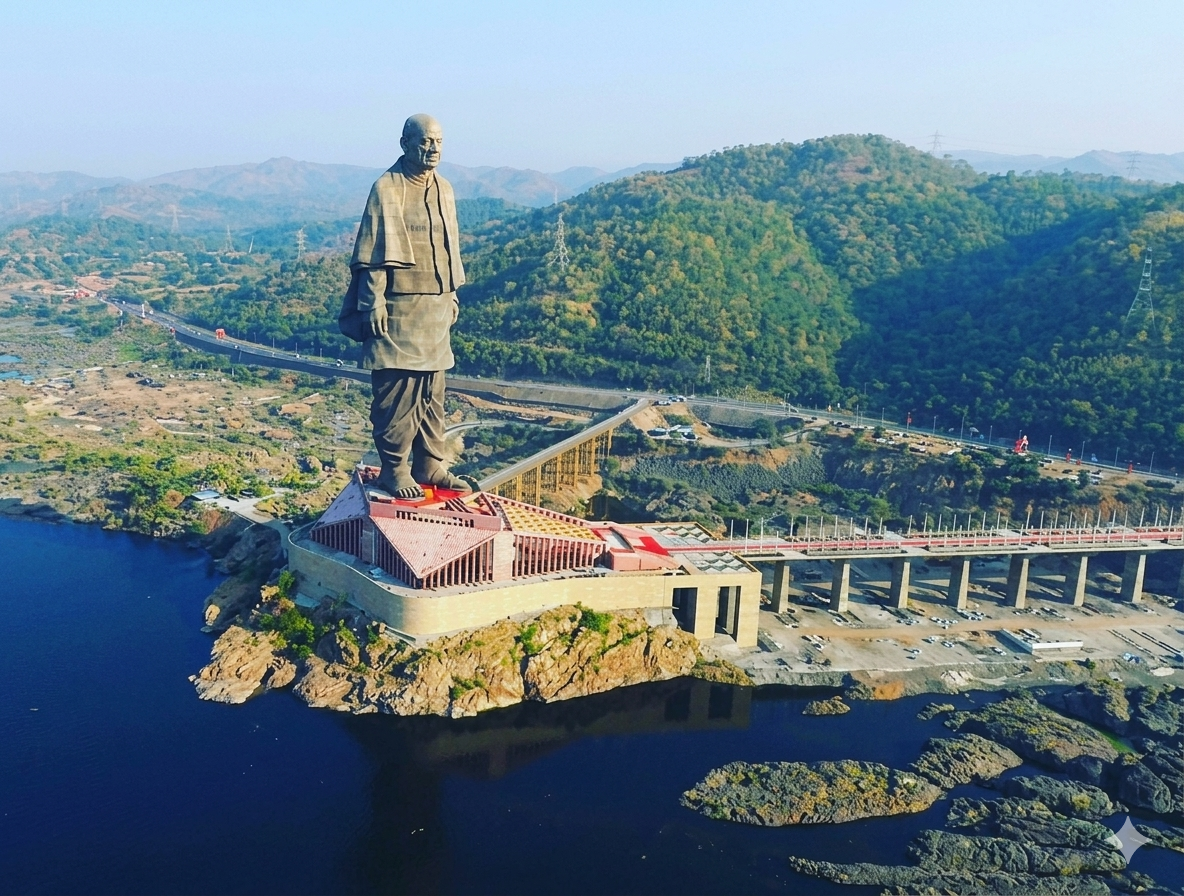
There is a particular kind of monument that stops you before you even reach it. You see it from the road, rising above the treeline and the river valley, impossibly large, impossibly still, and something in you shifts slightly — the way it does when scale exceeds expectation and the mind scrambles to catch up with what the eyes are reporting. The Statue of Unity in Kevadia, Gujarat is that kind of monument. At 182 metres from base to crown, it is the tallest statue in the world — nearly twice the height of the Statue of Liberty, and almost 30 metres taller than its nearest rival. But height alone does not explain why it has become India's most visited modern tourism attraction, drawing millions of visitors every year from across the country and around the world. The Statue of Unity earns its place not just through scale, but through the story it tells and the experience it delivers.
The statue depicts Sardar Vallabhbhai Patel — India's first Deputy Prime Minister and Home Minister, the man known as the Iron Man of India — in a posture of quiet authority, standing on a broad island base at the confluence of the Narmada and Sadhu rivers, looking out over the valley and the Sardar Sarovar Dam that his vision helped inspire. Inaugurated in October 2018 after just 33 months of construction, it stands as both a tribute to one of modern India's most consequential statesmen and a declaration of what contemporary India is capable of building. It is, in every sense of the phrase, a statement of ambition.
👤 The Man Behind the Monument
Understanding who Sardar Patel was adds immeasurable depth to the experience of standing before his likeness. Born in 1875 in the Nadiad district of Gujarat, Vallabhbhai Patel rose from modest origins to become one of the central architects of independent India. Where Nehru was the visionary and Gandhi the moral compass, Patel was the pragmatist — the man who held things together, who negotiated, cajoled, and when necessary pressured more than 560 princely states into acceding to the newly independent Indian Union. Without Patel's diplomatic tenacity and political skill, the map of India would look dramatically different today.
He died in 1950, before he could see the full flowering of the nation he helped build. The Statue of Unity is, in part, a long-overdue acknowledgment of how much he shaped it. For Indian visitors, standing at the feet of this statue carries genuine emotional weight — it is a reckoning with a chapter of history that is foundational to the country's identity. For international visitors, it is an entry point into one of the twentieth century's most remarkable political stories.
🌄 The Viewing Gallery
The centrepiece of any visit to the Statue of Unity is the ascent to the viewing gallery, located within the statue at the level of Sardar Patel's chest, approximately 153 metres above the ground. An express elevator carries visitors up through the interior of the statue in under a minute, and the gallery itself offers a 360-degree panoramic view that is, on a clear winter morning, quite simply breathtaking.
To the north, the Sardar Sarovar Dam stretches across the Narmada River, its concrete face holding back an enormous reservoir that glitters in the sunlight. To the south and east, the Satpura and Vindhya mountain ranges frame the valley in a wide, green embrace. The Narmada itself winds through the landscape below, broad and silver, looking from this height less like a river and more like a brushstroke across the land. On particularly clear days, the view extends for over 50 kilometres in every direction. The gallery accommodates 200 visitors at a time, and the combination of scale, height, and natural beauty makes it one of the most memorable viewpoints in all of India.
🏛 Museum and Memorial
At the base of the statue, a well-designed museum and memorial dedicated to Sardar Patel traces his life, his political philosophy, and his extraordinary role in shaping modern India. Multimedia exhibits, archival photographs, personal artefacts, and carefully curated displays bring his story to life with a level of production quality that matches the scale of the monument above. The museum is genuinely educational without being dry — it is designed for visitors with no prior knowledge of Patel's life as much as for those who arrive already familiar with his legacy.
The memorial also houses a research centre and an audio-visual gallery that presents the broader story of Indian independence and unification, placing Patel's contribution in its full historical context. For families visiting with children, the museum offers one of the most engaging and accessible introductions to modern Indian history available anywhere in the country.
🌊 Riverfront Tourism and the Broader Experience
The Kevadia development around the Statue of Unity has transformed the area into a full destination. A laser and light show projected onto the statue in the evenings is among the most spectacular of its kind in India — the changing colours and narratives projected onto the 182-metre surface create an experience that is both technically impressive and genuinely moving.
The Narmada riverfront below the statue has been developed with walking paths, boat cruise facilities, and open viewpoints that allow the statue to be appreciated from water level, its full height rising above the valley in a way that no photograph entirely prepares you for.
The Valley of Flowers, Cactus Garden, Jungle Safari, and Children's Nutrition Park add further dimensions for visitors spending a full day or overnight. The tent city accommodation nearby is well-appointed and positioned for stunning early morning views across the river valley, when the mist sits low over the Narmada and the statue emerges slowly from the haze like something from another scale of reality entirely.
📅 Best Time to Visit & Recommended Stay
October to March delivers the best conditions — cool temperatures, clear skies, and the rich, golden winter light that makes both the statue and the surrounding valley landscape look their finest. A one-night stay is strongly recommended, allowing for the evening light show, an unhurried morning visit before the crowds build, and full exploration of the broader Kevadia circuit.
The Statue of Unity is not subtle. It was never meant to be. It is a monument built at the scale of the story it tells — and that story, once you know it, is one of the great ones.