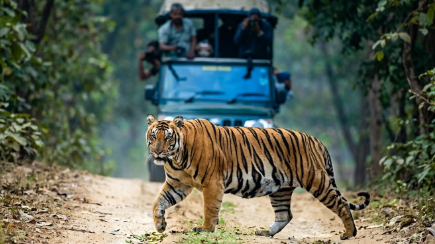
Madumalai-Tiger-Reserve : Where Tigers Roam Free
Mudumalai Tiger Reserve stands as one of the most ecologically significant and richly biodiverse wildlife destinations in southern India, a protected forest landscape of extraordinary depth and variety that has served as a sanctuary for some of the subcontinent's most iconic and endangered species for well over eight decades. Situated in the Nilgiris district of Tamil Nadu at the northwestern foothills of the Nilgiri Mountains, Mudumalai covers an area of approximately 321 square kilometres and occupies a unique and strategically vital position at the tri-junction of Tamil Nadu, Karnataka, and Kerala — a geographical convergence that connects it to the larger Bandipur and Nagarahole Tiger Reserves in Karnataka and the Wayanad Wildlife Sanctuary in Kerala, forming together one of the largest contiguous protected forest blocks in peninsular India.
🐅 Mudumalai Tiger Reserve (Tamil Nadu)
🌿 Overview
Mudumalai Tiger Reserve stands as one of the most ecologically significant and richly biodiverse wildlife destinations in southern India, a protected forest landscape of extraordinary depth and variety that has served as a sanctuary for some of the subcontinent's most iconic and endangered species for well over eight decades. Situated in the Nilgiris district of Tamil Nadu at the northwestern foothills of the Nilgiri Mountains, Mudumalai covers an area of approximately 321 square kilometres and occupies a unique and strategically vital position at the tri-junction of Tamil Nadu, Karnataka, and Kerala — a geographical convergence that connects it to the larger Bandipur and Nagarahole Tiger Reserves in Karnataka and the Wayanad Wildlife Sanctuary in Kerala, forming together one of the largest contiguous protected forest blocks in peninsular India.
The name Mudumalai derives from the Tamil words meaning ancient hill ranges, a name that reflects both the geological antiquity of the Nilgiris and the long-established character of this forest as a place apart from human habitation. Established in 1940 as one of the first wildlife sanctuaries in South India and later declared a Tiger Reserve under Project Tiger, Mudumalai has been at the centre of wildlife conservation in the south for generations. The reserve forms a critical part of the Nilgiri Biosphere Reserve, designated in 1986 as a unified ecoconservation zone spanning the three neighbouring states and recognised as one of the most important biodiversity hotspots in Asia.
What distinguishes Mudumalai from other wildlife reserves in southern India is the seamless diversity of its terrain — encompassing tropical moist deciduous forest, dry deciduous forest, scrub land, savanna grassland, swamps, and river valleys — each habitat supporting a distinct community of species and together creating a landscape of extraordinary biological richness. The reserve is home to approximately 103 tigers, one of the significant wild tiger populations in India, as well as one of the densest concentrations of Asian elephants on the subcontinent, making it a destination of the very first rank for wildlife travellers and conservation enthusiasts.
🌟 Why Visit Mudumalai Tiger Reserve
The most compelling reason to visit Mudumalai is the sheer and unhurried immersion in a living forest that the reserve offers — an experience that cannot be replicated at a zoo, a wildlife documentary, or any other setting. The forest at dawn, when the light filters through the canopy in long columns, the air carries the scent of damp earth and leaf litter, and the sounds of the jungle unfold gradually around the slow-moving safari vehicle, is one of the defining encounters with wild India that the country's protected areas system exists to provide and preserve.
Mudumalai is particularly celebrated among wildlife enthusiasts for the reliability and variety of its wildlife sightings. Elephants move through the reserve in large herds and are frequently encountered both on safari and along the approach roads, creating opportunities for close and prolonged observation that are difficult to match elsewhere in Tamil Nadu. Gaur — the world's largest wild bovine — graze in the open grasslands in impressive numbers, and the forest's large population of spotted deer, sambar, barking deer, wild boar, and langur provides the prey base that sustains the reserve's tigers and leopards, whose movements can be tracked through the alarm calls of these animals as much as by direct sighting.
The reserve also offers the particular pleasure of being situated within reach of the Nilgiri highlands, with Ooty approximately 65 kilometres away and the tea gardens, viewpoints, and cooler climate of the hills providing a natural complement to a stay at the forest level. The combination of a wildlife experience at Mudumalai with a visit to the Nilgiri hill country above creates a journey of unusual variety and depth within a compact geographical area.
📍 Key Highlights Within the Area
🐘 Theppakadu Elephant Camp
Theppakadu, the headquarters of the Mudumalai Tiger Reserve and the primary entry and visitor centre for the protected area, is home to the Theppakadu Elephant Camp — one of the oldest elephant camps in India and a facility where domesticated elephants and their calves are maintained by the Tamil Nadu Forest Department as part of the reserve's management and conservation programme. Visitors can observe the elephants being bathed, fed, and exercised at designated morning and evening hours, and the sight of the camp's resident elephants against the backdrop of the forest is one of the most immediately engaging experiences the reserve offers.
🌲 Forest Ranges
The five ranges into which Mudumalai is divided — Masinagudi, Theppakadu, Mudumalai, Kargudi, and Nellakota — each present a slightly different character of forest and terrain, and the safari routes through these ranges expose visitors to a variety of habitat types within a single excursion. The Masinagudi range, accessible from the popular base town of the same name, is particularly well regarded for its open terrain and the frequency of wildlife sightings in the grassland and scrub zones along its roads.
🌊 Moyar River Gorge
The Moyar River, flowing along the northern boundary of the reserve and cutting through a dramatic gorge, provides a significant water source for the reserve's wildlife and creates a riparian habitat of particular richness along its banks. The Moyar River Gorge itself is one of the most scenic natural features within the broader landscape, offering viewpoints of considerable visual drama especially in the early morning hours when the mist rises from the water below. The Kallatty Falls, a waterfall within the reserve's vicinity, and the surrounding forest scenery add further natural points of interest to an exploration of the area.
📖 Interpretation Centre
The Interpretation Centre at Theppakadu, maintained by the forest department, provides a well-assembled introduction to the ecology, wildlife, and conservation history of Mudumalai, with exhibits on the reserve's fauna, flora, and the broader Nilgiri Biosphere Reserve of which it forms a part. A visit to the centre is a rewarding way to contextualise the safari experience and deepen the understanding of what the forest contains and how it functions as an integrated ecosystem.
🏞 Gudalur
The town of Gudalur, approximately 3.7 kilometres from the reserve boundary, sits at the meeting point of Tamil Nadu, Karnataka, and Kerala and serves as a practical service town for visitors staying in the Mudumalai area, with its own modest character as a highland market town that reflects the cultural diversity of the tri-state region it inhabits.
🚙 Activities
Wildlife safari is the primary and most essential activity at Mudumalai, available in two forms — the forest department-operated bus safari running on fixed routes through the reserve during the morning and evening windows, and the jeep safari available through authorised private operators from Masinagudi and Theppakadu, which allows for more flexible movement through the forest and a closer engagement with the terrain and its inhabitants. Both forms of safari reward patience and a willingness to move slowly and quietly, as the forest reveals itself gradually to those who allow it the time to do so.
Elephant safari, where available, offers the distinctive experience of moving through the forest at the height and pace of the elephant itself — a mode of travel that allows access to terrain inaccessible to vehicles and provides an intimately different perspective on the forest and its wildlife. The elephant feeding sessions at Theppakadu provide an additional and more relaxed encounter with these animals, suitable for families and those wishing for a gentler introduction to the reserve's elephant population.
Birdwatching at Mudumalai is a highly rewarding pursuit, as the reserve supports over 260 species of resident and migratory birds, including the critically endangered Indian white-rumped vulture and long-billed vulture, as well as a diverse range of raptors, hornbills, woodpeckers, and forest specialists that are best observed in the early morning hours on forest trails and along the river. Guided nature walks and trekking in the buffer zones around the reserve, arranged through the forest department or authorised eco-tourism operators, provide an on-foot encounter with the forest environment that complements the vehicular safari experience and allows for the observation of the smaller fauna, insects, and plant life that pass unnoticed from a moving vehicle.
📅 Best Time to Visit
The most favorable period to visit Mudumalai Tiger Reserve is from October to May, with the winter months of October to February offering the most pleasant conditions for wildlife viewing and outdoor exploration. During these months the vegetation is at its lushest following the northeast monsoon, the water levels in the Moyar River and the reserve's waterholes are adequate to attract wildlife, and the cool temperatures at the Nilgiri foothills make early morning and evening safaris particularly comfortable. Wildlife sightings — particularly of elephants and gaur — are generally reliable during this period, and the clearer skies allow for unobstructed photography in the forest clearings and open grasslands.
March to May sees rising temperatures at the forest floor, and as the dry season progresses and the water sources within the reserve begin to diminish, wildlife tends to concentrate around the remaining waterholes and river sections, often making sightings easier and more concentrated. This period is considered among the most productive for tiger sightings, as the thinning vegetation and the predictable movement of prey animals to water increase the chances of an encounter. The heat during midday can be considerable, but the morning and late afternoon safari windows remain comfortable and productive.
The monsoon from June to September brings significant rainfall to the Nilgiris and the forests of Mudumalai, and the reserve's roads can become difficult to navigate during the heaviest rainfall periods. Some sections of the reserve may be temporarily closed, and the thick monsoon vegetation reduces visibility within the forest. This period is generally the least recommended for a wildlife-focused visit, though the landscape reaches its most intensely green and the waterfalls in the surrounding area are at full flow.
🚗 Connectivity
Mudumalai Tiger Reserve is situated at the convergence of three states and is consequently accessible from multiple directions and from several major cities in southern India. The reserve is approximately 65 kilometres from Ooty, which serves as the nearest significant hill town and a natural combination destination for travellers wishing to pair a wildlife experience with the cooler highland landscapes of the Nilgiris. From Ooty, the descent through the Gudalur road to Theppakadu takes approximately two hours and passes through scenery of considerable beauty.
From Mysuru in Karnataka, Mudumalai is approximately 95 kilometres away via the Bandipur National Park road, making it easily reachable for visitors approaching from that direction. From Coimbatore, the nearest city with a significant airport, the reserve is approximately 160 kilometres away, with Coimbatore International Airport offering regular domestic flights from Chennai, Bengaluru, Mumbai, Delhi, and Hyderabad. The nearest airport for those approaching from Karnataka is Bengaluru's Kempegowda International Airport, approximately 300 kilometres from the reserve, with well-established road connectivity through Mysuru and Bandipur.
Within the reserve, all safari transport is organised through the Tamil Nadu Forest Department and authorised private operators based at Theppakadu and Masinagudi. Accommodation is available in a range of options from forest department guest houses and eco-lodges within or immediately adjacent to the reserve to private jungle resorts and camps near Masinagudi, making Mudumalai a destination that accommodates travellers across a range of budgets and preferences.