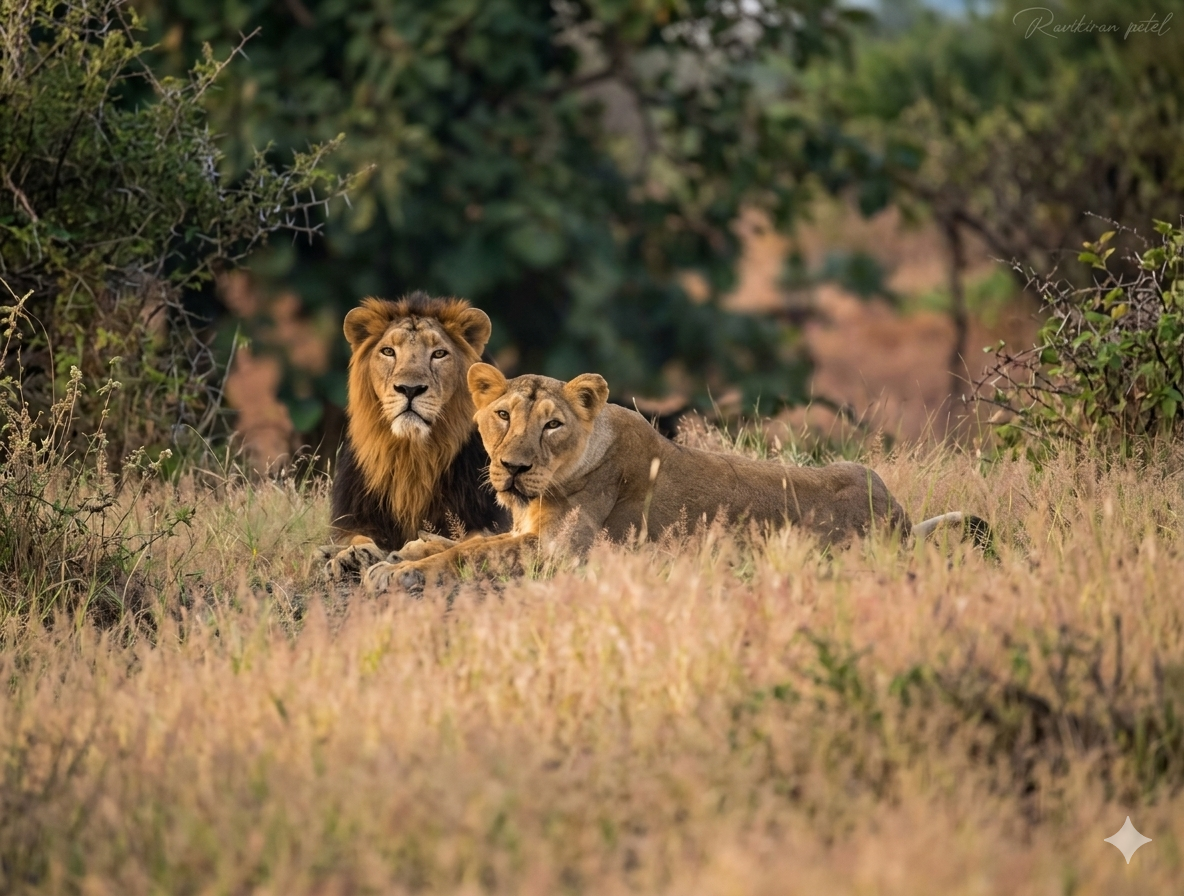
Gir-National-Park : Home Of Asiatic Lions
There are destinations that offer beautiful landscapes, thrilling wildlife, and memorable experiences. And then there are destinations that offer something the rest of the world simply cannot — a once-in-a-lifetime encounter found nowhere else on earth. Gir National Park in Gujarat, western India, belongs firmly in the second category. It is the world's only natural habitat of the Asiatic Lion, a subspecies that once roamed freely across a vast corridor stretching from the Mediterranean to the Indian subcontinent. Today, the entire wild population exists within this single protected forest. To visit Gir is to stand in the presence of one of conservation's greatest comebacks. Covering approximately 1,412 square kilometres in the Saurashtra region of Gujarat, the park is a landscape of dry deciduous forest, open grasslands, rocky plateaus, and meandering rivers. The Hiran, Shingoda, and Machhundri rivers thread through the terrain, drawing wildlife to their banks during the drier months and giving the landscape a lush, layered quality during cooler seasons. It is a place that feels ancient, unhurried, and entirely on its own terms — the perfect stage for an encounter with one of nature's most iconic predators
🦁 Gir National Park
The Last Kingdom of the Asiatic Lion
There are destinations that offer beautiful landscapes, thrilling wildlife, and memorable experiences. And then there are destinations that offer something the rest of the world simply cannot — a once-in-a-lifetime encounter found nowhere else on earth. Gir National Park in Gujarat, western India, belongs firmly in the second category. It is the world's only natural habitat of the Asiatic Lion, a subspecies that once roamed freely across a vast corridor stretching from the Mediterranean to the Indian subcontinent. Today, the entire wild population exists within this single protected forest. To visit Gir is to stand in the presence of one of conservation's greatest comebacks.
Covering approximately 1,412 square kilometres in the Saurashtra region of Gujarat, the park is a landscape of dry deciduous forest, open grasslands, rocky plateaus, and meandering rivers. The Hiran, Shingoda, and Machhundri rivers thread through the terrain, drawing wildlife to their banks during the drier months and giving the landscape a lush, layered quality during cooler seasons. It is a place that feels ancient, unhurried, and entirely on its own terms — the perfect stage for an encounter with one of nature's most iconic predators.
📜 A Conservation Story Unlike Any Other
The Asiatic Lion (Panthera leo persica) is a creature of quiet power. Slightly smaller than its African cousin, it carries a distinctive fold of skin along its belly, a less developed mane, and eyes that hold a calm, unhurried confidence. At the start of the twentieth century, relentless hunting had reduced the entire population to fewer than twenty individuals. The species stood at the very edge of extinction.
What followed is one of India's most remarkable wildlife conservation achievements. Through sustained protection by the Gujarat Forest Department, strict anti-poaching measures, and the extraordinary cooperation of the Maldhari community — pastoral families who have lived inside the forest for generations and coexist with the lions in a relationship built on deep mutual familiarity — the population has rebounded to over 670 individuals in the most recent census. Gir is not just a national park. It is living proof that committed conservation works.
For the traveller, this history adds profound meaning to every sighting. When a lioness steps out of the teak forest and pauses in a shaft of morning light, she is not just a beautiful animal — she is a survivor, and a symbol.
🐾 Why Visit: An Exclusive Wildlife Experience
Gir offers something that very few wildlife destinations in the world can genuinely claim: near-certain sightings of a species found nowhere else on the planet. The Asiatic Lion's familiarity with human presence — developed over generations of coexistence with the Maldhari — means encounters here are unhurried and close. This is not a distant silhouette on a flat horizon. This is a pride resting under a cluster of trees fifty metres from your jeep, completely at ease, while cubs tumble over one another in the afternoon shade.
The park also supports a rich supporting cast of wildlife. Leopards haunt the rocky hillsides. Sloth bears forage noisily at dusk. Nilgai, sambar, chital, and the rare four-horned antelope move through the clearings. Over 300 bird species have been recorded, including the Crested Serpent Eagle, Indian Pitta, and Changeable Hawk-Eagle — making Gir a rewarding destination for birders alongside big-cat enthusiasts.
For the premium traveller seeking exclusivity, Gir delivers on every level. Safari permits are strictly controlled, visitor numbers are capped, and the forest zones are divided to prevent overcrowding. This is not a mass-market safari experience. It is a curated, privileged encounter with one of the world's rarest animals.
🚙 Activities
🌿 Jeep Safaris
Jeep Safaris are the heart of any Gir itinerary. Government-authorised open-top vehicles, accompanied by trained naturalist guides and Forest Department trackers, enter the park twice daily — at dawn and in the late afternoon, when lions are most active and the light is at its finest. Six entry zones, each with a distinct terrain and wildlife character, ensure that no two safaris feel the same. The Devalia Safari Park, a fenced enclosure within the broader sanctuary, offers a more structured experience ideal for guests wanting a guaranteed sighting in a shorter window. For those seeking the full, unscripted wilderness experience, the open forest zones deliver the real magic: tracking pugmarks in soft soil, reading the alarm calls of deer moving through the undergrowth, and coming upon a pride entirely on its own terms.
📷 Wildlife Photography
Wildlife Photography finds an exceptional home at Gir. The dry deciduous forest offers longer sightlines than the denser jungles of central India, and the lions' habituation to vehicles means extended, relaxed observation windows that allow for considered, unhurried shooting. The winter light in Gujarat — clear, golden, and low in the sky during morning and evening hours — is exceptional. Photography-focused safaris can be arranged with specialist guides who understand animal behaviour and positioning. Two to three days covering multiple zones will yield lions, leopards, birds, and landscapes in the kind of light that transforms a good frame into a remarkable one.
📅 Best Time to Visit
December to March is the sweet spot. Temperatures are comfortable, the forest has thinned after the monsoon, visibility is excellent, and the lions are active during daylight hours. Cool, misty mornings make for atmospheric safaris and superb photography. April and May are hotter but concentrate wildlife around water sources, increasing sighting opportunities for those willing to trade comfort for intensity.
🏨 Recommended Stay & Who Should Visit
Two nights allows for four safaris across different zones — enough to experience the full range of the park's terrain and significantly raise the probability of outstanding sightings. The nearby Somnath Temple and the ancient city of Junagadh offer compelling cultural extensions for those with more time.
Gir is made for wildlife travellers who appreciate rarity, and for luxury travellers who seek the truly exclusive. There is only one place on earth where you can look into the eyes of a wild Asiatic Lion. This is it.