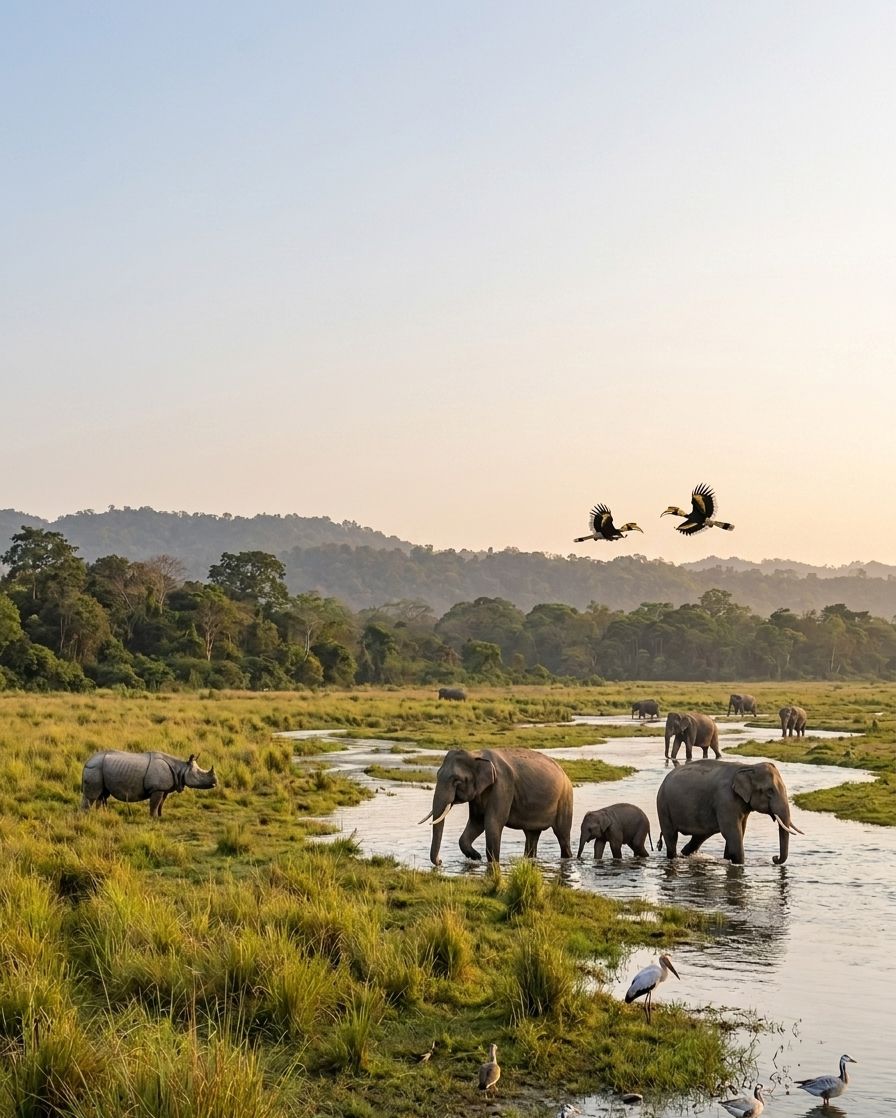
Kaziranga-National-Park : Land Of The Great Indian Rhinoceros
Situated along the floodplains of the Brahmaputra River in the northeastern state of Assam, Kaziranga National Park is one of India's most celebrated wildlife destinations and a UNESCO World Heritage Site. Spanning over 430 square kilometers, the park is internationally renowned for protecting the world's largest population of the endangered Indian one-horned rhinoceros. Its vast grasslands, wetlands, dense forests, and riverine ecosystems support an extraordinary diversity of wildlife, making Kaziranga National Park a paradise for nature lovers, wildlife photographers, birdwatchers, families, couples, and adventure enthusiasts. With its rich biodiversity and successful conservation efforts, Kaziranga tourism offers one of the finest wildlife experiences in Asia.
Kaziranga, a Brahmaputra floodplain sanctuary and rhino stronghold
A 430 sq. km UNESCO World Heritage Site holding the world's largest population of the Indian one-horned rhinoceros, structured into four distinct safari zones across grassland, wetland and riverine terrain — a core inclusion for any Assam or Northeast India wildlife itinerary.
Landscape & Conservation Context
OverviewKaziranga's ecosystem is built on annual flood cycles from the Brahmaputra — tall elephant grass, marshland, oxbow lakes and patches of tropical forest, with the terrain visibly shifting from monsoon green to winter gold. This seasonal contrast is worth using directly in marketing material, since repeat visitors see a genuinely different park each time.
Conservation history here is well documented and adds credibility to itinerary narratives: protection efforts date to 1905, the park was formally established in 1974, and UNESCO World Heritage status followed in 1985 on the strength of its biodiversity and conservation record.
The park sits within reach of Assam's indigenous community traditions, festivals and handicrafts, which extends naturally into cultural add-on programming around a wildlife-led itinerary rather than requiring a separate cultural circuit.
Four tourism zones give operators route flexibility: Central (Kohora), Western (Bagori), Eastern (Agoratoli) and Burapahar, each with a different balance of grassland, water and forest terrain.
Safari Zones
Route planningKohora
The most-visited zone; strong rhino density and the widest range of safari and permit infrastructure.
Bagori
Known for elephant safari access and reliable early-morning rhino sightings across open grassland.
Agoratoli
Wetland-heavy terrain, strong for waterbird sightings and a quieter alternative to the central zone.
Western Range
Forested hill terrain distinct from the other three zones; useful for itinerary variety across a multi-day stay.
Wildlife & Adventure Experiences
The Big FiveKaziranga is one of the few parks anywhere holding all of India's "Big Five" in a single protected area, alongside an Important Bird Area designation covering more than 500 recorded species.
Attractions, Cuisine & Local Craft
Beyond the safariKaziranga Orchid & Biodiversity Park
A dedicated horticultural and biodiversity showcase, workable as a half-day add-on between safari sessions.
Kakochang Waterfall
A nearby waterfall stop suited to itineraries with a free morning or afternoon slot.
Deoparbat Ruins & Tea Estates
Historical ruins paired with working tea estates — a natural cultural and agri-tourism extension to the park.
Assamese Cuisine
Assamese Thali, Masor Tenga, duck curry, bamboo shoot preparations, Pitha, Laru and Khar served at nearby eco-lodges and restaurants.
Craft & Retail
Assam tea, bamboo handicrafts, cane furniture, handwoven Mekhela Chador, bell metal crafts and silk products from nearby towns.
Indigenous Community Programming
Festivals, handicrafts and sustainable-living traditions of Assam's indigenous communities, bookable as cultural add-ons.
Access & Logistics
Routing reference| Mode | Nearest point | Note |
|---|---|---|
| Air (regional) | Jorhat Airport | Closest airport to the park |
| Air (international) | Lokpriya Gopinath Bordoloi International Airport, Guwahati | Primary international gateway for Northeast India |
| Rail | Furkating & Jorhat | Nearest railway stations |
| Road | Guwahati, Jorhat, Tezpur | Regular road transport to the park |
Seasonality Calendar
Route planningThe park operates for tourism from November to April, when water levels recede and sightings are most reliable. It closes for most of May to October during monsoon flooding, which is the mechanism that sustains the ecosystem rather than an access limitation to work around — worth stating plainly in trade materials.